
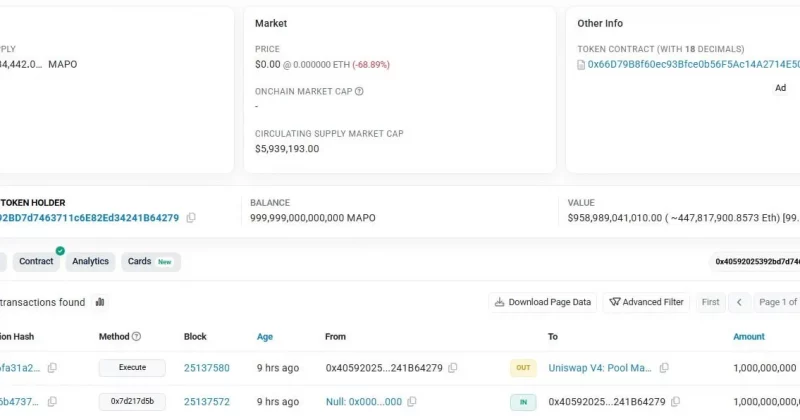
Map Protocol token MAPO plunges 96% after exploit mints quadrillion tokens
An attacker exploited the Butter Bridge to create over 100,000 times MAPO's legitimate supply, pocketing roughly $110K in ETH while cratering the token's value.
Someone just printed a quadrillion tokens out of thin air. That’s a one followed by fifteen zeros, or roughly 100,000 times the entire legitimate circulating supply of MAPO, the native token of Map Protocol.
The result was about as predictable as you’d expect. MAPO’s price cratered from around $0.003 to approximately $0.0001 within hours on Wednesday, a decline of roughly 96%. The token’s market cap collapsed to below $1 million, effectively vaporizing whatever value holders had been sitting on.
How a bridge became a money printer
The exploit targeted the Butter Network cross-chain bridge, specifically version 3.1 of the Butter Bridge infrastructure. Cross-chain bridges are the connective tissue between different blockchains, allowing tokens to move from one network to another.
The attacker found a way to trick the bridge into believing a massive mint was legitimate. The bridge obliged, creating 1,000,000,000,000,000 MAPO tokens in a single stroke.
MAPO’s circulating supply before the attack sat around 6 billion tokens. The attacker’s mint exceeded that by a factor of more than 100,000.
The attacker then liquidated a portion of the freshly minted tokens, walking away with approximately 52.2 ETH, worth roughly $110,000. The reason the profit was relatively modest is straightforward: when you flood a market with 100,000 times the existing supply, there simply aren’t enough buyers to absorb the sell pressure. Most of the minted tokens remain effectively unsellable, sitting in wallets with no realistic path to liquidity.
The news moving money, markets, and the world—before your day starts.
Daily. Free. Join 34,000+ readers across crypto, finance, and policy.
Map Protocol has since paused all bridge operations while conducting security assessments.
Cross-chain bridges remain crypto’s soft underbelly
The fundamental problem is architectural. Bridges must validate transactions across multiple chains, creating a complex attack surface. Every additional chain a bridge supports introduces new potential failure points. Map Protocol positions itself as an “omnichain” infrastructure layer, meaning it’s designed to connect many different blockchains simultaneously.
Ethereum co-founder Vitalik Buterin warned about the security limitations of cross-chain bridges back in early 2022, arguing that the fundamental security models of bridges are weaker than the security models of the individual chains they connect.
The Butter Bridge exploit is smaller in dollar terms than the headline-grabbing incidents of previous years, but minting a quadrillion tokens suggests a fundamental flaw in how the bridge validated cross-chain messages, not just a clever extraction of existing funds.
What this means for MAPO holders and the broader market
For existing MAPO holders, the situation is grim. A 96% price decline is the kind of event that functionally destroys a token’s credibility.
There’s also the question of whether the attacker’s remaining tokens — the vast majority of the quadrillion mint — could still be dumped if any liquidity returns to MAPO trading pairs. Until Map Protocol addresses this overhang, any recovery in price faces a ceiling made of trillions of illegitimate tokens waiting to be sold.
The $110,000 the attacker extracted might seem small relative to the damage caused. A relatively modest financial incentive was enough to motivate an attack that destroyed nearly all of a token’s market value.