
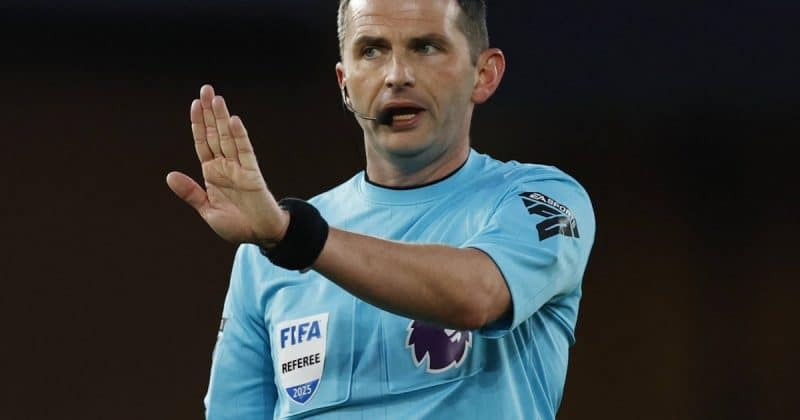
Michael Oliver could miss World Cup final due to conflict rules

Michael Oliver could miss World Cup final due to conflict rules

FIFA's neutrality protocols and Falklands War sensitivities could sideline England's top referee from the sport's biggest stage

The world’s most-watched sporting event has a referee problem. Michael Oliver, widely regarded as one of the best officials in the game, is on track to be a leading candidate for the 2026 World Cup final at MetLife Stadium. There’s just one catch: two of the tournament’s most likely finalists could make his appointment impossible.

FIFA’s neutrality rules bar referees from officiating matches involving their home nation. For Oliver, an Englishman, that takes England off the table. But there’s a second restriction that’s considerably more unusual, one rooted not in sport but in geopolitics.

Advertisement

The Falklands factor

English referees are prohibited from officiating Argentina matches due to sensitivities stemming from the 1982 Falklands War. In English, that means if Argentina makes the final, Oliver is out. Combined with the England restriction, that’s two of the most realistic World Cup finalists who could trigger his exclusion from the biggest assignment in refereeing.

This isn’t new territory for English referees. Anthony Taylor faced similar restrictions during earlier tournaments, navigating the same neutrality framework that now applies to Oliver. The precedent is established; Oliver’s situation is simply a high-profile instance of protocols that have been in place for years.

Seven matches and counting

Oliver is currently officiating his second World Cup, having previously refereed at the 2022 tournament in Qatar. He has handled at least seven matches in the 2026 edition, a workload that signals FIFA’s confidence in his abilities and positions him as a serious candidate for the final appointment.

The final at MetLife Stadium will be one of the most-watched broadcasts in television history. Referee selection for that match is not a minor administrative decision. FIFA’s officiating committee will be weighing experience, consistency, and neutrality simultaneously, and Oliver’s profile checks every box except the last one, depending on who shows up in the final.

The complication is that strict neutrality rules, applied across a field of referees from footballing nations, inevitably create a narrowing effect. The more nations advance deep into a tournament, the smaller the eligible pool of referees becomes for the final. Oliver’s situation illustrates that dynamic clearly: strong performance throughout the tournament, strong candidacy for the final, and a set of rules that could make that candidacy irrelevant based entirely on factors outside his control.

Disclosure: This article was edited by Editorial Team. For more information on how we create and review content, see our Editorial Policy.

Michael Oliver could miss World Cup final due to conflict rules

Michael Oliver could miss World Cup final due to conflict rules

FIFA's neutrality protocols and Falklands War sensitivities could sideline England's top referee from the sport's biggest stage

The world’s most-watched sporting event has a referee problem. Michael Oliver, widely regarded as one of the best officials in the game, is on track to be a leading candidate for the 2026 World Cup final at MetLife Stadium. There’s just one catch: two of the tournament’s most likely finalists could make his appointment impossible.

FIFA’s neutrality rules bar referees from officiating matches involving their home nation. For Oliver, an Englishman, that takes England off the table. But there’s a second restriction that’s considerably more unusual, one rooted not in sport but in geopolitics.

Advertisement

The Falklands factor

English referees are prohibited from officiating Argentina matches due to sensitivities stemming from the 1982 Falklands War. In English, that means if Argentina makes the final, Oliver is out. Combined with the England restriction, that’s two of the most realistic World Cup finalists who could trigger his exclusion from the biggest assignment in refereeing.

This isn’t new territory for English referees. Anthony Taylor faced similar restrictions during earlier tournaments, navigating the same neutrality framework that now applies to Oliver. The precedent is established; Oliver’s situation is simply a high-profile instance of protocols that have been in place for years.

Seven matches and counting

Oliver is currently officiating his second World Cup, having previously refereed at the 2022 tournament in Qatar. He has handled at least seven matches in the 2026 edition, a workload that signals FIFA’s confidence in his abilities and positions him as a serious candidate for the final appointment.

The final at MetLife Stadium will be one of the most-watched broadcasts in television history. Referee selection for that match is not a minor administrative decision. FIFA’s officiating committee will be weighing experience, consistency, and neutrality simultaneously, and Oliver’s profile checks every box except the last one, depending on who shows up in the final.

The complication is that strict neutrality rules, applied across a field of referees from footballing nations, inevitably create a narrowing effect. The more nations advance deep into a tournament, the smaller the eligible pool of referees becomes for the final. Oliver’s situation illustrates that dynamic clearly: strong performance throughout the tournament, strong candidacy for the final, and a set of rules that could make that candidacy irrelevant based entirely on factors outside his control.

Disclosure: This article was edited by Editorial Team. For more information on how we create and review content, see our Editorial Policy.