
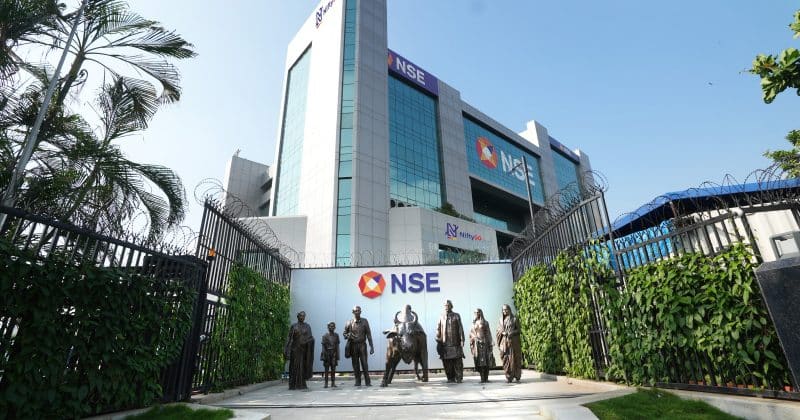
National Stock Exchange of India files for IPO, boosting billionaire investors

National Stock Exchange of India files for IPO, boosting billionaire investors

The NSE's $3.5 billion offer-for-sale could be one of India's largest-ever listings, with top shareholders set to pocket $2.6 billion in gains

The world’s busiest derivatives exchange just filed to go public, and the biggest winners aren’t exactly scraping by. India’s National Stock Exchange filed its draft red herring prospectus with the Securities and Exchange Board of India, setting the stage for an IPO that could raise approximately ₹29,780 crore, or roughly $3.5B.

Here’s the thing: the exchange itself won’t see a single rupee of fresh capital. The entire offering is structured as an offer-for-sale, meaning existing shareholders are cashing out. The top ten selling investors stand to gain about $2.6B in aggregate, based on their original acquisition costs.

Who’s getting paid

The list of beneficiaries reads like a who’s who of Indian finance. State Bank of India, the country’s largest public sector bank, could book gains of roughly $498M from the sale. Billionaires Azim Premji and Radhakishan Damani, whose holdings could be worth over $1B at the exchange’s current unlisted valuation of around $53B, are among the prominent sellers.

Life Insurance Corporation of India holds the largest stake at approximately 10.7% but is notably sitting this one out. LIC is not participating in the sale, suggesting India’s biggest institutional investor sees more upside ahead.

Advertisement

The exchange serves over 129 million unique registered investors, a number that reflects just how central the NSE has become to India’s financial ecosystem. It holds the distinction of being India’s largest stock exchange by trading volume, processing the vast majority of equities and derivatives trades in the country.

A decade of delays

If this IPO feels overdue, that’s because it is. The NSE first explored going public around 2016. A regulatory co-location controversy, which involved allegations of unfair access to the exchange’s systems, effectively froze the process for years.

The logjam finally broke in January 2026, when SEBI granted the NSE a no-objection certificate to proceed with its listing plans. The DRHP filing followed on approximately June 17, 2026, a full decade after the initial IPO ambitions first surfaced.

The timing is notable for another reason. India’s IPO market has shown signs of renewed vigor after a period of subdued activity. The NSE filing arrives alongside anticipation for other major listings, including Reliance Jio, suggesting the broader market is warming up for a wave of large-cap debuts.

What this means for investors

The OFS structure deserves scrutiny. Since no fresh capital flows into the NSE itself, the offering is purely a liquidity event for existing shareholders. That’s not inherently bad, but it means the IPO proceeds won’t fund new technology, expansion, or product development at the exchange. Investors buying in are essentially purchasing shares from early backers who got in at far lower prices.

The $2.6B in gains for the top ten shareholders underscores a familiar pattern in marquee IPOs: the biggest returns accrue to those who had access before the public offering. For retail investors evaluating the listing price, the question becomes whether the NSE at a $53B valuation still offers meaningful upside, or whether the easy money has already been made.

There’s also the competitive angle. The Bombay Stock Exchange, India’s older but smaller exchange, is already publicly traded. NSE’s listing would give investors a direct comparison between the two, and it’s worth noting that the NSE handles a vastly larger share of trading volume. That dominance is both an asset and a potential regulatory risk, since monopolistic market structures tend to attract scrutiny.

Disclosure: This article was edited by Editorial Team. For more information on how we create and review content, see our Editorial Policy.

National Stock Exchange of India files for IPO, boosting billionaire investors

National Stock Exchange of India files for IPO, boosting billionaire investors

The NSE's $3.5 billion offer-for-sale could be one of India's largest-ever listings, with top shareholders set to pocket $2.6 billion in gains

The world’s busiest derivatives exchange just filed to go public, and the biggest winners aren’t exactly scraping by. India’s National Stock Exchange filed its draft red herring prospectus with the Securities and Exchange Board of India, setting the stage for an IPO that could raise approximately ₹29,780 crore, or roughly $3.5B.

Here’s the thing: the exchange itself won’t see a single rupee of fresh capital. The entire offering is structured as an offer-for-sale, meaning existing shareholders are cashing out. The top ten selling investors stand to gain about $2.6B in aggregate, based on their original acquisition costs.

Who’s getting paid

The list of beneficiaries reads like a who’s who of Indian finance. State Bank of India, the country’s largest public sector bank, could book gains of roughly $498M from the sale. Billionaires Azim Premji and Radhakishan Damani, whose holdings could be worth over $1B at the exchange’s current unlisted valuation of around $53B, are among the prominent sellers.

Life Insurance Corporation of India holds the largest stake at approximately 10.7% but is notably sitting this one out. LIC is not participating in the sale, suggesting India’s biggest institutional investor sees more upside ahead.

Advertisement

The exchange serves over 129 million unique registered investors, a number that reflects just how central the NSE has become to India’s financial ecosystem. It holds the distinction of being India’s largest stock exchange by trading volume, processing the vast majority of equities and derivatives trades in the country.

A decade of delays

If this IPO feels overdue, that’s because it is. The NSE first explored going public around 2016. A regulatory co-location controversy, which involved allegations of unfair access to the exchange’s systems, effectively froze the process for years.

The logjam finally broke in January 2026, when SEBI granted the NSE a no-objection certificate to proceed with its listing plans. The DRHP filing followed on approximately June 17, 2026, a full decade after the initial IPO ambitions first surfaced.

The timing is notable for another reason. India’s IPO market has shown signs of renewed vigor after a period of subdued activity. The NSE filing arrives alongside anticipation for other major listings, including Reliance Jio, suggesting the broader market is warming up for a wave of large-cap debuts.

What this means for investors

The OFS structure deserves scrutiny. Since no fresh capital flows into the NSE itself, the offering is purely a liquidity event for existing shareholders. That’s not inherently bad, but it means the IPO proceeds won’t fund new technology, expansion, or product development at the exchange. Investors buying in are essentially purchasing shares from early backers who got in at far lower prices.

The $2.6B in gains for the top ten shareholders underscores a familiar pattern in marquee IPOs: the biggest returns accrue to those who had access before the public offering. For retail investors evaluating the listing price, the question becomes whether the NSE at a $53B valuation still offers meaningful upside, or whether the easy money has already been made.

There’s also the competitive angle. The Bombay Stock Exchange, India’s older but smaller exchange, is already publicly traded. NSE’s listing would give investors a direct comparison between the two, and it’s worth noting that the NSE handles a vastly larger share of trading volume. That dominance is both an asset and a potential regulatory risk, since monopolistic market structures tend to attract scrutiny.

Disclosure: This article was edited by Editorial Team. For more information on how we create and review content, see our Editorial Policy.