
 Earn with Nexo
Nvidia’s Huang spurs Asia tech rally with AI and robotics hype
Jensen Huang's 'physical AI' vision sends Asian semiconductor and robotics stocks surging, with ripple effects reaching AI-linked crypto tokens.
Jensen Huang has a gift for turning earnings calls into pep rallies. Nvidia’s latest quarterly results didn’t just beat expectations, they sent a shockwave through Asian tech markets, lifting shares of semiconductor manufacturers, robotics firms, and component suppliers across the region.
The catalyst: Nvidia posted quarterly revenue of $22.1B, a 265% jump year-over-year. Data-center revenue alone hit $18.4B, up a staggering 409% from the same period last year. Those numbers are driven almost entirely by insatiable demand for AI GPUs, and Huang used the moment to paint an even bigger picture of where all that compute power is headed.
The ‘physical AI’ thesis
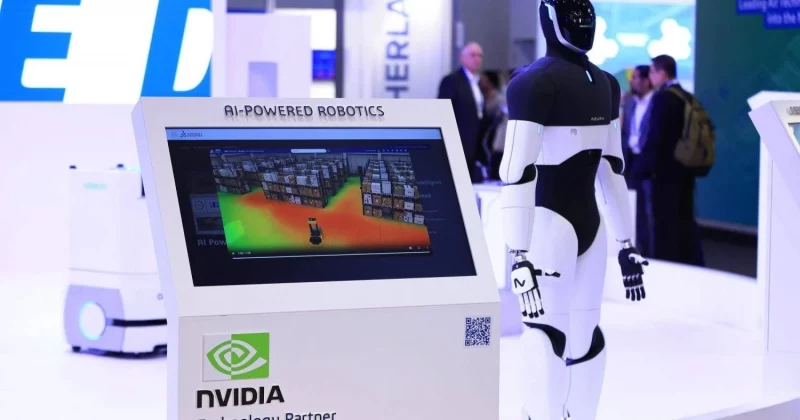
Here’s the thing about Nvidia’s AI narrative. It’s no longer just about chatbots and large language models. Huang is now pushing what he calls “physical AI,” a term that covers robots, autonomous machines, automated factories, and AI-integrated devices that operate in the real world rather than on a screen.
In English: Nvidia wants its chips powering not just the software that thinks, but the hardware that moves. The company has been building out platforms like Nvidia Isaac for robotics development and Omniverse for digital-twin simulations. Both are designed to make it easier for manufacturers to build, train, and deploy robots at scale.
And where do you build robots at scale? Asia.
Huang specifically praised China’s capabilities in robotics and microelectronics, acknowledging what everyone in the supply chain already knows: the US robotics industry is deeply dependent on Asian manufacturing for critical components. That kind of endorsement from the CEO of the world’s most valuable semiconductor company is essentially a green light for investors to pile into the region’s tech sector.
Major Asian semiconductor firms and robotics companies saw their share prices climb on the back of Huang’s commentary. The rally wasn’t limited to one country or one subsector. It swept through chipmakers, contract manufacturers, sensor producers, and automation specialists, essentially anyone with a plausible connection to Nvidia’s expanding ecosystem.
Why this matters beyond stock prices
The significance of Huang’s framing goes deeper than a one-day stock bounce. By positioning robotics and physical AI as the next major growth vector, Nvidia is signaling to the market that the AI capital expenditure cycle isn’t a bubble waiting to pop. It’s a sustained buildout with years of runway.
Think of it like the early days of cloud computing. Amazon Web Services didn’t just benefit Amazon. It created an entire ecosystem of companies building tools, services, and infrastructure on top of it. Nvidia is attempting something similar with physical AI, creating a platform layer that hundreds of hardware manufacturers will build on.
For Asian tech firms, this is the best possible positioning. They’re not competing with Nvidia. They’re supplying it. Every robot that runs on Nvidia’s Isaac platform needs sensors, actuators, processors, and chassis that largely come from factories in Taiwan, South Korea, Japan, and China. The more Nvidia succeeds in physical AI, the more orders flow through these supply chains.
This dynamic also explains why the rally was so broad-based. Investors aren’t just betting on one or two companies. They’re betting on an entire regional supply chain becoming essential infrastructure for the next wave of AI deployment.
Crypto’s AI sympathy trade
The ripple effects extend beyond traditional equity markets. AI-themed crypto tokens have increasingly become proxies for AI market sentiment, and Nvidia’s performance tends to move them.
There’s no specific Nvidia-linked crypto token, and Huang didn’t mention blockchain or digital assets in his remarks. But that hasn’t stopped traders from treating AI tokens as leveraged bets on the broader AI narrative. When Nvidia beats earnings and the CEO talks about robots taking over factories, tokens associated with AI protocols, decentralized compute networks, and machine-learning marketplaces tend to catch a bid.
Look, the correlation isn’t perfect, and it’s not always rational. But it’s real enough that crypto traders now watch Nvidia earnings the way traditional investors watch Federal Reserve meetings. The logic, such as it is, goes like this: if the world’s biggest AI company says demand is accelerating, then any asset with “AI” in its pitch deck benefits from the sentiment overflow.
For crypto investors specifically, the question is whether this sympathy trade has staying power or whether it’s just hype chasing hype. The honest answer is probably both. AI tokens with genuine utility, like those powering decentralized GPU rental networks or on-chain inference protocols, have a plausible connection to the same demand drivers Nvidia is capitalizing on. Tokens that simply slapped “AI” onto an existing project are riding a wave that will eventually recede.
The 265% revenue growth Nvidia just reported is the kind of number that makes entire sectors re-rate. Asian tech stocks are repricing around the assumption that physical AI will require massive, sustained investment in hardware and components. If that assumption holds, companies in Nvidia’s supply chain could see years of elevated demand. If it doesn’t, well, we’ve seen what happens when AI hype cycles cool. Investors who remember the metaverse pivot of 2022 know how quickly “the next big thing” can become last quarter’s mistake.
The difference this time is that Nvidia is backing up the narrative with actual revenue, not just slide decks and developer previews. A 409% increase in data-center revenue is not a vision statement. It’s a financial reality that suppliers, partners, and yes, even crypto speculators are now building their strategies around.