
Nvidia’s Jensen Huang calls AI job concerns ‘complete nonsense’
The GPU kingpin has spent months pushing back on fears that AI will destroy jobs, arguing instead that it will re-industrialize America. He also happens to sell the shovels.
Jensen Huang has a message for anyone worried that AI is coming for their paycheck: relax.
The Nvidia CEO has been on a months-long campaign to reframe the narrative around artificial intelligence and employment, arguing that AI will create jobs rather than eliminate them. His latest salvo came on May 4, when he declared that AI is America’s “best opportunity to re-industrialize,” positioning the technology as an engine for new, well-paid work across the economy.
The anti-doom tour
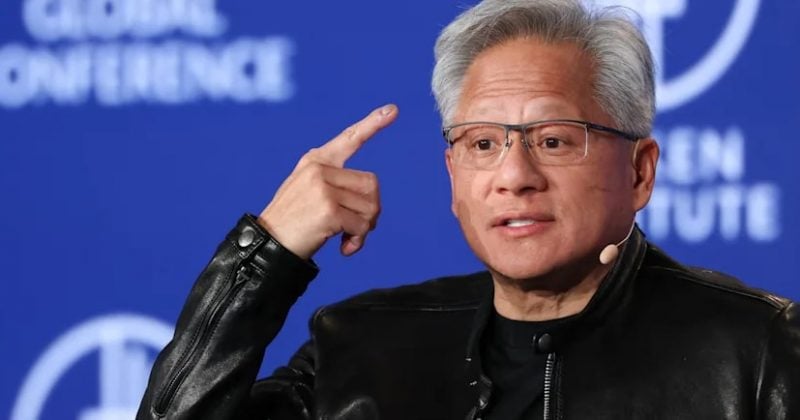
Huang hasn’t been subtle about this. He’s turned nearly every public appearance in 2026 into an opportunity to push back against job displacement fears, from the Milken Institute conference to a commencement speech at Carnegie Mellon University.
At the Carnegie Mellon graduation, he told fresh graduates that “AI is not likely to replace you.”
In an interview on April 22, he offered a more nuanced take: it’s unlikely that people will lose jobs to AI itself, but rather to other people who know how to use AI. The distinction matters. In Huang’s framing, AI is a tool that amplifies human capability, not a replacement for it. Those who adopt it early gain an edge. Those who don’t risk falling behind.
He doubled down in a March 10 blog post, comparing the current AI infrastructure buildout to the era of electrification. Just as wiring America for electricity created massive demand for skilled labor, Huang argued, the construction and maintenance of AI data centers and compute infrastructure will generate a wave of well-paid blue-collar positions. No advanced degree required.
The man selling shovels in a gold rush
Nvidia’s GPUs and data-center technology are the foundation on which every major AI model, from large language models to autonomous driving systems, gets trained and deployed. When Huang says AI infrastructure will create millions of jobs, he’s also making the case for why companies and governments should keep spending billions on Nvidia’s products.
His comments also stand in contrast to warnings from other business leaders and economists who have raised genuine concerns about the pace of AI-driven displacement. Automation has historically created new categories of work, yes. But the transition periods can be brutal for the workers caught in between, and the new jobs don’t always go to the same people who lost the old ones.
What this means for investors
Huang’s relentless optimism serves a strategic purpose beyond public relations. By framing AI as a job creator rather than a job killer, he’s making the political and social case for continued, aggressive investment in AI infrastructure. That’s directly relevant to anyone with exposure to the semiconductor and AI compute sectors.
The more immediate signal is Huang’s emphasis on companies that integrate AI into operations gaining competitive advantages. This suggests a widening gap between firms that adopt AI tools effectively and those that lag behind. For portfolio construction, that means looking beyond pure-play AI chip stocks and evaluating which companies across sectors are positioned to capture productivity gains from AI deployment.