
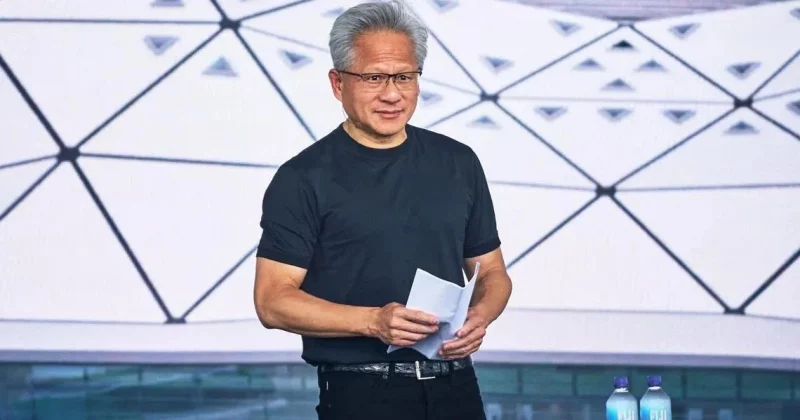
Nvidia CEO Jensen Huang joins advisory board of Tsinghua University amid US-China chip tensions
Huang takes a seat alongside Tim Cook, Elon Musk, and Satya Nadella on a prestigious Beijing academic board, weeks after accompanying Trump to China.
Jensen Huang, the CEO of Nvidia, is joining the advisory board of Tsinghua University’s School of Economics and Management in Beijing. The appointment places him on a panel chaired by Apple CEO Tim Cook, alongside roughly 65 members that include Elon Musk, Microsoft’s Satya Nadella, and JPMorgan’s Jamie Dimon.
The timing is hard to ignore. Huang accompanied US President Donald Trump on a visit to China around May 13-14, and now, barely two weeks later, he’s formalizing an institutional relationship with the country’s most politically connected university. For a company whose advanced AI chips remain subject to US export restrictions targeting China, this is a calculated move wrapped in the veneer of academic collaboration.
The board and what it signals
Tsinghua University isn’t just any school. It’s the institution that has educated a significant portion of China’s political and business elite, functioning as something like a hybrid of Harvard and West Point for the Chinese establishment.
The SEM advisory board, with its roughly 65 members, reads like a who’s-who of global corporate leadership. Tim Cook has chaired it for years, serving as a kind of diplomatic bridge between Silicon Valley and Beijing. Huang’s addition extends that bridge further into the AI chip supply chain, which happens to be the single most contested technology in the US-China relationship right now.
Some US commentators have already flagged potential national security concerns. The worry isn’t that Huang will hand over chip blueprints during a board meeting. It’s that the optics of deepening institutional ties could complicate Nvidia’s position as export controls tighten further.
Nvidia’s China balancing act
Huang’s recent trip to China alongside Trump was itself a statement. Nvidia’s CEO positioning himself as part of a presidential trade delegation signals that the company views its China strategy as inseparable from broader US foreign policy. The Tsinghua board appointment extends that logic from government corridors into academic ones.
Tsinghua’s SEM is a business school. The advisory board focuses on economic and technological trends, not chip design. But the symbolic weight of Nvidia’s CEO sitting on a board at China’s most elite university, at a moment when AI chips are the sharpest point of geopolitical friction, carries meaning that transcends the formal job description.
What this means for investors
On the other hand, Nvidia’s approach mirrors what Apple has done for years under Tim Cook’s leadership. Cook has maintained deep relationships with Chinese institutions and supply chains while navigating US regulatory requirements. The fact that Cook chairs the very board Huang is now joining suggests a shared playbook: stay close enough to China to protect commercial interests, but calibrate the relationship carefully enough to avoid triggering a crackdown at home.
The crypto market has shown no discernible reaction to this news. Crypto-focused media outlets have reported on the development in the context of tech engagement between the US and China, but there were no direct references to digital assets or tokens, and initial observations have failed to show any market-moving implications associated with specific tokens related to Huang’s new role.