
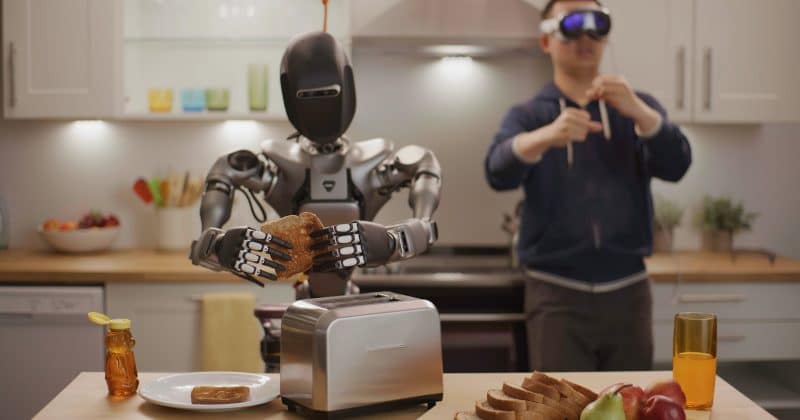
Nvidia develops motion tokenization method that lets humanoid robots learn to recover from falls
The GPU giant's new approach treats human movement like language, training GPT-style models on motion data instead of text to create robots that can improvise physical behaviors.
Nvidia has figured out how to make humanoid robots pick themselves up after falling down, and the method borrows directly from the same technology that powers ChatGPT. The company’s research team built what it calls Generative Pretrained Controllers, or GPC, which tokenize human motion the same way large language models tokenize words, then use next-token prediction to generate physical behaviors in robots.
The robots weren’t explicitly programmed with fall-recovery routines. They learned to get back up because the underlying model, trained on over 600 hours of motion data, developed a general enough understanding of human movement to improvise when things went sideways.
How teaching a robot to move became a language problem
In a large language model, text gets broken into tokens, small units that the model learns to predict sequentially. GPC does the same thing with motion. Human movements get discretized into a vocabulary of motion tokens, and a transformer architecture learns to predict what comes next.
The GPC was presented at SIGGRAPH 2026 and represents a shift in how Nvidia thinks about robotics controllers. Traditional approaches require engineers to define reward signals for every task a robot needs to perform. GPC sidesteps this by creating a general-purpose motion foundation model. The controllers it produces are reusable and fine-tunable for new tasks without starting from scratch each time.
The broader motion tokenization ecosystem
GPC isn’t Nvidia’s only bet on motion tokenization. MotionBricks, another research initiative, uses structured multi-head tokenizers trained on approximately 350,000 motion clips. The system is designed for real-time animation and robot control, achieving processing speeds of up to 15,000 frames per second.
AI, tech, and the markets they move—in one daily briefing.
Daily. Free. Join 34,000+ readers across crypto, finance, and policy.
Then there’s Kimodo, which focuses on text-to-motion generation. A separate project called AMPLIFY explores how robots can generalize from video data to physical actions, essentially learning to move by watching rather than by being manually programmed.
All of these feed into Nvidia’s Isaac GR00T platform, which serves as the integration layer connecting motion models with simulation tools like Isaac Lab. The platform lets researchers train robotic policies in simulation before deploying them in the real world.
What this means for the robotics industry
The 600-plus hours of training data that GPC uses is substantial but not enormous by the standards of modern AI training. GPT-class language models train on datasets many orders of magnitude larger, suggesting motion tokenization is still in relatively early days.
Nvidia is positioning itself not just as a chip supplier to robotics companies but as a full-stack provider of the software and simulation infrastructure that makes humanoid robots viable. The Isaac GR00T platform combined with motion tokenization research creates a moat that goes well beyond selling GPUs.
Companies building humanoid robots, from Tesla’s Optimus program to startups like Figure and Apptronik, all need to solve the motion problem. The 15,000 fps processing speed of MotionBricks suggests the latency problem is solvable, but robustness in unpredictable environments remains an open challenge.