
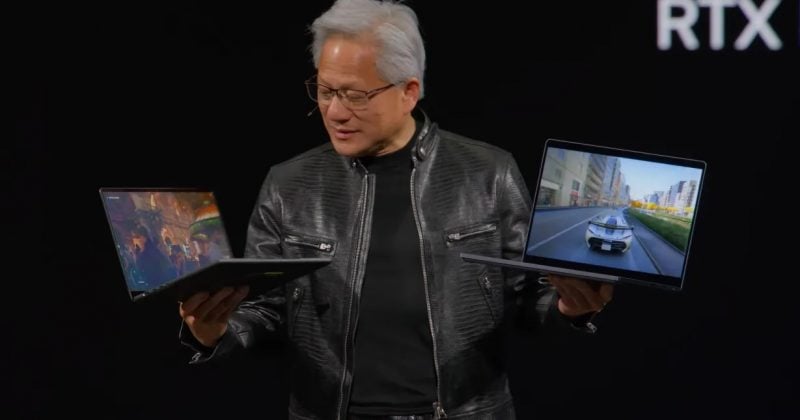
Nvidia unveils RTX Spark as most efficient PC chip ever built
The GPU giant is entering the consumer PC chip market this fall, putting a complete computing system on a single chip for laptops and mini-PCs.
Nvidia is no longer content just powering your graphics card. This fall, the company will ship the RTX Spark, its first complete computing chip designed for laptops and mini-PCs, putting it in direct competition with Intel, AMD, Apple, and Qualcomm in the consumer PC silicon market.
The company calls it “the most efficient PC chip ever built.” The catch: Nvidia hasn’t shared a single benchmark, statistic, or chart to support that claim.
What we actually know about RTX Spark
The RTX Spark represents Nvidia’s first foray into building a full system-on-chip for consumer PCs, not just a discrete GPU that slots into someone else’s machine. The chip is designed to compete with the best thin-and-light Windows laptops on the market, combining CPU and GPU capabilities into one package.
Mark Aevermann, Nvidia’s senior director of product management, made the efficiency claim during the announcement. He offered zero data to back it up.
The RTX Spark is the first in what Nvidia describes as a family of chips.
AI, tech, and the markets they move—in one daily briefing.
Daily. Free. Join 34,000+ readers across crypto, finance, and policy.
Nvidia’s broader silicon ambitions
The company already shipped the DGX Spark, a compact desktop AI system powered by the GB10 Grace Blackwell Superchip. That device, which began shipping in October 2025, combines a 20-core Arm CPU with a Blackwell GPU and delivers up to 1 petaFLOP of FP4 AI performance. It packs 128 GB of unified LPDDR5X memory and supports up to 4 TB of NVMe storage, all running at roughly 140 watts in a small desktop form factor.
The DGX Spark is priced between $3,000 and $4,000 and is available through ASUS, Dell, HP, Lenovo, and MSI. CEO Jensen Huang personally hand-delivered some of the first units, including one to Elon Musk.
Software updates in 2026 added support for agentic AI frameworks like Hermes on the DGX Spark, improving memory management and local AI agent capabilities. The company has positioned the device as the “world’s smallest AI supercomputer,” designed to let developers prototype and run sophisticated AI models without paying for cloud compute time.