
Nexo Earn with Nexo
Nvidia’s Jensen Huang confirms Vera CPUs will use SK Hynix memory chips

Nvidia’s Jensen Huang confirms Vera CPUs will use SK Hynix memory chips

The deal deepens a strategic partnership that spans AI supercomputers, PCs, and robotics platforms, while Nvidia enters the standalone CPU arena.

Jensen Huang flew to Seoul and walked out with a memory deal that stretches across nearly every major Nvidia platform in the pipeline. The Nvidia CEO confirmed on June 7 that the company’s upcoming Vera central processing units will be built with SK Hynix DRAM, a move that cements SK Hynix’s role as the dominant memory supplier for Nvidia’s AI hardware ambitions.

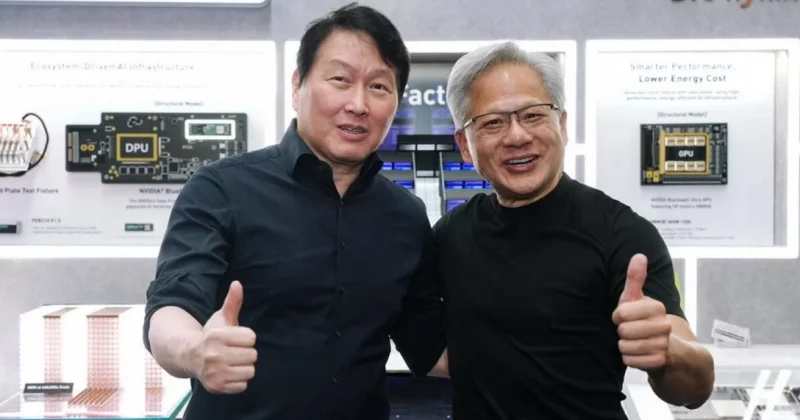
The announcement came during a meeting with SK Group Chairman Chey Tae-won and SK Hynix CEO Kwak Noh-Jung. The partnership isn’t limited to one chip. It covers memory for the Vera Rubin AI supercomputer, RTX Spark PCs, and Jetson Thor robotics systems, with the collaboration expected to extend into 2027.

Nvidia’s first real CPU play

The Vera CPU is Nvidia’s first standalone data center microprocessor, meaning the company is stepping directly into territory long dominated by Intel’s Xeon, AMD’s EPYC, and Amazon’s custom Graviton chips.

Huang described the Vera CPU as “revolutionary.” Nvidia has spent years building dominance in GPUs for AI training. Now it wants to own the CPU side of the data center, too.

Advertisement

Why SK Hynix matters so much

SK Hynix already supplies an estimated 50-70% of Nvidia’s HBM4 requirements for the Blackwell and Vera Rubin platforms.

Huang himself acknowledged that memory shortages could persist for several years, which makes locking in a primary supplier less of a business decision and more of a survival strategy.

Nvidia has approved three companies for HBM4 production on the Vera Rubin platform: Samsung, SK Hynix, and Micron. All three are reportedly in production as of early June 2026. But SK Hynix’s dominant share of Nvidia’s HBM requirements tells you who’s sitting at the head of that particular table.

The two companies are jointly developing next-generation memory technologies tailored to Nvidia’s platforms, meaning SK Hynix engineers are likely working alongside Nvidia’s chip architects to optimize memory performance for specific workloads, from AI training to autonomous robotics.

What this means for investors

For SK Hynix, the deal reinforces its position as the most important memory supplier in the AI era. Deepening its integration with Nvidia’s roadmap through 2027 provides a degree of revenue visibility that most semiconductor companies would envy.

Samsung and Micron are both approved HBM4 suppliers for Vera Rubin, competing for the remaining 30-50% of Nvidia’s memory needs. Investors watching the semiconductor space should pay close attention to how HBM4 allocation shifts between these three suppliers over the next 12 months.

The risk worth watching is concentration. Nvidia relying on SK Hynix for the majority of its HBM supply creates a single point of vulnerability. Any production disruption, geopolitical tension on the Korean peninsula, or capacity shortfall at SK Hynix’s fabs could ripple across Nvidia’s entire AI hardware lineup.

Disclosure: This article was edited by Editorial Team. For more information on how we create and review content, see our Editorial Policy.

Nvidia’s Jensen Huang confirms Vera CPUs will use SK Hynix memory chips

Nvidia’s Jensen Huang confirms Vera CPUs will use SK Hynix memory chips

The deal deepens a strategic partnership that spans AI supercomputers, PCs, and robotics platforms, while Nvidia enters the standalone CPU arena.

Jensen Huang flew to Seoul and walked out with a memory deal that stretches across nearly every major Nvidia platform in the pipeline. The Nvidia CEO confirmed on June 7 that the company’s upcoming Vera central processing units will be built with SK Hynix DRAM, a move that cements SK Hynix’s role as the dominant memory supplier for Nvidia’s AI hardware ambitions.

The announcement came during a meeting with SK Group Chairman Chey Tae-won and SK Hynix CEO Kwak Noh-Jung. The partnership isn’t limited to one chip. It covers memory for the Vera Rubin AI supercomputer, RTX Spark PCs, and Jetson Thor robotics systems, with the collaboration expected to extend into 2027.

Nvidia’s first real CPU play

The Vera CPU is Nvidia’s first standalone data center microprocessor, meaning the company is stepping directly into territory long dominated by Intel’s Xeon, AMD’s EPYC, and Amazon’s custom Graviton chips.

Huang described the Vera CPU as “revolutionary.” Nvidia has spent years building dominance in GPUs for AI training. Now it wants to own the CPU side of the data center, too.

Advertisement

Why SK Hynix matters so much

SK Hynix already supplies an estimated 50-70% of Nvidia’s HBM4 requirements for the Blackwell and Vera Rubin platforms.

Huang himself acknowledged that memory shortages could persist for several years, which makes locking in a primary supplier less of a business decision and more of a survival strategy.

Nvidia has approved three companies for HBM4 production on the Vera Rubin platform: Samsung, SK Hynix, and Micron. All three are reportedly in production as of early June 2026. But SK Hynix’s dominant share of Nvidia’s HBM requirements tells you who’s sitting at the head of that particular table.

The two companies are jointly developing next-generation memory technologies tailored to Nvidia’s platforms, meaning SK Hynix engineers are likely working alongside Nvidia’s chip architects to optimize memory performance for specific workloads, from AI training to autonomous robotics.

What this means for investors

For SK Hynix, the deal reinforces its position as the most important memory supplier in the AI era. Deepening its integration with Nvidia’s roadmap through 2027 provides a degree of revenue visibility that most semiconductor companies would envy.

Samsung and Micron are both approved HBM4 suppliers for Vera Rubin, competing for the remaining 30-50% of Nvidia’s memory needs. Investors watching the semiconductor space should pay close attention to how HBM4 allocation shifts between these three suppliers over the next 12 months.

The risk worth watching is concentration. Nvidia relying on SK Hynix for the majority of its HBM supply creates a single point of vulnerability. Any production disruption, geopolitical tension on the Korean peninsula, or capacity shortfall at SK Hynix’s fabs could ripple across Nvidia’s entire AI hardware lineup.

Disclosure: This article was edited by Editorial Team. For more information on how we create and review content, see our Editorial Policy.