
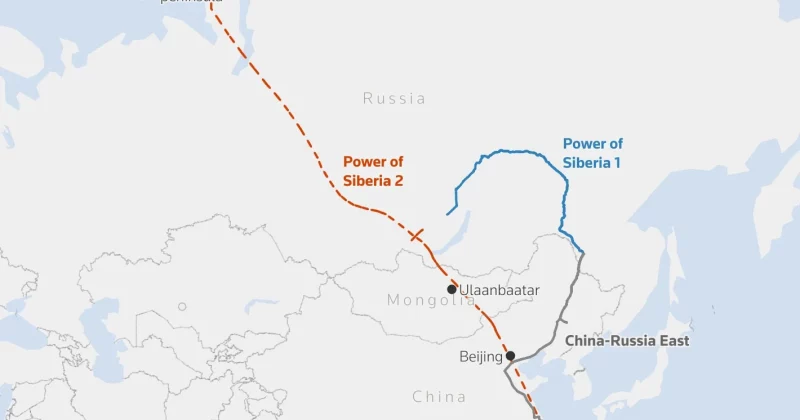
Putin leaves Beijing without agreement on Power of Siberia 2 gas pipeline
China's hardball pricing tactics leave Russia's flagship energy deal in limbo, potentially accelerating Moscow's pivot toward crypto-based trade settlement.
Vladimir Putin flew home from Beijing this week with plenty of photo ops, a fresh round of joint statements about enduring partnership, and zero ink on the deal he actually needed. The Power of Siberia 2 gas pipeline, a roughly 2,600 to 2,700 kilometer megaproject designed to funnel up to 50 billion cubic meters of Russian gas per year into China, remains unsigned.
What Power of Siberia 2 actually is, and why it matters
The existing Power of Siberia 1 pipeline already delivered around 38 billion cubic meters of gas to China last year, with plans to ramp that up to 44 bcm annually. Power of Siberia 2 would nearly double Russia’s pipeline capacity to China. At full throughput of 50 bcm per year, it would represent one of the largest energy infrastructure commitments on the planet.
The problem is Beijing knows exactly how much leverage it holds. China is reportedly pushing for long-term pricing significantly below what Russia previously received from European buyers. Russia, cut off from its former premium customers, doesn’t have many alternatives. China does. It can source liquefied natural gas from Qatar, Australia, and the US. It can expand its own renewable capacity. It can simply wait.
The pricing standoff
Russia’s negotiating position has deteriorated steadily since the full-scale invasion of Ukraine in 2022. European gas contracts that once generated enormous revenue for Moscow are either canceled or winding down. China wants prices that reflect Russia’s constrained options, not the premium rates Moscow once commanded in Europe. The gap between what Russia wants to charge and what China is willing to pay has been wide enough to stall negotiations across multiple summits now.
Macro, rates, and crypto—what moved markets and what matters next.
Daily. Free. Join 34,000+ readers across crypto, finance, and policy.
The crypto angle Russia can’t ignore
Russia has already been exploring stablecoins and Bitcoin as mechanisms for cross-border trade settlement. Several reports over the past two years have documented Russian entities using Tether’s USDT and other stablecoins to settle energy and commodity transactions with counterparties in the Middle East and Asia.
Watch for two things in the coming months. First, whether Russia and China announce any interim energy agreements that fall short of the full Power of Siberia 2 commitment but include unusual payment terms. Second, whether on-chain analysts detect upticks in stablecoin flows along corridors associated with Russian commodity exports.