
Qualcomm plans new chip architecture for smartphones

Qualcomm plans new chip architecture for smartphones

The chipmaker's custom Oryon CPU cores, born from a $1.4 billion acquisition, are reshaping mobile processing as the company eyes a post-smartphone future.

Qualcomm is pushing deeper into custom chip design for mobile devices, building on its Oryon CPU microarchitecture with a string of new Snapdragon platforms that represent a meaningful departure from the company’s historical reliance on off-the-shelf Arm core designs.

The effort traces back to Qualcomm’s 2021 acquisition of Nuvia for $1.4B, a deal that gave the chipmaker access to a team of former Apple silicon engineers and the foundation for what would become the Oryon architecture.

Oryon’s expansion across Snapdragon platforms

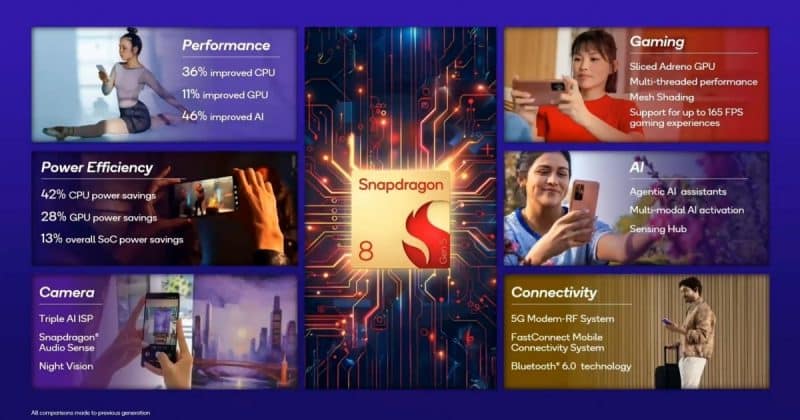
The Oryon architecture first appeared in the Snapdragon X Elite for PCs in June 2024. Qualcomm then adapted the custom cores for mobile use in the Snapdragon 8 Elite series, targeting premium smartphones.

On May 6, 2026, Qualcomm unveiled the Snapdragon 6 Gen 5 and 4 Gen 5 mobile platforms. These chips bring features like Snapdragon Smooth Motion UI to mid-range and budget devices.

Advertisement

The 4 Gen 5 variant reportedly delivers up to 43% faster app launches compared to its predecessor.

Devices running the new chips are expected from OEMs including Honor, OPPO, realme, and REDMI in the second half of 2026.

Qualcomm has stated that Oryon CPU cores contain 1% or less of Arm’s original technology in select implementations, suggesting Qualcomm has built something genuinely its own on top of the Arm instruction set, rather than simply tweaking reference designs.

Beyond smartphones: XR and the AI pivot

On June 16, 2026, Qualcomm announced the Snapdragon Reality Elite XR platform. The chip targets extended reality headsets and promises up to 60% GPU performance gains.

Qualcomm has been steadily integrating on-device AI capabilities across its Snapdragon lineup, positioning its chips as the hardware backbone for everything from real-time translation to generative AI features running locally on a device.

What this means for investors

Qualcomm’s move toward fully custom CPU architecture mirrors what Apple did years ago when it began designing its own cores for iPhones and, eventually, Macs. The key difference is that Qualcomm sells its chips to dozens of device makers, not just itself. Broader adoption across OEM partners at multiple price tiers, from flagship to mid-range, creates a wider addressable market than premium-only designs would.

The expansion into XR hardware is worth watching closely. Qualcomm has been the dominant chip supplier for standalone VR and MR headsets for several years. A 60% GPU improvement in the new XR platform could help maintain that position as competition intensifies.

There’s a competitive risk worth noting. MediaTek continues to gain share in the mid-range and budget smartphone segments, and Arm itself has been pushing to offer more competitive reference designs. Qualcomm’s claim that Oryon uses minimal Arm technology could also become a legal flashpoint, as the two companies have clashed before over licensing terms.

Whether the $1.4B Nuvia acquisition ultimately looks like a bargain or an overpay will depend on how effectively Oryon-based chips can defend Qualcomm’s mobile dominance while opening new markets in XR, automotive, and edge AI.

Disclosure: This article was edited by Editorial Team. For more information on how we create and review content, see our Editorial Policy.

Qualcomm plans new chip architecture for smartphones

Qualcomm plans new chip architecture for smartphones

The chipmaker's custom Oryon CPU cores, born from a $1.4 billion acquisition, are reshaping mobile processing as the company eyes a post-smartphone future.

Qualcomm is pushing deeper into custom chip design for mobile devices, building on its Oryon CPU microarchitecture with a string of new Snapdragon platforms that represent a meaningful departure from the company’s historical reliance on off-the-shelf Arm core designs.

The effort traces back to Qualcomm’s 2021 acquisition of Nuvia for $1.4B, a deal that gave the chipmaker access to a team of former Apple silicon engineers and the foundation for what would become the Oryon architecture.

Oryon’s expansion across Snapdragon platforms

The Oryon architecture first appeared in the Snapdragon X Elite for PCs in June 2024. Qualcomm then adapted the custom cores for mobile use in the Snapdragon 8 Elite series, targeting premium smartphones.

On May 6, 2026, Qualcomm unveiled the Snapdragon 6 Gen 5 and 4 Gen 5 mobile platforms. These chips bring features like Snapdragon Smooth Motion UI to mid-range and budget devices.

Advertisement

The 4 Gen 5 variant reportedly delivers up to 43% faster app launches compared to its predecessor.

Devices running the new chips are expected from OEMs including Honor, OPPO, realme, and REDMI in the second half of 2026.

Qualcomm has stated that Oryon CPU cores contain 1% or less of Arm’s original technology in select implementations, suggesting Qualcomm has built something genuinely its own on top of the Arm instruction set, rather than simply tweaking reference designs.

Beyond smartphones: XR and the AI pivot

On June 16, 2026, Qualcomm announced the Snapdragon Reality Elite XR platform. The chip targets extended reality headsets and promises up to 60% GPU performance gains.

Qualcomm has been steadily integrating on-device AI capabilities across its Snapdragon lineup, positioning its chips as the hardware backbone for everything from real-time translation to generative AI features running locally on a device.

What this means for investors

Qualcomm’s move toward fully custom CPU architecture mirrors what Apple did years ago when it began designing its own cores for iPhones and, eventually, Macs. The key difference is that Qualcomm sells its chips to dozens of device makers, not just itself. Broader adoption across OEM partners at multiple price tiers, from flagship to mid-range, creates a wider addressable market than premium-only designs would.

The expansion into XR hardware is worth watching closely. Qualcomm has been the dominant chip supplier for standalone VR and MR headsets for several years. A 60% GPU improvement in the new XR platform could help maintain that position as competition intensifies.

There’s a competitive risk worth noting. MediaTek continues to gain share in the mid-range and budget smartphone segments, and Arm itself has been pushing to offer more competitive reference designs. Qualcomm’s claim that Oryon uses minimal Arm technology could also become a legal flashpoint, as the two companies have clashed before over licensing terms.

Whether the $1.4B Nuvia acquisition ultimately looks like a bargain or an overpay will depend on how effectively Oryon-based chips can defend Qualcomm’s mobile dominance while opening new markets in XR, automotive, and edge AI.

Disclosure: This article was edited by Editorial Team. For more information on how we create and review content, see our Editorial Policy.