
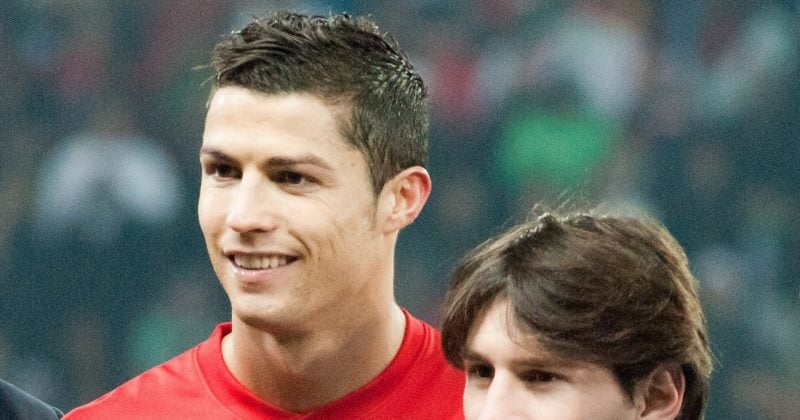
Cristiano Ronaldo and Lionel Messi share record for longest World Cup goal gap at 20 years, 11 days

Cristiano Ronaldo and Lionel Messi share record for longest World Cup goal gap at 20 years, 11 days

The two greatest players of their generation have each scored across a two-decade span in football's biggest tournament, a feat no one else has managed

Cristiano Ronaldo and Lionel Messi now share yet another record: the longest span between a player’s first and last FIFA World Cup goals, stretching exactly 20 years and 11 days. Both men first found the net in the 2006 World Cup, and both have scored in the ongoing 2026 tournament, meaning they’ve been putting the ball past World Cup goalkeepers across five different editions of the competition.

Ronaldo scored his first World Cup goal in Germany in 2006, a tournament where a young Messi also made his debut and found the net. Ronaldo was 21, already a star at Manchester United. Messi was 18, already terrifying defenders at Barcelona.

Advertisement

Both have scored in five different World Cups, a feat that speaks to something beyond talent. It requires surviving injuries, staying motivated through the inevitable decline in pace that comes with age, and convincing successive national team coaches that you still belong.

Messi’s recent performances in the 2026 World Cup have been particularly striking, with multi-goal outings that have put him in conversation with, or potentially beyond, some of the tournament’s all-time scoring records, including those held by players like Miroslav Klose.

Beyond the pitch, tokens like $ARG, tied to the Argentine national team, and $CHZ, the native token of the Chiliz platform that powers much of the fan token ecosystem, tend to see activity spikes during major tournaments. Previous World Cups and Champions League runs have shown that fan tokens are essentially sentiment-driven assets, reacting to goals and victories rather than fundamentals.

The risk is that these tokens are inherently speculative. They don’t generate yield. They don’t represent ownership in anything meaningful. Their value is almost entirely a function of how excited fans are on any given day, making them volatile in both directions, and tournament exits can send prices crashing just as quickly as they rose.

Disclosure: This article was edited by Editorial Team. For more information on how we create and review content, see our Editorial Policy.

Cristiano Ronaldo and Lionel Messi share record for longest World Cup goal gap at 20 years, 11 days

Cristiano Ronaldo and Lionel Messi share record for longest World Cup goal gap at 20 years, 11 days

The two greatest players of their generation have each scored across a two-decade span in football's biggest tournament, a feat no one else has managed

Cristiano Ronaldo and Lionel Messi now share yet another record: the longest span between a player’s first and last FIFA World Cup goals, stretching exactly 20 years and 11 days. Both men first found the net in the 2006 World Cup, and both have scored in the ongoing 2026 tournament, meaning they’ve been putting the ball past World Cup goalkeepers across five different editions of the competition.

Ronaldo scored his first World Cup goal in Germany in 2006, a tournament where a young Messi also made his debut and found the net. Ronaldo was 21, already a star at Manchester United. Messi was 18, already terrifying defenders at Barcelona.

Advertisement

Both have scored in five different World Cups, a feat that speaks to something beyond talent. It requires surviving injuries, staying motivated through the inevitable decline in pace that comes with age, and convincing successive national team coaches that you still belong.

Messi’s recent performances in the 2026 World Cup have been particularly striking, with multi-goal outings that have put him in conversation with, or potentially beyond, some of the tournament’s all-time scoring records, including those held by players like Miroslav Klose.

Beyond the pitch, tokens like $ARG, tied to the Argentine national team, and $CHZ, the native token of the Chiliz platform that powers much of the fan token ecosystem, tend to see activity spikes during major tournaments. Previous World Cups and Champions League runs have shown that fan tokens are essentially sentiment-driven assets, reacting to goals and victories rather than fundamentals.

The risk is that these tokens are inherently speculative. They don’t generate yield. They don’t represent ownership in anything meaningful. Their value is almost entirely a function of how excited fans are on any given day, making them volatile in both directions, and tournament exits can send prices crashing just as quickly as they rose.

Disclosure: This article was edited by Editorial Team. For more information on how we create and review content, see our Editorial Policy.