
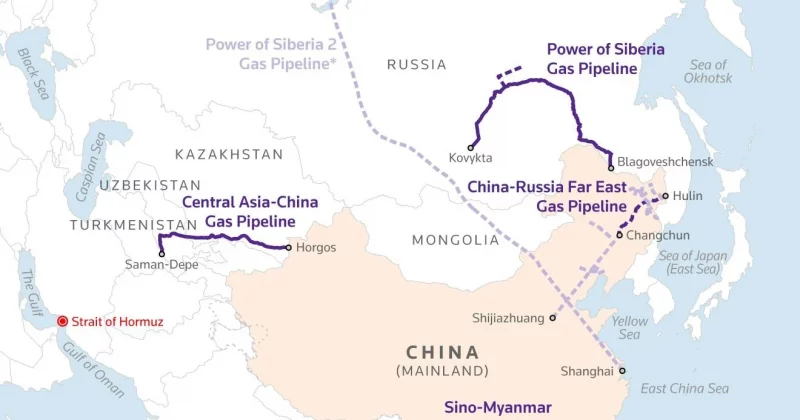
Russia and China reach understanding on Power of Siberia 2 pipeline, but the hard part remains
Both sides agree on construction parameters for the massive gas pipeline, while price and volume negotiations remain unresolved in a deal that could reshape Eurasian energy flows.
Russia and China have agreed on the main points for building the Power of Siberia 2 gas pipeline, a project that would funnel up to 50 billion cubic meters of natural gas annually from Russia’s Yamal fields to northern China. The catch: the commercial terms that actually determine whether this thing makes money for either side are still being hashed out.
Think of it like agreeing on the blueprints for a house while still arguing over the mortgage rate. The construction parameters are settled, but price, volume, duration, and take-or-pay clauses, the stuff that determines who profits and who bleeds, remain on the table.
What the pipeline actually is
Power of Siberia 2 would be a roughly 2,600-kilometer pipeline running from Russia’s prolific Yamal gas fields through Mongolia and into northern China. At full capacity, it would deliver up to 50 billion cubic meters of gas per year over a projected 30-year lifespan, with potential deliveries starting around 2030.
If completed, it would dramatically expand Russia’s pipeline capacity to China. Combined with existing infrastructure, total Russian pipeline capacity to China could exceed 100 billion cubic meters per year. That figure would account for more than one-fifth of China’s projected gas demand by 2030.
Russia has characterized the agreement as a legally binding understanding on construction parameters. China, for its part, has been considerably less specific in its public statements. No binding gas sale contract has been signed.
That gap in enthusiasm tells you a lot about who holds the leverage here.
The negotiation imbalance
Here’s the thing. Russia needs this deal more than China does, and both sides know it.
After losing most of its European gas market following the invasion of Ukraine, Russia has been scrambling to redirect its energy exports eastward. Gazprom, the state-controlled energy giant that would operate the pipeline, has limited alternative pipeline routes. That’s not a great position to be in when your negotiating partner has options.
China, meanwhile, has multiple gas supply sources. It imports LNG from Qatar, Australia, and the US. It has pipeline gas from Central Asia. It has growing domestic production. Beijing is not desperate for Russian gas. It would like Russian gas, preferably at a steep discount.
Macro, rates, and crypto—what moved markets and what matters next.
Daily. Free. Join 34,000+ readers across crypto, finance, and policy.
Analysts have flagged this power imbalance as a core risk to the deal’s economics. China is reportedly seeking a price in the range of $120 to $150 per 1,000 cubic meters. At those levels, Gazprom’s returns on the massive infrastructure investment could be squeezed thin.
In English: China wants cheap gas, Russia needs a customer, and the resulting price may not justify the billions needed to build the thing.
Why this matters beyond energy markets
The Power of Siberia 2 is not just a gas pipeline. It is a geopolitical instrument that would fundamentally reshape energy flows across Eurasia.
For Russia, it represents the centerpiece of its pivot to Asia. Moscow has spent the past three years reorienting its economy away from Europe, and a functioning pipeline to China would be the most concrete evidence that the strategy is working. Without it, Russia’s position as an energy superpower looks increasingly shaky.
For China, the calculus is different. A massive new pipeline from Russia would deepen energy ties with Moscow, but it would also give Beijing significant strategic leverage. When you are someone’s primary customer and they have nowhere else to go, you tend to set the terms.
Mongolia, the transit country, stands to benefit from transit fees and potential gas offtake agreements, though it has been a relatively quiet participant in the public negotiations.
The broader energy market should also be paying attention. If Power of Siberia 2 reaches full capacity, the combined Russian pipeline flows to China would represent a significant chunk of the global gas trade. That volume moving from West to East on a long-term contract basis could tighten LNG markets for other Asian buyers, particularly Japan, South Korea, and India, who compete for spot cargoes.
For crypto markets specifically, the pipeline’s relevance is indirect but worth noting. Energy costs are a fundamental input for Bitcoin mining and proof-of-work networks. Any major shift in global gas supply dynamics affects electricity prices, particularly in regions where gas-fired power generation sets the marginal cost of electricity. Cheaper Russian gas flowing to China could, in theory, lower energy costs for Chinese-adjacent mining operations, though Beijing’s ongoing crackdown on crypto mining complicates that picture considerably.
What investors should watch
The fact that construction parameters are agreed upon is progress. But progress and a signed contract are very different things.
The unresolved commercial terms are not minor details. They are the deal itself. Price per thousand cubic meters, guaranteed annual volumes, take-or-pay obligations, and contract duration will determine whether Power of Siberia 2 is a profitable venture or a geopolitical vanity project that hemorrhages money for Gazprom.
Look at the precedent. The original Power of Siberia pipeline, which began deliveries in 2019, was widely reported to have been signed at terms very favorable to China. Gazprom has never disclosed the exact price, which usually means it is not something worth bragging about. There is little reason to expect China to be more generous the second time around, especially when Russia’s bargaining position has deteriorated.
The timeline also deserves scrutiny. A target of 2030 for first deliveries is ambitious given that construction has not formally begun and a final investment decision has not been announced. Major pipeline projects of this scale routinely face delays measured in years, not months.
For energy market participants and anyone tracking the geopolitical reshuffling of global commodity flows, the key signal will be whether a binding gas sale contract materializes in 2025. Until that happens, Power of Siberia 2 remains an understanding, not a pipeline.