
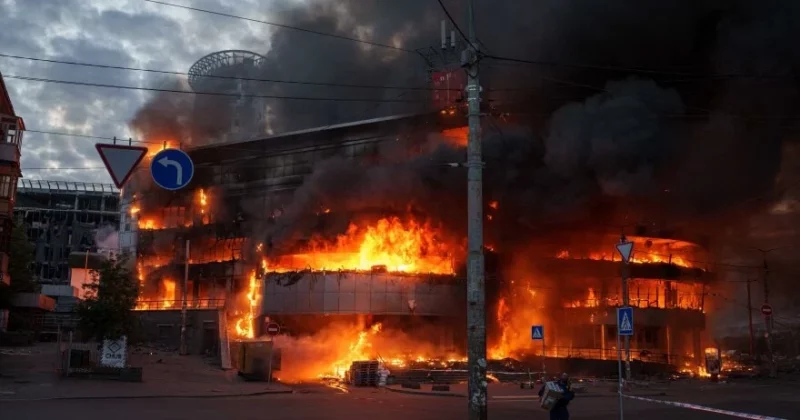
Russia claims successful strikes on Ukraine with hypersonic, ballistic missiles
Moscow deployed its Oreshnik IRBM and Zircon hypersonic cruise missiles in escalating attacks, though crypto markets have barely flinched.
Russia has ramped up its use of advanced missile systems against Ukraine, deploying both its Oreshnik intermediate-range ballistic missile and Zircon hypersonic cruise missiles in separate strikes.
On January 9, 2026, Russia fired the Oreshnik IRBM at an aviation repair plant in Ukraine’s Lviv region, uncomfortably close to NATO territory. It was only the second confirmed deployment of the missile, which Moscow describes as nuclear-capable and engineered with advanced maneuverability to evade interception systems.
What happened, and why it matters
The Kremlin framed the Oreshnik strike as a targeted response to what it alleged were drone attacks on a residence belonging to President Putin. Ukraine and the US have both denied that claim.
Then, on February 16, 2026, Russia launched four Zircon hypersonic cruise missiles alongside Iskander-M systems and other weapons in a broader assault on Ukrainian targets. Ukrainian air defenses reportedly managed to intercept or jam two of the four incoming Zircon missiles.
The Zircon is a sea-launched hypersonic cruise missile capable of traveling at speeds exceeding Mach 5. The Oreshnik, as an intermediate-range ballistic missile, follows a higher trajectory and achieves extreme speeds on reentry. Russia has emphasized its nuclear capability, though there’s no indication nuclear warheads were involved in the January strike.
The news moving money, markets, and the world—before your day starts.
Daily. Free. Join 34,000+ readers across crypto, finance, and policy.
The broader conflict context
These strikes are part of an escalation pattern that has defined the Russia-Ukraine war since Russia’s full-scale invasion in February 2022. The INF Treaty, which the US and Russia abandoned in 2019, had banned intermediate-range ballistic missiles for decades. Now they’re being fired at targets within a few hundred kilometers of NATO borders.
What this means for investors
Despite the severity of these military developments, cryptocurrency markets have shown essentially no reaction to either the January or February strikes. No notable price swings, no spike in volatility, no rush into or out of digital assets.
Earlier in the conflict, particularly around the initial invasion in February 2022, crypto markets moved sharply on war headlines. Bitcoin dropped alongside equities as risk appetite evaporated, and there was intense focus on whether digital assets would be used to circumvent sanctions on Russia.
The sanctions angle remains worth watching. Previous sanctions rounds prompted increased scrutiny of digital asset flows and led to enforcement actions against platforms facilitating Russian transactions.