
Russian defense ministry intercepts 660 Ukrainian drones as Crimea declares emergency

Russian defense ministry intercepts 660 Ukrainian drones as Crimea declares emergency

The overnight barrage marks the largest single drone assault since the full-scale invasion began in 2022, triggering blackouts and fuel shortages across occupied Crimea

Ukraine launched what appears to be its most extensive drone operation of the entire war on June 26, sending hundreds of unmanned aerial vehicles across Russian-controlled territory overnight. Russian air defenses reportedly intercepted 660 drones across more than a dozen regions, including airspace over the Black Sea, the Sea of Azov, and occupied Crimea.

Crimean authorities responded by declaring a state of emergency, citing severe damage to power grids, water systems, and fuel infrastructure. The peninsula, which Russia annexed in 2014 and has held since, is now grappling with widespread blackouts and critical resource shortages.

Advertisement

A new record in an escalating air war

The scale of this attack dwarfs previous benchmarks. The prior record for Ukrainian drone interceptions stood at 556, set on May 17. That means this latest wave represents roughly an 18% increase over the previous high-water mark, and some follow-up reports pushed the total interception count as high as 706 when subsequent strikes were included.

Moscow did not provide casualty figures or detailed damage assessments in its initial reporting.

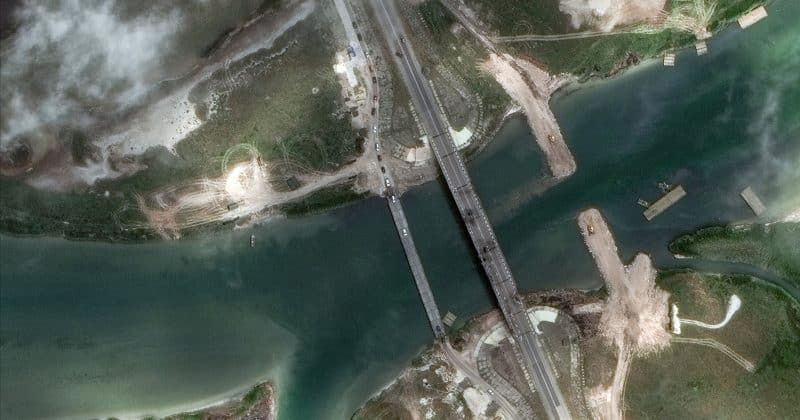
Residents in Crimea are dealing with power outages and fuel shortages severe enough to trigger long queues at critical exit points, including the Crimean Bridge, the strategic chokepoint connecting the peninsula to mainland Russia.

Ukraine’s drone capabilities keep expanding

Ukraine has been steadily increasing both the volume and the reach of its drone operations throughout the conflict. The fact that Ukraine can now mount operations of this magnitude suggests its domestic drone production infrastructure has matured significantly since the early months of the war.

Intercepting 660 drones in a single night burns through enormous quantities of missiles and ammunition. Many of those interceptor missiles cost orders of magnitude more than the drones they’re shooting down, creating an asymmetric cost equation that favors the attacker over time.

Disclosure: This article was edited by Editorial Team. For more information on how we create and review content, see our Editorial Policy.

Russian defense ministry intercepts 660 Ukrainian drones as Crimea declares emergency

Russian defense ministry intercepts 660 Ukrainian drones as Crimea declares emergency

The overnight barrage marks the largest single drone assault since the full-scale invasion began in 2022, triggering blackouts and fuel shortages across occupied Crimea

Ukraine launched what appears to be its most extensive drone operation of the entire war on June 26, sending hundreds of unmanned aerial vehicles across Russian-controlled territory overnight. Russian air defenses reportedly intercepted 660 drones across more than a dozen regions, including airspace over the Black Sea, the Sea of Azov, and occupied Crimea.

Crimean authorities responded by declaring a state of emergency, citing severe damage to power grids, water systems, and fuel infrastructure. The peninsula, which Russia annexed in 2014 and has held since, is now grappling with widespread blackouts and critical resource shortages.

Advertisement

A new record in an escalating air war

The scale of this attack dwarfs previous benchmarks. The prior record for Ukrainian drone interceptions stood at 556, set on May 17. That means this latest wave represents roughly an 18% increase over the previous high-water mark, and some follow-up reports pushed the total interception count as high as 706 when subsequent strikes were included.

Moscow did not provide casualty figures or detailed damage assessments in its initial reporting.

Residents in Crimea are dealing with power outages and fuel shortages severe enough to trigger long queues at critical exit points, including the Crimean Bridge, the strategic chokepoint connecting the peninsula to mainland Russia.

Ukraine’s drone capabilities keep expanding

Ukraine has been steadily increasing both the volume and the reach of its drone operations throughout the conflict. The fact that Ukraine can now mount operations of this magnitude suggests its domestic drone production infrastructure has matured significantly since the early months of the war.

Intercepting 660 drones in a single night burns through enormous quantities of missiles and ammunition. Many of those interceptor missiles cost orders of magnitude more than the drones they’re shooting down, creating an asymmetric cost equation that favors the attacker over time.

Disclosure: This article was edited by Editorial Team. For more information on how we create and review content, see our Editorial Policy.