
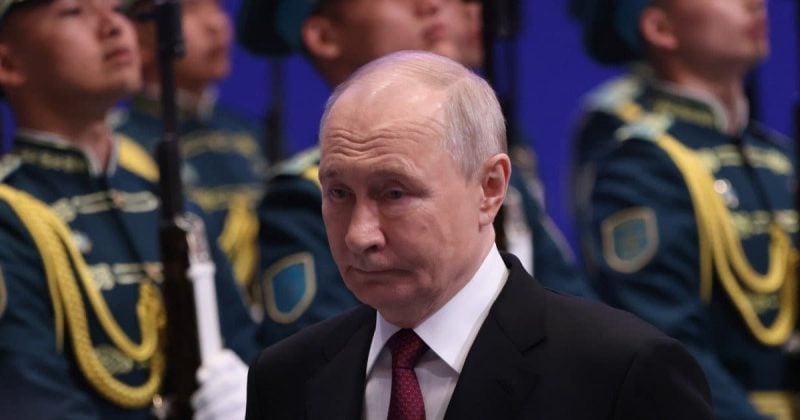
Russian officials warn Putin that war spending risks triggering a budget crisis
Russia's defense budget has ballooned to nearly 40% of federal spending, and the country's own financial stewards are sounding alarms that the math no longer works.
Russia’s Finance Ministry and central bank officials have delivered a blunt message to President Vladimir Putin: the country’s military spending trajectory is unsustainable and risks plunging the federal budget into crisis.
The warning, reported by Bloomberg on June 1, lands at a moment when the numbers already look grim. Russia’s federal budget deficit hit 5.9 trillion rubles just four months into 2026, a figure that already exceeds the full-year deficit target of 3.8 trillion rubles.
The numbers behind the warning
Projected military spending for 2026 is now set to exceed earlier plans by at least 2 trillion rubles, roughly $28 billion. Total planned defense and security spending has climbed to 16.84 trillion rubles, approximately $238 billion, which accounts for nearly 40% of Russia’s entire federal expenditure.
The trajectory has been steep. In 2025, military funding stood at approximately 16 trillion rubles, already corresponding to 7.5% of Russia’s GDP. The initial 2026 budget law actually attempted to reduce defense funding by 4% in nominal terms. That restraint didn’t last. Subsequent adjustments pushed spending well past previous levels, suggesting the battlefield is dictating the budget rather than the other way around.
A Kremlin divided
The warnings from the Finance Ministry and central bank signal a growing divide within the Russian government. On one side, financial technocrats who understand that deficits of this magnitude, compounded by Western sanctions limiting access to international capital markets and critical resources, create genuine economic risk. On the other, hardline factions within the Kremlin who view any talk of defense cuts as politically unacceptable during an ongoing military campaign.
What this means for markets and crypto
Russia has previously been documented using crypto channels for sanctions evasion and cross-border transactions. There is no direct evidence that the current fiscal warnings are tied to any cryptocurrency strategy or digital asset policy within the Kremlin. If the fiscal situation continues to deteriorate and conventional funding mechanisms remain constrained by Western sanctions, the incentive for state-adjacent actors to lean more heavily on digital assets for financing could grow.
Investors watching the ruble should note that a government spending 40% of its budget on defense while running a deficit 55% over target is a government that will eventually face difficult choices about its currency.