
Nexo Earn with Nexo
Samsung reaches deal to avert strike over AI profits

Samsung reaches deal to avert strike over AI profits

The tech giant's largest labor union secured a bonus pool worth 13% of operating profit, narrowly avoiding an 18-day walkout by 48,000 workers.

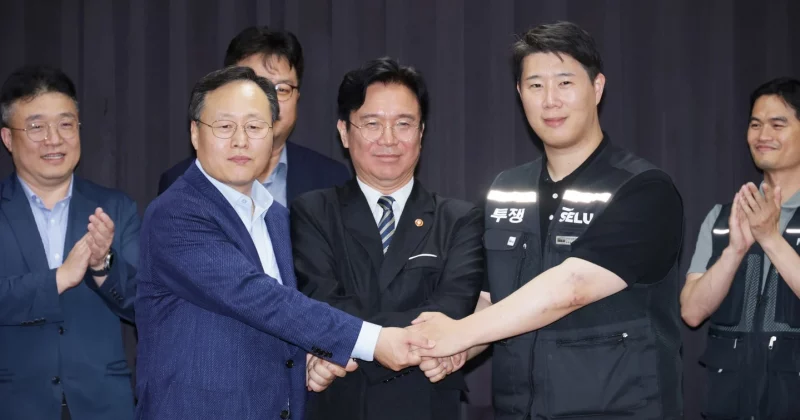
Samsung Electronics just dodged a bullet. The company reached a last-minute agreement with its largest labor union, the National Samsung Electronics Union (NSEU), to prevent an 18-day strike that would have pulled roughly 48,000 workers off the job.

The deal and what sparked it

The union wanted a guaranteed annual bonus tied to operating performance rather than the one-time bonus payout management initially proposed. The compromise landed on a bonus pool equivalent to 13% of operating profit, working out to roughly $340K per employee.

Their benchmark was SK hynix, Samsung’s crosstown rival in the memory chip business, where bonuses reportedly reached around $900K. When your competitor’s workers are making nearly three times more in profit-sharing, “we want more” isn’t exactly an unreasonable opening position.

Advertisement

Samsung’s share price briefly dropped 5% during the period when negotiations appeared to be breaking down, a dip significant enough to weigh on South Korea’s benchmark index.

Why AI profits changed the calculus

The catalyst is artificial intelligence. More specifically, it’s the enormous demand for high-bandwidth memory (HBM) chips and other semiconductor products that power AI training and inference. When an entire industry is scrambling to secure chip supply, the workers who fabricate those chips gain leverage they simply didn’t have during normal market cycles.

The union’s push for a recurring, formula-based bonus rather than a discretionary one-time payment reflects a sophisticated read on the situation. One-time payouts can be quietly reduced or eliminated when management decides the boom is over. A profit-sharing formula, pegged to operating results, is much harder to walk back.

Broader implications for the chip industry

For Samsung specifically, the timing of this dispute is awkward. The company has been working to close a widely discussed gap with SK hynix in HBM chip technology and market share. SK hynix has been the dominant supplier of HBM3E chips to Nvidia, and Samsung has been racing to qualify its own products and win orders. An 18-day production halt would have been devastating to those catch-up efforts.

SK hynix’s generous bonuses already signaled this trend. Samsung’s deal with the NSEU confirms it. If Samsung’s profit-sharing formula becomes the floor rather than the ceiling, other chipmakers may face similar pressure from their own workforces.

Disclosure: This article was edited by Editorial Team. For more information on how we create and review content, see our Editorial Policy.

Samsung reaches deal to avert strike over AI profits

Samsung reaches deal to avert strike over AI profits

The tech giant's largest labor union secured a bonus pool worth 13% of operating profit, narrowly avoiding an 18-day walkout by 48,000 workers.

Samsung Electronics just dodged a bullet. The company reached a last-minute agreement with its largest labor union, the National Samsung Electronics Union (NSEU), to prevent an 18-day strike that would have pulled roughly 48,000 workers off the job.

The deal and what sparked it

The union wanted a guaranteed annual bonus tied to operating performance rather than the one-time bonus payout management initially proposed. The compromise landed on a bonus pool equivalent to 13% of operating profit, working out to roughly $340K per employee.

Their benchmark was SK hynix, Samsung’s crosstown rival in the memory chip business, where bonuses reportedly reached around $900K. When your competitor’s workers are making nearly three times more in profit-sharing, “we want more” isn’t exactly an unreasonable opening position.

Advertisement

Samsung’s share price briefly dropped 5% during the period when negotiations appeared to be breaking down, a dip significant enough to weigh on South Korea’s benchmark index.

Why AI profits changed the calculus

The catalyst is artificial intelligence. More specifically, it’s the enormous demand for high-bandwidth memory (HBM) chips and other semiconductor products that power AI training and inference. When an entire industry is scrambling to secure chip supply, the workers who fabricate those chips gain leverage they simply didn’t have during normal market cycles.

The union’s push for a recurring, formula-based bonus rather than a discretionary one-time payment reflects a sophisticated read on the situation. One-time payouts can be quietly reduced or eliminated when management decides the boom is over. A profit-sharing formula, pegged to operating results, is much harder to walk back.

Broader implications for the chip industry

For Samsung specifically, the timing of this dispute is awkward. The company has been working to close a widely discussed gap with SK hynix in HBM chip technology and market share. SK hynix has been the dominant supplier of HBM3E chips to Nvidia, and Samsung has been racing to qualify its own products and win orders. An 18-day production halt would have been devastating to those catch-up efforts.

SK hynix’s generous bonuses already signaled this trend. Samsung’s deal with the NSEU confirms it. If Samsung’s profit-sharing formula becomes the floor rather than the ceiling, other chipmakers may face similar pressure from their own workforces.

Disclosure: This article was edited by Editorial Team. For more information on how we create and review content, see our Editorial Policy.