
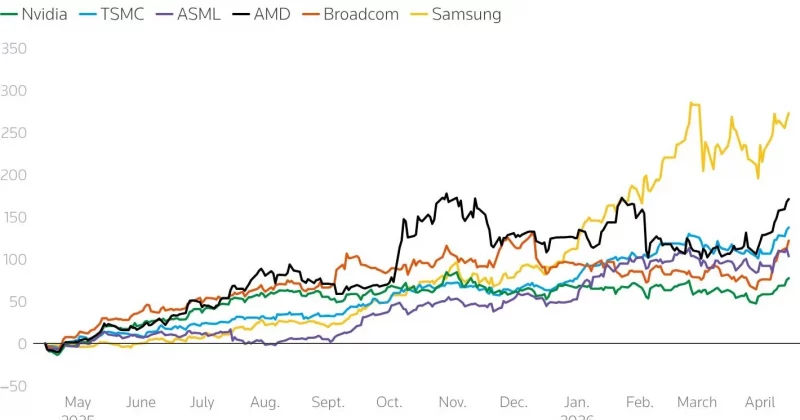
Samsung, TSMC drive AI stock boom, reshaping Korea and Taiwan markets
The AI semiconductor supercycle is rewriting the playbook for Asia's two most chip-dependent stock markets, with ripple effects reaching into crypto infrastructure.
Korea’s KOSPI and Taiwan’s Taiex have surged to historic highs, propelled almost entirely by a single force: insatiable global demand for AI chips.
At the center of this rally sit three companies. Samsung Electronics, SK Hynix, and Taiwan Semiconductor Manufacturing Co. (TSMC) have collectively become the gravitational core of their respective indices, pulling entire national markets upward as data centers, cloud providers, and AI labs scramble to secure next-generation silicon.
The numbers behind the boom
Samsung Electronics has crossed a $1 trillion market capitalization, driven by surging demand for its AI-oriented semiconductor products.
Samsung and SK Hynix together account for 38.2% of the KOSPI’s total market capitalization.
The KOSPI itself has hit a record high of 4,457.52. Goldman Sachs has gone even further, projecting the index could reach 8,000 if the AI chip cycle continues to accelerate.
Across the Taiwan Strait, the Taiex index has punched through 30,000, fueled by optimism around TSMC’s dominant position in advanced semiconductor fabrication. TSMC manufactures the most cutting-edge AI accelerators for Nvidia and other designers.
The news moving money, markets, and the world—before your day starts.
Daily. Free. Join 34,000+ readers across crypto, finance, and policy.
Both South Korean and Taiwanese equities are leading global markets in year-to-date performance, driven almost exclusively by AI excitement.
Why chips are the new oil
Samsung and SK Hynix dominate the HBM market, which is the memory architecture that AI accelerators like Nvidia’s H100 and B200 require in massive quantities. TSMC, meanwhile, is the only foundry capable of manufacturing chips at the 3-nanometer and upcoming 2-nanometer nodes at scale.
What this means for crypto investors
Several crypto-native projects are building decentralized GPU marketplaces and AI compute networks that rely directly on the hardware Samsung, SK Hynix, and TSMC produce. A supply-constrained HBM market raises costs for anyone trying to build a decentralized AI training network.
AI is absorbing attention and allocation that might otherwise find its way into risk assets like Bitcoin and altcoins. Digital assets are competing for mindshare with a sector generating tangible revenue growth and record earnings.
Goldman’s KOSPI 8,000 target assumes the AI chip cycle keeps accelerating. If demand plateaus, or if hyperscalers pull back on capital expenditure, the same concentration that powered the rally becomes a vulnerability.