
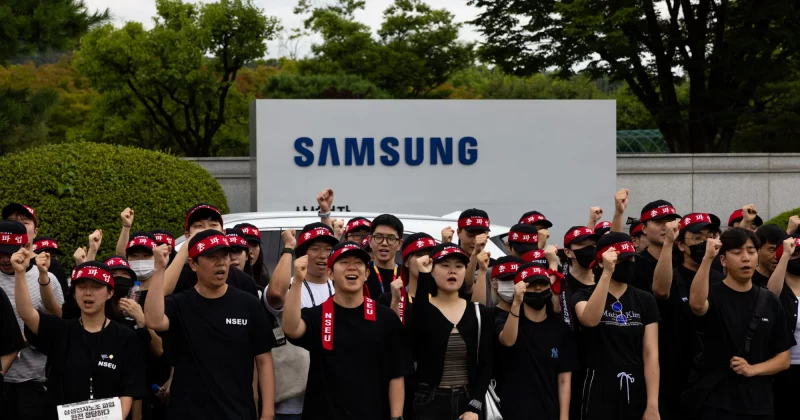
Samsung Electronics reaches union deal, averts chip strike as KOSPI jumps 8%
A tentative wage and bonus agreement with nearly 48,000 union workers prevents an 18-day walkout that could have rattled global AI chip supply chains.
Samsung Electronics just dodged a bullet the size of its entire memory chip division. The world’s largest memory chipmaker reached a tentative wage and bonus agreement with its leading labor union, pulling the plug on a planned 18-day strike that would have disrupted production across its semiconductor facilities.
The Korean benchmark KOSPI index surged 8% in a relief rally, reflecting just how nervous the market had been about the prospect of Samsung’s chip lines going quiet. For context, Samsung isn’t just another tech company. It’s the backbone of the global high-bandwidth memory supply chain that powers AI accelerators, and a prolonged work stoppage would have sent shockwaves well beyond Seoul.
What the deal looks like
The union’s opening demands were aggressive. Workers pushed for uncapped performance payouts fixed at 15% of operating profit, on top of base wage increases. That’s the kind of ask that makes CFOs reach for the antacids.
The final agreement landed somewhere more palatable for both sides. It includes base wage increases alongside a new compensation structure featuring special bonuses paid in company stock. Those stock bonuses are tied to long-term performance targets for Samsung’s chip division, specifically contingent on the unit exceeding 200 trillion won in revenue.
In English: Samsung is telling workers, “Help us hit massive revenue goals, and you’ll share in the upside through equity.” It’s the kind of alignment-of-incentives play that looks smart on paper, though the revenue threshold is ambitious enough that workers aren’t exactly cashing checks tomorrow.
Approximately 48,000 union members are now set to vote on ratifying the agreement. If approved, the deal would formally end the labor dispute and allow Samsung to maintain uninterrupted production at a time when every chip counts.
Why this matters beyond Korea
Samsung’s semiconductor operations don’t exist in a vacuum. The company is a critical supplier of high-bandwidth memory, or HBM, and advanced DRAM chips. These are the components that make AI accelerators from companies like Nvidia actually function. A strike would have constrained supply at precisely the moment when every major cloud provider and AI lab is scrambling for more compute.
The ripple effects would have been felt across multiple sectors. Crypto miners who rely on next-generation AI hardware, investors in AI-related tokens, and anyone watching the intersection of semiconductors and digital assets had reason to pay attention. A stable Samsung output is one of those quiet prerequisites that keeps the entire AI supply chain humming.
Look, semiconductor labor disputes don’t usually make headlines in crypto circles. But the convergence of AI compute demand, chip scarcity, and the financialization of everything AI-adjacent means that a factory floor dispute in Pyeongtaek can move markets in San Francisco and beyond.
The planned 18-day strike threatened to disrupt production across Samsung’s memory and logic chip lines, with particular risk to products serving the AI market. That’s not a hypothetical concern. Samsung’s HBM chips are already in tight supply as the company races to catch up with rival SK Hynix in supplying Nvidia’s next-generation GPU platforms.
The bigger picture for Samsung and semiconductors
This labor dispute didn’t materialize out of nowhere. Samsung’s workforce has been watching the company pour billions into expanding its foundry and memory operations while competitors like TSMC and SK Hynix have posted strong results on the back of AI demand. Workers wanted a bigger piece of the pie, and it’s hard to blame them.
The introduction of stock-linked bonuses tied to division-level revenue targets is a notable shift in how Samsung compensates its semiconductor workforce. It mirrors practices more common in Silicon Valley than in Korean conglomerates, where traditional bonus structures have historically been more formulaic. Whether this model sticks could influence labor negotiations across the broader Korean tech sector.
Samsung’s chip division has been under pressure to improve yields on its advanced process nodes and to secure its position in the HBM market. A strike would have compounded those challenges at the worst possible time, potentially costing the company market share that would be extraordinarily difficult to reclaim. The agreement removes that risk, at least for now.
The KOSPI’s 8% jump tells you everything about how the market was pricing in strike risk. Korean equities had been under pressure from multiple headwinds, and the Samsung labor situation was acting as an additional weight on sentiment. The resolution functions as a sentiment reset, though the underlying challenges facing Korean markets haven’t disappeared.
For investors watching the semiconductor space, the deal is a net positive but not a permanent fix. Labor relations at Samsung are entering a new chapter, one where workers have demonstrated they can credibly threaten production and extract meaningful concessions. The 48,000-member union now has a template for future negotiations, and the revenue-linked stock bonus structure creates interesting dynamics. If Samsung’s chip division hits its targets, workers benefit alongside shareholders. If it doesn’t, the next round of negotiations could be considerably more contentious.
The ratification vote is the next milestone to watch. Until those 48,000 workers formally approve the deal, the strike threat technically remains on the table, even if markets are already trading as though it’s resolved. Here’s the thing: markets have a habit of pricing in good news fast and repricing bad news even faster. Anyone positioned around Korean tech or AI supply chain plays should keep an eye on the vote outcome rather than assuming the rally has fully priced in the risk removal.