
Second China Shock reverberates through US markets and politics

Second China Shock reverberates through US markets and politics

China's record trade surplus and a new wave of high-value exports are reshaping global manufacturing, trade alliances, and investment calculus

The first China Shock cost the US somewhere between one and two million manufacturing jobs after China joined the World Trade Organization in 2001. Now, two decades later, the sequel has arrived.

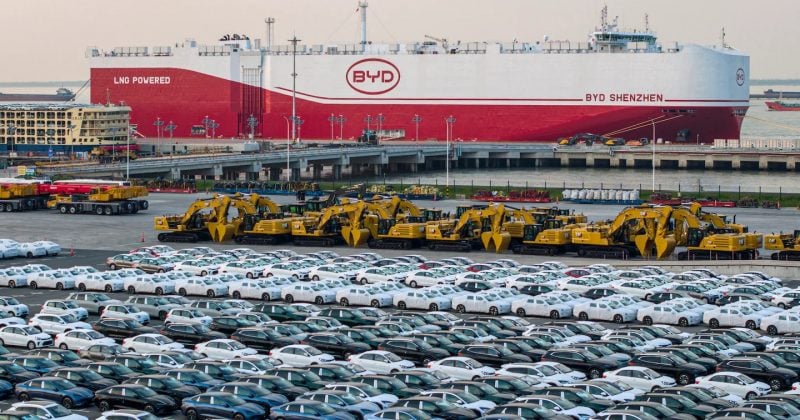
China’s export machine has shifted into a higher gear, this time powered not by cheap textiles and basic electronics, but by electric vehicles, solar panels, advanced machinery, and other high-value manufactured goods. The country’s trade surplus hit a record $1.2 trillion in 2025, a number so large it roughly equals the entire GDP of the Netherlands.

Tariffs as a firewall

Washington’s response has been blunt-force protectionism. US tariffs on Chinese goods climbed to a trade-weighted average of approximately 47.5% by November 2025.

Advertisement

Chinese exports to the US dropped about 20% in the initial aftermath. China has pivoted its export flows toward Southeast Asia, Africa, and Europe. A November 2025 report from the US-China Economic and Security Review Commission laid out the threat in stark terms, warning that “China Shock 2.0” poses serious risks to global manufacturing sectors outside the US.

The global ripple effects

European automakers are now competing head-to-head with Chinese EV manufacturers that benefit from massive state support and overcapacity-driven pricing. By mid-2026, the continued export boom was pressuring factories across Europe and developing countries, triggering fears of job losses and growing dependence on Chinese goods.

For emerging markets trying to climb the manufacturing ladder, the calculus is brutal. Compete with a state-subsidized industrial giant that has decades of infrastructure and scale advantages, or accept a role as a consumer of Chinese goods rather than a producer of your own.

What this means for investors

US-based manufacturers shielded by tariffs could see near-term benefits, particularly in automotive, clean energy components, and tech hardware. Companies with domestic production capacity are, for now, insulated from the price pressure that Chinese overcapacity creates.

The sectors most exposed to second-order effects include solar technology, where Chinese manufacturers dominate global production, and automotive, where Chinese EV makers are pricing aggressively in every market they can access. European automakers and clean energy firms are particularly vulnerable, and that vulnerability shows up in earnings forecasts that keep getting revised downward.

The coordinated policy response that analysts say is needed to manage this transition hasn’t materialized yet.

Disclosure: This article was edited by Editorial Team. For more information on how we create and review content, see our Editorial Policy.

Second China Shock reverberates through US markets and politics

Second China Shock reverberates through US markets and politics

China's record trade surplus and a new wave of high-value exports are reshaping global manufacturing, trade alliances, and investment calculus

The first China Shock cost the US somewhere between one and two million manufacturing jobs after China joined the World Trade Organization in 2001. Now, two decades later, the sequel has arrived.

China’s export machine has shifted into a higher gear, this time powered not by cheap textiles and basic electronics, but by electric vehicles, solar panels, advanced machinery, and other high-value manufactured goods. The country’s trade surplus hit a record $1.2 trillion in 2025, a number so large it roughly equals the entire GDP of the Netherlands.

Tariffs as a firewall

Washington’s response has been blunt-force protectionism. US tariffs on Chinese goods climbed to a trade-weighted average of approximately 47.5% by November 2025.

Advertisement

Chinese exports to the US dropped about 20% in the initial aftermath. China has pivoted its export flows toward Southeast Asia, Africa, and Europe. A November 2025 report from the US-China Economic and Security Review Commission laid out the threat in stark terms, warning that “China Shock 2.0” poses serious risks to global manufacturing sectors outside the US.

The global ripple effects

European automakers are now competing head-to-head with Chinese EV manufacturers that benefit from massive state support and overcapacity-driven pricing. By mid-2026, the continued export boom was pressuring factories across Europe and developing countries, triggering fears of job losses and growing dependence on Chinese goods.

For emerging markets trying to climb the manufacturing ladder, the calculus is brutal. Compete with a state-subsidized industrial giant that has decades of infrastructure and scale advantages, or accept a role as a consumer of Chinese goods rather than a producer of your own.

What this means for investors

US-based manufacturers shielded by tariffs could see near-term benefits, particularly in automotive, clean energy components, and tech hardware. Companies with domestic production capacity are, for now, insulated from the price pressure that Chinese overcapacity creates.

The sectors most exposed to second-order effects include solar technology, where Chinese manufacturers dominate global production, and automotive, where Chinese EV makers are pricing aggressively in every market they can access. European automakers and clean energy firms are particularly vulnerable, and that vulnerability shows up in earnings forecasts that keep getting revised downward.

The coordinated policy response that analysts say is needed to manage this transition hasn’t materialized yet.

Disclosure: This article was edited by Editorial Team. For more information on how we create and review content, see our Editorial Policy.