

Should I Care About User Anonymity in My Crypto Product?

Should I Care About User Anonymity in My Crypto Product?

Ensuring user anonymity in crypto products is crucial to protect privacy, prevent unwanted surveillance, and maintain user trust.

The concept of public blockchains changed digital payments by making transactions transparent and verifiable by anyone. Every transfer made can be independently read and confirmed, giving users confidence that funds have moved exactly as intended.

However, that same transparency creates a challenge for businesses building crypto products. Every transaction they make leaves a permanent record that can expose balances, payment history, relationships, and user activity to anyone with a blockchain explorer. This challenge has created a bigger issue where products now strive to protect what becomes visible outside their interface.

To help address this, crypto infrastructure providers have introduced private transfer capabilities that reduce unnecessary on-chain exposure without changing how public blockchains operate. One example is ChangeNOW, through its Private Transfers API, which allows routing transfers through a temporary deposit address and separate operational hot wallet to break the direct on-chain link between sender and recipient.

To understand why this matters, we first examine how public blockchains operate.

How Public Blockchains Work

Most networks record every transaction in a public database. This means anyone with a block explorer can see what address sent funds, how much, the timing, and, in most cases, links to past behavior. This is great for transparency but not good for personal privacy, especially when a particular wallet is linked to an entity.

Today, blockchain analytics has evolved. Through ‘wallet clustering,’ firms can group multiple blockchain addresses likely controlled by the same user or service into a single analytical unit.

The concept is straightforward: if you can determine that address A, address B, and address C are all controlled by the same party, you treat them as one entity. The moment that happens, these wallets become a public affair. Anyone with a browser can inspect their balances, counterparties, transaction frequency, and any of their activities. So has pseudonymity failed to offer that limited protection promised?

Three groups can attest to that:

Corporate Businesses

Businesses paying suppliers, moving treasury funds, or settling across borders on-chain are the biggest victims of public visibility. Once a corporate wallet is identified, its transaction log becomes a map that shows who gets paid, how often, which vendors recur, and which relationships look significant. Run that map long enough, and it starts to describe the business’s operating structure, something that most do not intend to publish.

To a competitor, this is free, helpful information that can suggest which suppliers matter, where the company is active, and how certain relationships change over time.

High-Risk Users and Donors

For the second group, the stakes go beyond commercial discretion to direct exposure risk. We are talking about journalists, dissidents, whistleblowers, human rights organizations, and the donors funding them. All these people may need stronger privacy around financial flows.

For them, a visible transfer can point directly to funding sources, field contacts, or operational details that put them at risk.

Advertisement

Everyday Users

The third group is less dramatic, but it is the biggest by volume: regular people paying with crypto for everyday things. A merchant checkout, a card top-up, or an in-app wallet transfer. None of it looks sensitive on its own.

The risk shows up with reuse. The same address split across purchases, subscriptions, or peer-to-peer payments turns into a spending history anyone can piece together. A stranger with a block explorer can estimate a wallet’s balance, spot recurring habits, or connect one payment to unrelated ones. Most of these users never think about this until it is pointed out, and when they realize what has been happening, that trust they had for your product is at stake.

In such a time, facilitation of private transfers is no longer a good-to-have feature; it is a necessity any serious crypto product has to look for. Luckily, ChangeNOW offers one…

ChangeNOW Private Transfers Via API

ChangeNOW API-Private Transfers is an optional integration feature that allows partner platforms to reduce the traceability of cryptocurrency transfers for their users. It works by breaking the direct on-chain link between a sender’s wallet and the final payout using temporary deposit addresses and separate hot wallets.
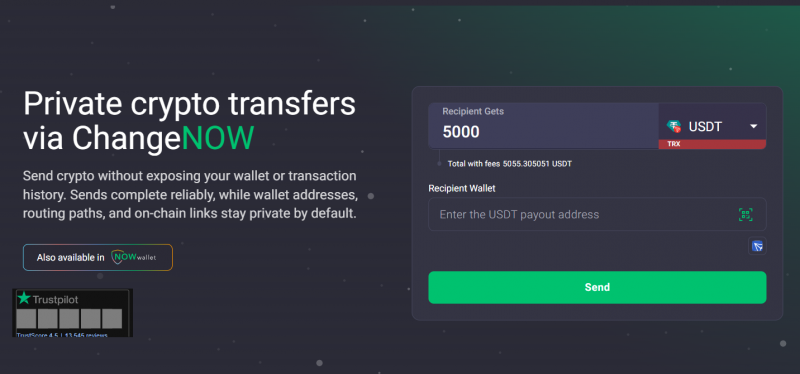
ChangeNOW private transfer
The ChangeNOW private transfer page

Although the feature does not make users invisible, once activated, it lets partners add privacy support to make their users’ transaction patterns less accessible and reduces the risk of wallet profiling, targeted surveillance, or unwanted attention. Let us look at its mechanics.

How it Works

ChangeNOW private transfers happen through the separation of the incoming and outgoing transactions. Instead of sending funds directly to the recipient, the API first generates a unique deposit address for each transfer. The sender deposits the required amount into this address, and the transaction is confirmed on the blockchain.

Once the deposit is confirmed, ChangeNOW processes the transfer within its infrastructure and sends a separate payout transaction from an independent operational wallet to the recipient’s address. Because the payout originates from a different wallet than the one that received the funds, there is no direct on-chain path connecting the sender and the recipient.

How ChangeNOW Private Transfers Fit Into Existing Products

While private transfers come as an additional solution to the public blockchain problem, they should not feel like a second product or an advanced privacy tool that only expert users understand. ChangeNOW understands that and allows the API Private Transfers to be added around the existing transfer flow. This means users still start from the same wallet, checkout, merchant flow, exchange interface, or crypto app.

For partners, the feature works as part of the API transfer setup. You use your current API key, with no additional access layers or configuration required. Coverage matches standard swaps and compliance, and all assets available for buy and sell are also available for private transfers. Execution timing matches regular exchanges, and routing, confirmation, and payout follow the same processing logic. API fees and commissions also remain unchanged.

All this happens while products keep control over the surrounding experience, such as where the transfer starts, how the option is presented, and what status the user sees. 

What API Partners Get

Building a privacy transfer feature in-house can be a long-term burden that requires weeks, months, or even years of research, building, and resource exhaustion. Also, do not forget the regular changes in transfer methods, network and token standards, exchange policies, fee structures, security threats, and regulatory requirements.

Each of these challenges can pull partner teams’ efforts away from the core goal of building. 

ChangeNOW’s API Private Transfer offers a shorter route. Any wallet, payment product, merchant tool, crypto app, merchant platform, treasury tool, or payment infrastructure provider can add a reduced-traceability option without building or maintaining specialized transfer infrastructure in-house.

This means users of these platforms now get to perform personal transfers, business payments, and asset management without public traceability. And for this reason those users have less reason to leave for another provider.

The feature also gives partners an argument point when privacy-sensitive users ask why they should keep transactions inside their platform.

How to Enable Private Transfers Through the ChangeNOW API

Private Transfers are enabled on request for ChangeNOW API partners. Once approved, the transaction structure is modified at the visibility layer, so sender wallets, routing paths, and on-chain links do not create a clear, traceable path.

This best fits wallets, payment products, merchant platforms, treasury tools, and payment infrastructure providers where transaction exposure could affect user trust, commercial confidentiality, or safety.

Disclaimer: Privacy Does Not Mean Anonymity

While private transfers have turned out to be a great solution to the existing traceability in public blockchains, the claim has to stay narrow. Traceability goes down, not away. There is no full anonymity, no legal immunity, and no exemption from platform controls.

For partner products, you have to understand this commercial language. Private transfers should not be sold as a way to bypass KYC, AML, reporting thresholds, or transaction review. Unusual activity can still be flagged and subjected to a risk-based verification and control framework to prevent misuse.

The feature also does not cover wallet security. Phishing, account compromise, malware, incorrect addresses, weak authentication, and custody errors sit outside its scope. Therefore, users and platforms still need to handle authentication and addresses carefully on their own end.

Finally, reduced traceability is not a permanent guarantee against future breakthroughs. Better analytics, repeated usage patterns, metadata, or off-chain records can still narrow things down later. Therefore, understand that this feature is not a mixing service but only reduces traceability in standard transfers.

Final Thoughts

We can’t deny that public blockchains opened the door to financial transparency, but privacy should not be the price we have to pay for participation. Luckily, through ChangeNOW’s Private Transfers via API, you have a way to keep your everyday transactions more discreet and reflective of your privacy expectations.

And know, this is not just about secrecy. It is about taking back ownership of your products’ financial footprint in an era where blockchain transparency often comes out as surveillance.

Disclosure: This is sponsored content. It does not represent Crypto Briefing's editorial views. For more information, see our Editorial Policy.

Should I Care About User Anonymity in My Crypto Product?

Should I Care About User Anonymity in My Crypto Product?

Ensuring user anonymity in crypto products is crucial to protect privacy, prevent unwanted surveillance, and maintain user trust.

The concept of public blockchains changed digital payments by making transactions transparent and verifiable by anyone. Every transfer made can be independently read and confirmed, giving users confidence that funds have moved exactly as intended.

However, that same transparency creates a challenge for businesses building crypto products. Every transaction they make leaves a permanent record that can expose balances, payment history, relationships, and user activity to anyone with a blockchain explorer. This challenge has created a bigger issue where products now strive to protect what becomes visible outside their interface.

To help address this, crypto infrastructure providers have introduced private transfer capabilities that reduce unnecessary on-chain exposure without changing how public blockchains operate. One example is ChangeNOW, through its Private Transfers API, which allows routing transfers through a temporary deposit address and separate operational hot wallet to break the direct on-chain link between sender and recipient.

To understand why this matters, we first examine how public blockchains operate.

How Public Blockchains Work

Most networks record every transaction in a public database. This means anyone with a block explorer can see what address sent funds, how much, the timing, and, in most cases, links to past behavior. This is great for transparency but not good for personal privacy, especially when a particular wallet is linked to an entity.

Today, blockchain analytics has evolved. Through ‘wallet clustering,’ firms can group multiple blockchain addresses likely controlled by the same user or service into a single analytical unit.

The concept is straightforward: if you can determine that address A, address B, and address C are all controlled by the same party, you treat them as one entity. The moment that happens, these wallets become a public affair. Anyone with a browser can inspect their balances, counterparties, transaction frequency, and any of their activities. So has pseudonymity failed to offer that limited protection promised?

Three groups can attest to that:

Corporate Businesses

Businesses paying suppliers, moving treasury funds, or settling across borders on-chain are the biggest victims of public visibility. Once a corporate wallet is identified, its transaction log becomes a map that shows who gets paid, how often, which vendors recur, and which relationships look significant. Run that map long enough, and it starts to describe the business’s operating structure, something that most do not intend to publish.

To a competitor, this is free, helpful information that can suggest which suppliers matter, where the company is active, and how certain relationships change over time.

High-Risk Users and Donors

For the second group, the stakes go beyond commercial discretion to direct exposure risk. We are talking about journalists, dissidents, whistleblowers, human rights organizations, and the donors funding them. All these people may need stronger privacy around financial flows.

For them, a visible transfer can point directly to funding sources, field contacts, or operational details that put them at risk.

Advertisement

Everyday Users

The third group is less dramatic, but it is the biggest by volume: regular people paying with crypto for everyday things. A merchant checkout, a card top-up, or an in-app wallet transfer. None of it looks sensitive on its own.

The risk shows up with reuse. The same address split across purchases, subscriptions, or peer-to-peer payments turns into a spending history anyone can piece together. A stranger with a block explorer can estimate a wallet’s balance, spot recurring habits, or connect one payment to unrelated ones. Most of these users never think about this until it is pointed out, and when they realize what has been happening, that trust they had for your product is at stake.

In such a time, facilitation of private transfers is no longer a good-to-have feature; it is a necessity any serious crypto product has to look for. Luckily, ChangeNOW offers one…

ChangeNOW Private Transfers Via API

ChangeNOW API-Private Transfers is an optional integration feature that allows partner platforms to reduce the traceability of cryptocurrency transfers for their users. It works by breaking the direct on-chain link between a sender’s wallet and the final payout using temporary deposit addresses and separate hot wallets.

ChangeNOW private transfer
The ChangeNOW private transfer page

Although the feature does not make users invisible, once activated, it lets partners add privacy support to make their users’ transaction patterns less accessible and reduces the risk of wallet profiling, targeted surveillance, or unwanted attention. Let us look at its mechanics.

How it Works

ChangeNOW private transfers happen through the separation of the incoming and outgoing transactions. Instead of sending funds directly to the recipient, the API first generates a unique deposit address for each transfer. The sender deposits the required amount into this address, and the transaction is confirmed on the blockchain.

Once the deposit is confirmed, ChangeNOW processes the transfer within its infrastructure and sends a separate payout transaction from an independent operational wallet to the recipient’s address. Because the payout originates from a different wallet than the one that received the funds, there is no direct on-chain path connecting the sender and the recipient.

How ChangeNOW Private Transfers Fit Into Existing Products

While private transfers come as an additional solution to the public blockchain problem, they should not feel like a second product or an advanced privacy tool that only expert users understand. ChangeNOW understands that and allows the API Private Transfers to be added around the existing transfer flow. This means users still start from the same wallet, checkout, merchant flow, exchange interface, or crypto app.

For partners, the feature works as part of the API transfer setup. You use your current API key, with no additional access layers or configuration required. Coverage matches standard swaps and compliance, and all assets available for buy and sell are also available for private transfers. Execution timing matches regular exchanges, and routing, confirmation, and payout follow the same processing logic. API fees and commissions also remain unchanged.

All this happens while products keep control over the surrounding experience, such as where the transfer starts, how the option is presented, and what status the user sees. 

What API Partners Get

Building a privacy transfer feature in-house can be a long-term burden that requires weeks, months, or even years of research, building, and resource exhaustion. Also, do not forget the regular changes in transfer methods, network and token standards, exchange policies, fee structures, security threats, and regulatory requirements.

Each of these challenges can pull partner teams’ efforts away from the core goal of building. 

ChangeNOW’s API Private Transfer offers a shorter route. Any wallet, payment product, merchant tool, crypto app, merchant platform, treasury tool, or payment infrastructure provider can add a reduced-traceability option without building or maintaining specialized transfer infrastructure in-house.

This means users of these platforms now get to perform personal transfers, business payments, and asset management without public traceability. And for this reason those users have less reason to leave for another provider.

The feature also gives partners an argument point when privacy-sensitive users ask why they should keep transactions inside their platform.

How to Enable Private Transfers Through the ChangeNOW API

Private Transfers are enabled on request for ChangeNOW API partners. Once approved, the transaction structure is modified at the visibility layer, so sender wallets, routing paths, and on-chain links do not create a clear, traceable path.

This best fits wallets, payment products, merchant platforms, treasury tools, and payment infrastructure providers where transaction exposure could affect user trust, commercial confidentiality, or safety.

Disclaimer: Privacy Does Not Mean Anonymity

While private transfers have turned out to be a great solution to the existing traceability in public blockchains, the claim has to stay narrow. Traceability goes down, not away. There is no full anonymity, no legal immunity, and no exemption from platform controls.

For partner products, you have to understand this commercial language. Private transfers should not be sold as a way to bypass KYC, AML, reporting thresholds, or transaction review. Unusual activity can still be flagged and subjected to a risk-based verification and control framework to prevent misuse.

The feature also does not cover wallet security. Phishing, account compromise, malware, incorrect addresses, weak authentication, and custody errors sit outside its scope. Therefore, users and platforms still need to handle authentication and addresses carefully on their own end.

Finally, reduced traceability is not a permanent guarantee against future breakthroughs. Better analytics, repeated usage patterns, metadata, or off-chain records can still narrow things down later. Therefore, understand that this feature is not a mixing service but only reduces traceability in standard transfers.

Final Thoughts

We can’t deny that public blockchains opened the door to financial transparency, but privacy should not be the price we have to pay for participation. Luckily, through ChangeNOW’s Private Transfers via API, you have a way to keep your everyday transactions more discreet and reflective of your privacy expectations.

And know, this is not just about secrecy. It is about taking back ownership of your products’ financial footprint in an era where blockchain transparency often comes out as surveillance.

Disclosure: This is sponsored content. It does not represent Crypto Briefing's editorial views. For more information, see our Editorial Policy.