
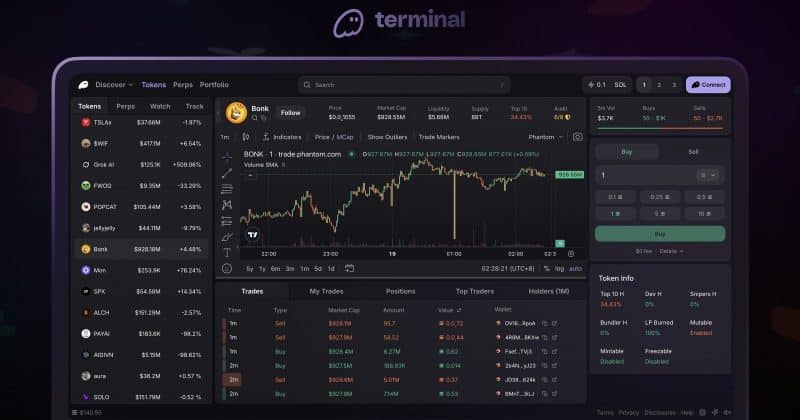
The feed evolves into crypto’s new trading terminal

The feed evolves into crypto’s new trading terminal

Social media platforms are collapsing discovery, analysis, and execution into a single scroll, and it's reshaping how retail investors trade digital assets.

Your timeline is becoming your Bloomberg terminal. That’s the simplest way to describe what’s happening across platforms like X and Robinhood, where the line between scrolling and trading is dissolving faster than a meme coin’s market cap after a rug pull.

The shift is straightforward: instead of bouncing between a social feed for ideas and a separate app to execute trades, platforms are merging those steps into one interface. Tap a ticker symbol in a post, see a live chart, hit buy. The entire pipeline from “hmm, interesting” to “I own that now” is collapsing into seconds.

How we got here

Robinhood kicked the door open in September 2025 with the launch of Robinhood Social. The feature introduced a verified in-app trading feed where users can follow successful traders, view their real-time positions, and execute trades directly from the content they’re consuming.

X took it a step further by February 2026, integrating what amount to trading cards directly into the feed. When users interact with ticker symbols in posts, they can pull up inline price charts, sentiment analytics, and buy/sell options without ever leaving the app.

Advertisement

Not everyone has pulled this off, though. Token.com attempted a similar model, aiming to convert social interactions into one-tap trading terminals. It ceased operations due to adoption challenges. The graveyard of social trading startups is not small, which makes Robinhood and X’s moves more notable. They already have the audiences. They don’t need to convince anyone to download a new app.

Why this matters for crypto specifically

By embedding trading functionality directly into social feeds, platforms are acknowledging this reality and building infrastructure around it. Discovery, social reinforcement, and execution are now happening in a single interface rather than across three different apps.

The competitive implications are worth watching too. These social platforms are positioning themselves as direct competitors to professional trading terminals. If a user can get price data, sentiment analysis, peer validation, and trade execution all within X or Robinhood’s social feed, the case for opening a separate exchange app weakens considerably.

What investors should actually worry about

Execution quality is a real concern. When you trade from a social feed, are you getting the best price? Are you routing through a market maker that’s paying for your order flow? These questions matter, and they become harder to answer when the trading interface is disguised as a content experience.

Regulatory scrutiny is the other elephant in the room. The SEC has spent years wrestling with how to regulate crypto exchanges. Now imagine regulators trying to classify a social media post that doubles as a securities offering.

Then there’s the information quality problem. Social feeds are optimized for engagement, not accuracy. When execution is one tap away from a viral but misleading post, the potential for retail investors to get burned increases meaningfully. The same dynamics that made meme stocks exciting in 2021 also left a lot of people holding bags.

The biggest risk might be the simplest one: confusing ease of access with quality of decision-making. Investors navigating this new landscape will need to treat social trading feeds as one input among many, not as a replacement for actual research.

Disclosure: This article was edited by Editorial Team. For more information on how we create and review content, see our Editorial Policy.

The feed evolves into crypto’s new trading terminal

The feed evolves into crypto’s new trading terminal

Social media platforms are collapsing discovery, analysis, and execution into a single scroll, and it's reshaping how retail investors trade digital assets.

Your timeline is becoming your Bloomberg terminal. That’s the simplest way to describe what’s happening across platforms like X and Robinhood, where the line between scrolling and trading is dissolving faster than a meme coin’s market cap after a rug pull.

The shift is straightforward: instead of bouncing between a social feed for ideas and a separate app to execute trades, platforms are merging those steps into one interface. Tap a ticker symbol in a post, see a live chart, hit buy. The entire pipeline from “hmm, interesting” to “I own that now” is collapsing into seconds.

How we got here

Robinhood kicked the door open in September 2025 with the launch of Robinhood Social. The feature introduced a verified in-app trading feed where users can follow successful traders, view their real-time positions, and execute trades directly from the content they’re consuming.

X took it a step further by February 2026, integrating what amount to trading cards directly into the feed. When users interact with ticker symbols in posts, they can pull up inline price charts, sentiment analytics, and buy/sell options without ever leaving the app.

Advertisement

Not everyone has pulled this off, though. Token.com attempted a similar model, aiming to convert social interactions into one-tap trading terminals. It ceased operations due to adoption challenges. The graveyard of social trading startups is not small, which makes Robinhood and X’s moves more notable. They already have the audiences. They don’t need to convince anyone to download a new app.

Why this matters for crypto specifically

By embedding trading functionality directly into social feeds, platforms are acknowledging this reality and building infrastructure around it. Discovery, social reinforcement, and execution are now happening in a single interface rather than across three different apps.

The competitive implications are worth watching too. These social platforms are positioning themselves as direct competitors to professional trading terminals. If a user can get price data, sentiment analysis, peer validation, and trade execution all within X or Robinhood’s social feed, the case for opening a separate exchange app weakens considerably.

What investors should actually worry about

Execution quality is a real concern. When you trade from a social feed, are you getting the best price? Are you routing through a market maker that’s paying for your order flow? These questions matter, and they become harder to answer when the trading interface is disguised as a content experience.

Regulatory scrutiny is the other elephant in the room. The SEC has spent years wrestling with how to regulate crypto exchanges. Now imagine regulators trying to classify a social media post that doubles as a securities offering.

Then there’s the information quality problem. Social feeds are optimized for engagement, not accuracy. When execution is one tap away from a viral but misleading post, the potential for retail investors to get burned increases meaningfully. The same dynamics that made meme stocks exciting in 2021 also left a lot of people holding bags.

The biggest risk might be the simplest one: confusing ease of access with quality of decision-making. Investors navigating this new landscape will need to treat social trading feeds as one input among many, not as a replacement for actual research.

Disclosure: This article was edited by Editorial Team. For more information on how we create and review content, see our Editorial Policy.