
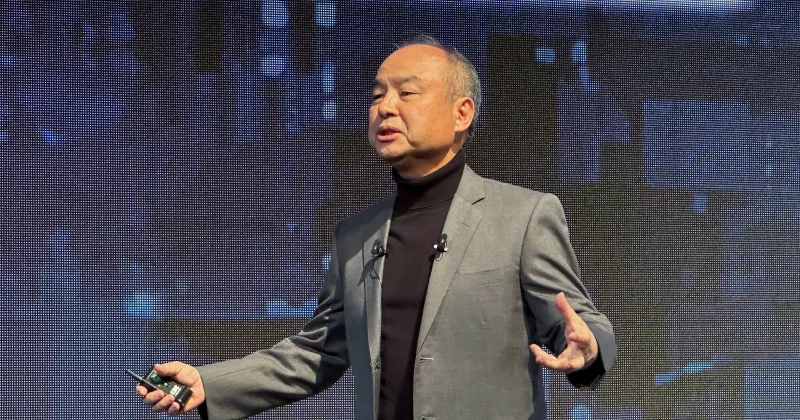
SoftBank surges past Toyota as Son doubles down on AI data centers
After years of bruising losses, Son's massive AI bets have turned SoftBank into Japan's most valuable company and made him a favorite of world leaders.


SoftBank briefly overtook Toyota as Japan’s most valuable company after investors rewarded Masayoshi Son’s aggressive pivot into AI infrastructure.
The Japanese investment group’s shares jumped 14% on June 1 after SoftBank announced plans to build AI data center capacity in France.
The rally lifted SoftBank’s market capitalization to 48.8 trillion yen, above Toyota’s 45.9 trillion yen, marking a major reversal for a company that spent years trying to recover from losses tied to WeWork and other Vision Fund bets.
The France plan is the clearest sign yet that Son is trying to turn SoftBank into a central player in the AI infrastructure buildout. SoftBank said it plans to develop up to 5 GW of AI data center capacity in France, with a first phase focused on 3.1 GW in the Hauts de France region by 2031.
The initial phase is expected to involve about €45 billion in investment over five years. The broader plan could reach €75 billion if additional sites are developed, making it one of Europe’s largest AI infrastructure commitments.
The project includes data center sites in Dunkirk, Bosquel, and Bouchain, with France’s power supply playing a central role in the pitch.
The news moving money, markets, and the world—before your day starts.
Daily. Free. Join 34,000+ readers across crypto, finance, and policy.
AI data centers require enormous amounts of electricity, and France’s nuclear heavy grid gives the country an advantage as governments compete to attract compute infrastructure.
Son has framed the AI boom in characteristically massive terms. In a recent interview, he said the AI revolution could be more than 10 times, and possibly 50 times, bigger than the dot com era, arguing that artificial intelligence represents a fundamental technology shift rather than a temporary market bubble.
SoftBank’s recovery is also tied to OpenAI. The company has committed tens of billions of dollars to the ChatGPT maker, giving it one of the most important private AI stakes in global markets. OpenAI’s rising valuation has helped restore investor confidence in Son’s strategy after years of skepticism.
Arm remains the other key piece of the story. SoftBank still owns a dominant stake in the chip design company, whose architecture powers mobile devices and is becoming more relevant to AI workloads. Together, OpenAI and Arm give SoftBank exposure to both the software and hardware sides of the AI boom.
That combination has changed how investors view the company. SoftBank is no longer being treated only as a volatile venture investor. It is increasingly being valued as a leveraged AI infrastructure platform, with exposure to chips, data centers, models, and compute demand.
The risk is execution. The France project runs through 2031, meaning SoftBank must fund years of infrastructure spending before the full returns are visible. Large AI data center projects also depend on power availability, permitting, customer demand, and the ability to control construction costs.
SoftBank’s debt load adds another pressure point. Son’s strategy depends on the value of holdings such as Arm and OpenAI continuing to support the company’s balance sheet while new AI infrastructure projects absorb capital.