
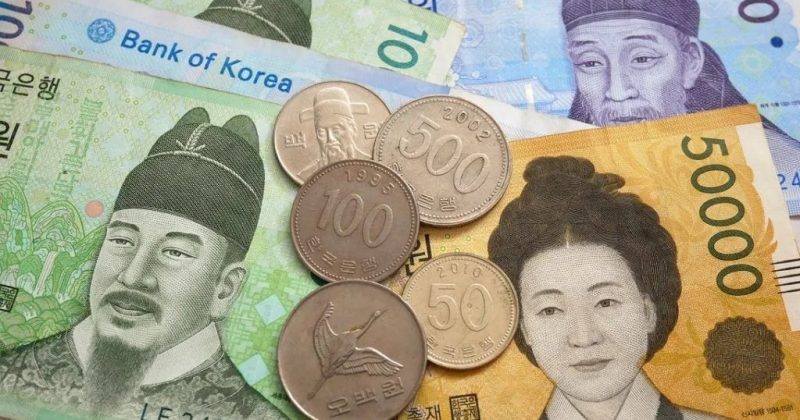
South Korea warns of market actions as won slides to worst-performing Asian currency
Seoul's finance ministry and central bank issue their first joint verbal intervention since December 2025, signaling readiness for decisive measures as the won falls 0.7% against the dollar.
South Korea just pulled out the diplomatic equivalent of clearing your throat very loudly. The country’s finance ministry and the Bank of Korea issued a joint statement on the won’s recent slide against the dollar, calling the currency’s movement “excessive relative to economic fundamentals.”
Here’s the thing: joint statements from a country’s finance ministry and central bank don’t happen casually. This marks the first such coordinated verbal intervention since December 2025, and it signals that Seoul is getting increasingly uncomfortable watching its currency deteriorate while its economic fundamentals tell a completely different story.
What happened to the won
The won fell 0.7% against the dollar on the day of the announcement, making it one of Asia’s worst-performing currencies in that session. The currency briefly recovered after the statement hit the wires, because markets tend to flinch when central banks start talking tough.
That recovery didn’t last. The won resumed its slide shortly after, which tells you something about how much conviction the market has in verbal warnings alone.
The decline is part of a broader worsening trend that has frustrated South Korean authorities for weeks. What makes this particularly puzzling, and presumably irritating for policymakers, is that the country’s current account surplus has been hitting record highs. In a textbook economy, a strong current account surplus should support the domestic currency. South Korea’s won apparently didn’t get that memo.
The disconnect between solid trade numbers and a weakening currency points to other forces at work. Notable foreign investor equity outflows have been a significant factor, with international money flowing out of Korean stocks and putting downward pressure on the won in the process. When foreign investors sell Korean equities and convert won back to dollars, the selling pressure on the currency compounds.
Seoul’s intervention playbook
South Korean authorities have a well-established toolkit for dealing with currency volatility, and they tend to escalate in a fairly predictable sequence. First comes the monitoring. Then comes the verbal warning. Then, if the market doesn’t take the hint, comes direct intervention.
The joint statement explicitly noted that authorities are prepared to “implement decisive measures if market conditions warranted.” In central bank speak, that’s about as close to a threat as you get without actually selling dollars on the open market.
Look, this isn’t new territory for Seoul. South Korea has a long history of stepping into the foreign exchange market when it believes the won is moving in ways that don’t reflect the underlying economy. The country’s approach typically combines verbal jawboning with the credible threat of actual market operations, and sometimes with the operations themselves.
Macro, rates, and crypto—what moved markets and what matters next.
Daily. Free. Join 34,000+ readers across crypto, finance, and policy.
The fact that this is the first joint statement since December 2025 suggests that policymakers had been hoping the situation would resolve itself. It hasn’t. And now they’re signaling that patience is running thin.
The pattern is familiar to anyone who has watched Asian central banks manage currency volatility. Japan’s Ministry of Finance employed similar escalating rhetoric before intervening in yen markets during previous bouts of currency weakness. The logic is the same: talk first, act later, and hope the talking is enough.
Why record surpluses aren’t saving the won
The most interesting part of this story is the gap between South Korea’s trade performance and its currency performance. Record-high current account surpluses should, in theory, create natural demand for the won as exporters convert foreign revenue back into the domestic currency.
But currency markets don’t operate on trade flows alone. Capital account flows, interest rate differentials, and global risk sentiment all play significant roles. And right now, the capital account side of the equation appears to be overwhelming the current account strength.
Foreign investors pulling money out of Korean equities creates a direct channel for won weakness. Each sale of Korean stocks by a foreign fund eventually translates into won being sold for dollars or other currencies. When those outflows are large enough, they can more than offset the supportive effect of a trade surplus.
This creates a frustrating feedback loop for policymakers. Currency weakness makes Korean assets less attractive to foreign investors when measured in dollar terms. That drives more outflows, which weakens the currency further. Breaking that cycle is precisely why authorities feel compelled to step in, or at least threaten to.
What this means for investors
The immediate signal is clear: South Korea’s tolerance for won weakness has limits, and those limits are being tested. For anyone with exposure to Korean assets, the foreign exchange component of returns just became significantly more uncertain in both directions.
If authorities follow through with actual market intervention, the won could strengthen rapidly. South Korea’s foreign exchange reserves give it substantial firepower to defend the currency if it chooses to deploy them. That creates a potential asymmetric setup where the downside in the won may be more limited than the recent trend suggests, simply because there’s a motivated seller of dollars waiting in the wings.
The broader regional implications matter too. When one Asian central bank starts intervening or threatening intervention, it tends to put other central banks on alert. Currency markets in the region are interconnected, and a shift in South Korea’s approach could ripple through other Asian currency pairs.
For crypto markets, the won’s volatility adds another layer of context to the global dollar-strength narrative. A strong dollar environment, which is what won weakness implies from the other side of the trade, has historically created headwinds for risk assets including Bitcoin and other digital assets. If South Korea successfully stabilizes the won, it could signal a broader easing of dollar pressure across Asian markets.
The key variable to watch now is whether verbal intervention proves sufficient or whether the Bank of Korea escalates to direct market operations. History suggests that joint statements buy time but don’t always resolve the underlying dynamics. If foreign equity outflows continue at their current pace, talking tough about the won might not be enough to stop it from sliding further. And that’s when the real intervention begins.