
Nexo Earn with Nexo
S&P 500 drops 2.64% as investors dump tech for healthcare and consumer staples

S&P 500 drops 2.64% as investors dump tech for healthcare and consumer staples

A scorching jobs report and Broadcom's earnings miss triggered the sharpest sector rotation of 2026, dragging Bitcoin below $60K in the process.

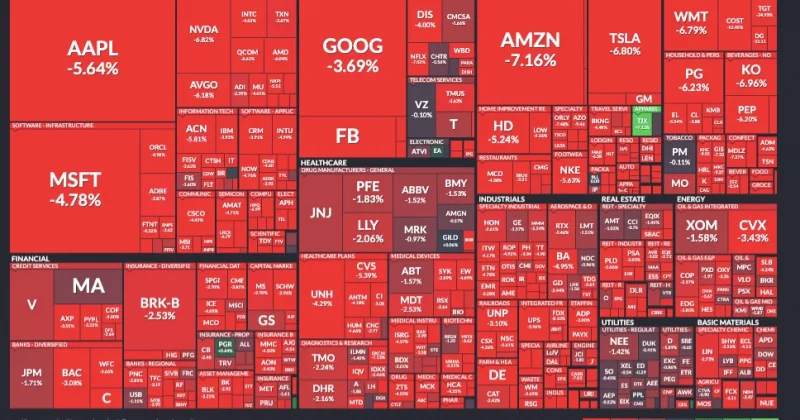
The S&P 500 fell 2.64% on June 5, closing at 7,383.74 in what became the index’s first negative week in ten. The Nasdaq Composite fared even worse, plunging 4.18% to 25,709.43 in its worst single-day performance since April 2025.

The catalyst was a one-two punch: Broadcom delivered earnings guidance that disappointed the market’s appetite for AI chip growth, and a May jobs report landed so hot it made inflation hawks look prescient. The economy added 172,000 jobs versus expectations of 80,000, pushing Treasury yields above 4.5%.

The great rotation: from momentum to defense

Healthcare and consumer staples absorbed a significant share of the capital fleeing tech. Procter & Gamble led the charge with a 5% gain, followed by Colgate-Palmolive at 4%, Coca-Cola at 3%, and Johnson & Johnson at 2%. The healthcare sector ETF XLV posted gains above 1%, while consumer staples broadly climbed more than 2%.

Advertisement

The semiconductor sector absorbed the worst of the damage. The SOXX ETF dropped 10% on the day. Individual names were even uglier: Broadcom (AVGO) fell 8%, Micron (MU) shed 13%, and Marvell Technology (MRVL) cratered more than 16%.

What the jobs report really means

Adding 172,000 jobs when economists expected 80,000 is not a rounding error. It’s a signal that the labor market remains resilient enough to keep the Federal Reserve on the sidelines, or worse, to push rate cut expectations further into the future.

Treasury yields surging above 4.5% reflects that recalibration in real time. Higher yields make future earnings less valuable in present terms, which disproportionately punishes growth stocks whose valuations depend on cash flows years down the road.

Bitcoin catches a cold from tech’s flu

Bitcoin dropped below $60,000 for the first time since late 2024. A move below $60K is psychologically significant. That level had served as a floor for roughly 18 months.

The broader pattern here is the unwinding of AI-driven concentration that defined markets in 2025 and early 2026. A handful of tech and semiconductor stocks drove an outsized share of index returns, and that concentration created fragility. One disappointing earnings report from a bellwether like Broadcom was enough to trigger a cascading reassessment of whether AI valuations had gotten ahead of reality.

Disclosure: This article was edited by Editorial Team. For more information on how we create and review content, see our Editorial Policy.

S&P 500 drops 2.64% as investors dump tech for healthcare and consumer staples

S&P 500 drops 2.64% as investors dump tech for healthcare and consumer staples

A scorching jobs report and Broadcom's earnings miss triggered the sharpest sector rotation of 2026, dragging Bitcoin below $60K in the process.

The S&P 500 fell 2.64% on June 5, closing at 7,383.74 in what became the index’s first negative week in ten. The Nasdaq Composite fared even worse, plunging 4.18% to 25,709.43 in its worst single-day performance since April 2025.

The catalyst was a one-two punch: Broadcom delivered earnings guidance that disappointed the market’s appetite for AI chip growth, and a May jobs report landed so hot it made inflation hawks look prescient. The economy added 172,000 jobs versus expectations of 80,000, pushing Treasury yields above 4.5%.

The great rotation: from momentum to defense

Healthcare and consumer staples absorbed a significant share of the capital fleeing tech. Procter & Gamble led the charge with a 5% gain, followed by Colgate-Palmolive at 4%, Coca-Cola at 3%, and Johnson & Johnson at 2%. The healthcare sector ETF XLV posted gains above 1%, while consumer staples broadly climbed more than 2%.

Advertisement

The semiconductor sector absorbed the worst of the damage. The SOXX ETF dropped 10% on the day. Individual names were even uglier: Broadcom (AVGO) fell 8%, Micron (MU) shed 13%, and Marvell Technology (MRVL) cratered more than 16%.

What the jobs report really means

Adding 172,000 jobs when economists expected 80,000 is not a rounding error. It’s a signal that the labor market remains resilient enough to keep the Federal Reserve on the sidelines, or worse, to push rate cut expectations further into the future.

Treasury yields surging above 4.5% reflects that recalibration in real time. Higher yields make future earnings less valuable in present terms, which disproportionately punishes growth stocks whose valuations depend on cash flows years down the road.

Bitcoin catches a cold from tech’s flu

Bitcoin dropped below $60,000 for the first time since late 2024. A move below $60K is psychologically significant. That level had served as a floor for roughly 18 months.

The broader pattern here is the unwinding of AI-driven concentration that defined markets in 2025 and early 2026. A handful of tech and semiconductor stocks drove an outsized share of index returns, and that concentration created fragility. One disappointing earnings report from a bellwether like Broadcom was enough to trigger a cascading reassessment of whether AI valuations had gotten ahead of reality.

Disclosure: This article was edited by Editorial Team. For more information on how we create and review content, see our Editorial Policy.