
Nexo Earn with Nexo
S&P 500’s largest stocks reach record 41% of market cap, raising concentration risk alarms

S&P 500’s largest stocks reach record 41% of market cap, raising concentration risk alarms

The top 10 US stocks now command an unprecedented share of the index, with mega-cap tech and AI names driving a level of concentration that should make passive investors uncomfortable.

Ten companies now control 41% of the entire S&P 500’s market capitalization. That is not a typo, and it is not normal.

The index, which theoretically represents the broad US stock market across 500 companies, has become a vehicle where roughly one in every $2.50 invested rides on the performance of just ten names.

The numbers behind the concentration

The S&P 500 represented more than $61.1 trillion in total market capitalization as of December 31, 2025. That means the top 10 stocks alone account for roughly $25 trillion in value.

Look at the individual weightings and the picture gets even more striking. Nvidia sits at the top with a 7.17% weighting and a market cap of $5.412 trillion. Alphabet follows at 6.39%, worth $4.663 trillion. Apple holds 5.86%.

Advertisement

These three companies alone represent nearly a fifth of the entire index. Add in Microsoft, Amazon, Meta, Broadcom, and a handful of others, and you get to 41%.

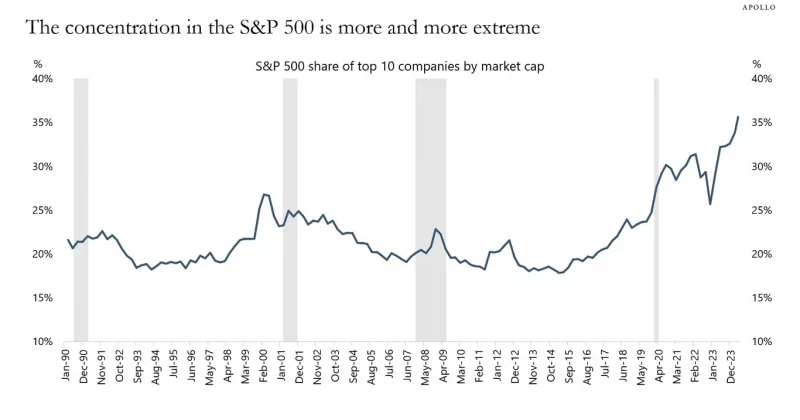
Historical data shows a consistent increase in the top 10’s share of the S&P 500 over time, with the pace accelerating in recent years, fueled by the AI investment boom and the earnings power of companies building the infrastructure for it.

Why this happened and why it matters

Two forces are at work here: genuine earnings growth and valuation expansion.

The mega-cap tech companies dominating the top of the index are generating enormous profits. Nvidia’s revenue growth has been extraordinary. Alphabet and Meta have monetized digital advertising at scale while investing heavily in AI. Microsoft has embedded AI across its product suite. Amazon’s cloud business continues to expand.

Valuation expansion has also played a significant role. When markets get excited about a secular trend like AI, capital floods into the perceived winners. That drives prices higher, which increases their index weighting, which forces passive funds to buy even more of them. It’s a self-reinforcing loop that concentrates the index further with each cycle.

What this means for investors

For passive investors, the implications are significant. If you bought an S&P 500 index fund because you wanted broad market exposure, you should understand what you actually own. You own a portfolio where 41% of your money is concentrated in 10 stocks, most of which operate in overlapping sectors and face correlated risks.

Consider the risk factors these companies share. They are all sensitive to interest rate policy, since higher rates compress the valuations of growth stocks. They all face increasing regulatory scrutiny across multiple jurisdictions. Several of them are making massive capital expenditure bets on AI infrastructure that need to pay off over time.

Equal-weight versions of the S&P 500, which give the same allocation to every stock regardless of size, have historically diverged from the cap-weighted version during periods of extreme concentration. That divergence is a useful barometer. When it widens, it signals that a small group of stocks is doing the heavy lifting.

Disclosure: This article was edited by Editorial Team. For more information on how we create and review content, see our Editorial Policy.

S&P 500’s largest stocks reach record 41% of market cap, raising concentration risk alarms

S&P 500’s largest stocks reach record 41% of market cap, raising concentration risk alarms

The top 10 US stocks now command an unprecedented share of the index, with mega-cap tech and AI names driving a level of concentration that should make passive investors uncomfortable.

Ten companies now control 41% of the entire S&P 500’s market capitalization. That is not a typo, and it is not normal.

The index, which theoretically represents the broad US stock market across 500 companies, has become a vehicle where roughly one in every $2.50 invested rides on the performance of just ten names.

The numbers behind the concentration

The S&P 500 represented more than $61.1 trillion in total market capitalization as of December 31, 2025. That means the top 10 stocks alone account for roughly $25 trillion in value.

Look at the individual weightings and the picture gets even more striking. Nvidia sits at the top with a 7.17% weighting and a market cap of $5.412 trillion. Alphabet follows at 6.39%, worth $4.663 trillion. Apple holds 5.86%.

Advertisement

These three companies alone represent nearly a fifth of the entire index. Add in Microsoft, Amazon, Meta, Broadcom, and a handful of others, and you get to 41%.

Historical data shows a consistent increase in the top 10’s share of the S&P 500 over time, with the pace accelerating in recent years, fueled by the AI investment boom and the earnings power of companies building the infrastructure for it.

Why this happened and why it matters

Two forces are at work here: genuine earnings growth and valuation expansion.

The mega-cap tech companies dominating the top of the index are generating enormous profits. Nvidia’s revenue growth has been extraordinary. Alphabet and Meta have monetized digital advertising at scale while investing heavily in AI. Microsoft has embedded AI across its product suite. Amazon’s cloud business continues to expand.

Valuation expansion has also played a significant role. When markets get excited about a secular trend like AI, capital floods into the perceived winners. That drives prices higher, which increases their index weighting, which forces passive funds to buy even more of them. It’s a self-reinforcing loop that concentrates the index further with each cycle.

What this means for investors

For passive investors, the implications are significant. If you bought an S&P 500 index fund because you wanted broad market exposure, you should understand what you actually own. You own a portfolio where 41% of your money is concentrated in 10 stocks, most of which operate in overlapping sectors and face correlated risks.

Consider the risk factors these companies share. They are all sensitive to interest rate policy, since higher rates compress the valuations of growth stocks. They all face increasing regulatory scrutiny across multiple jurisdictions. Several of them are making massive capital expenditure bets on AI infrastructure that need to pay off over time.

Equal-weight versions of the S&P 500, which give the same allocation to every stock regardless of size, have historically diverged from the cap-weighted version during periods of extreme concentration. That divergence is a useful barometer. When it widens, it signals that a small group of stocks is doing the heavy lifting.

Disclosure: This article was edited by Editorial Team. For more information on how we create and review content, see our Editorial Policy.