
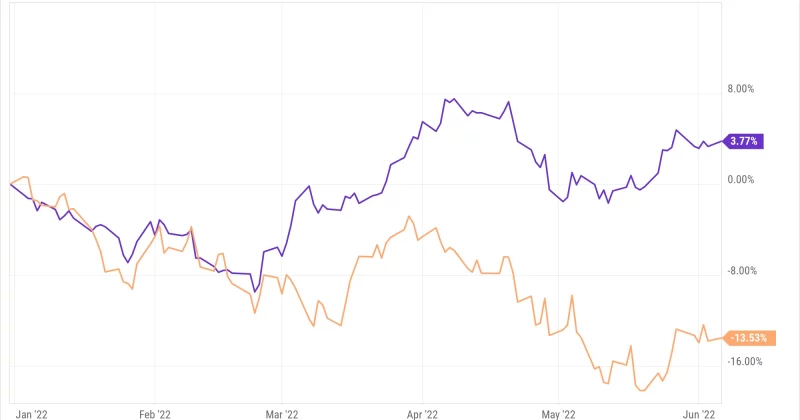
S&P 500 Utilities sector hits record low ratio of 0.06 against the broader index

S&P 500 Utilities sector hits record low ratio of 0.06 against the broader index

The defensive stalwart of American investing has never been this overshadowed, and the AI boom deserves most of the blame.

The S&P 500 Utilities sector’s performance ratio against the broader index has fallen to 0.06. The once-reliable defensive sector has never been this small relative to the market it belongs to.

Defensive sectors including utilities have reached multi-decade low weightings within the S&P 500 as investor capital floods into growth-oriented companies. The S&P 500 Utilities Select Sector ETF, known by its ticker XLU, has underperformed relative to tech-driven market gains, a trend that has accelerated as AI narratives continue to dominate Wall Street’s attention.

Advertisement

Consumer staples, another traditionally defensive sector, finds itself in a similar predicament.

The historical playbook for utilities

Historical trends show the sector typically underperforms during strong growth markets. Previous cycles saw utilities lag growth sectors by meaningful but manageable margins. A ratio of 0.06 against the S&P 500 suggests this isn’t just a normal rotation out of defensives. It’s a structural repricing of where investors believe value creation is happening.

Historically, utilities have rebounded effectively during cycles of interest rate cuts. When the economy slows and central banks start easing monetary policy, defensive sectors have looked attractive again. That pattern has played out reliably across multiple market cycles.

What this means for investors

Investors who hold broad S&P 500 index funds are now overwhelmingly exposed to technology and growth themes whether they intended to be or not. The defensive buffer that utilities and similar sectors traditionally provided has been diluted to the point of near-irrelevance within cap-weighted portfolios.

Any shift toward rate cuts would historically favor utilities and other yield-sensitive sectors.

Disclosure: This article was edited by Editorial Team. For more information on how we create and review content, see our Editorial Policy.

S&P 500 Utilities sector hits record low ratio of 0.06 against the broader index

S&P 500 Utilities sector hits record low ratio of 0.06 against the broader index

The defensive stalwart of American investing has never been this overshadowed, and the AI boom deserves most of the blame.

The S&P 500 Utilities sector’s performance ratio against the broader index has fallen to 0.06. The once-reliable defensive sector has never been this small relative to the market it belongs to.

Defensive sectors including utilities have reached multi-decade low weightings within the S&P 500 as investor capital floods into growth-oriented companies. The S&P 500 Utilities Select Sector ETF, known by its ticker XLU, has underperformed relative to tech-driven market gains, a trend that has accelerated as AI narratives continue to dominate Wall Street’s attention.

Advertisement

Consumer staples, another traditionally defensive sector, finds itself in a similar predicament.

The historical playbook for utilities

Historical trends show the sector typically underperforms during strong growth markets. Previous cycles saw utilities lag growth sectors by meaningful but manageable margins. A ratio of 0.06 against the S&P 500 suggests this isn’t just a normal rotation out of defensives. It’s a structural repricing of where investors believe value creation is happening.

Historically, utilities have rebounded effectively during cycles of interest rate cuts. When the economy slows and central banks start easing monetary policy, defensive sectors have looked attractive again. That pattern has played out reliably across multiple market cycles.

What this means for investors

Investors who hold broad S&P 500 index funds are now overwhelmingly exposed to technology and growth themes whether they intended to be or not. The defensive buffer that utilities and similar sectors traditionally provided has been diluted to the point of near-irrelevance within cap-weighted portfolios.

Any shift toward rate cuts would historically favor utilities and other yield-sensitive sectors.

Disclosure: This article was edited by Editorial Team. For more information on how we create and review content, see our Editorial Policy.