
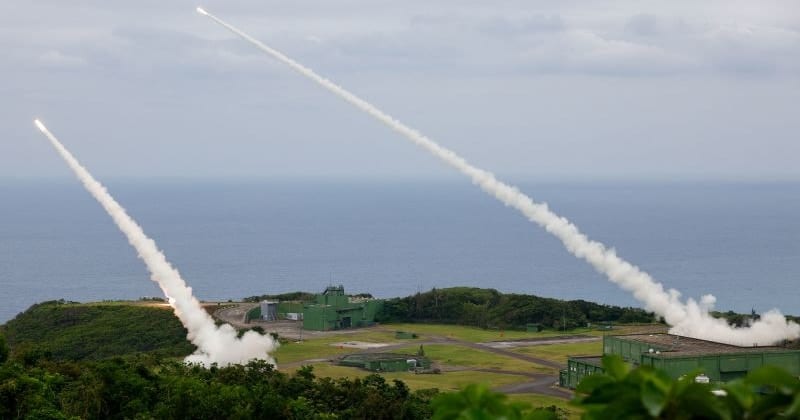
Taiwan test-fires US-supplied HIMARS missile launchers into waters facing China
The island's first live-fire exercise with American-made rocket systems sends 36 rockets into the Taiwan Strait, escalating an already tense geopolitical standoff with implications for global risk assets.
Taiwan launched 36 rockets from US-supplied High Mobility Artillery Rocket Systems (HIMARS) into the Taiwan Strait on June 10, marking the first time the island has live-fired American-made missile launchers in waters directly facing China.
The truck-mounted launchers were stationed along Taiwan’s western coast, positioned near sites that military planners have long identified as probable invasion landing zones.
What Taiwan just demonstrated
HIMARS is a mobile rocket launcher mounted on a truck chassis, designed to fire precision-guided munitions and then relocate before the enemy can return fire. It has a 300-kilometer reach, putting targets in China’s Fujian province squarely within striking distance.
Taiwan has procured 29 of these systems from the US as part of an asymmetric defense strategy: investing in mobile, hard-to-find weapons that make any invasion attempt prohibitively expensive for the aggressor.
An earlier live-fire HIMARS exercise took place on May 12, 2025, but that test didn’t carry the same symbolic weight as firing directly into strait waters that separate Taiwan from mainland China.
The news moving money, markets, and the world—before your day starts.
Daily. Free. Join 34,000+ readers across crypto, finance, and policy.
Taiwan’s broader military buildup
Taiwan’s defense budget has climbed to over 3% of GDP. On the missile front, Taiwan aims to grow its anti-ship missile inventory to more than 1,800 units by 2029.
Part of that buildup includes 450 Boeing Harpoon missiles that Taiwan secured in early June 2026, with an additional 400 units in the delivery pipeline.
The layered approach combines mobile land-based rocket systems like HIMARS, a deep stockpile of anti-ship missiles, and a developing layered air-and-missile defense network prioritizing rapid-response capabilities and coastal defense positions.
Why crypto investors should pay attention
Taiwan produces the vast majority of the world’s advanced semiconductors. A military escalation in the Taiwan Strait would send shockwaves through every asset class that depends on global supply chains.
Crypto markets have historically reacted to geopolitical shocks in unpredictable ways. Bitcoin has at various points been treated as both a risk-on asset and a safe-haven asset depending on the severity and nature of the crisis.