
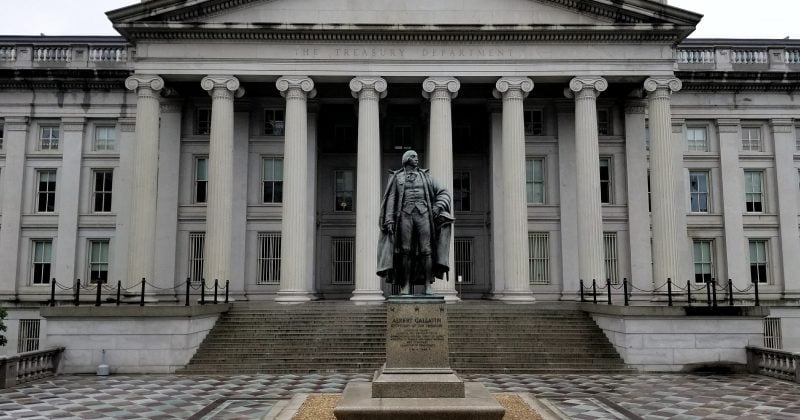
https://en.wikipedia.org/wiki/Treasury_Building_(Washington,_D.C.)
Tariff refunds push US June budget deficit to $120B
June inflation US - annual
The U.S. budget deficit for June 2026 reached $120 billion, driven primarily by substantial tariff refunds. These refunds, totaling approximately $22 billion, were the result of a Supreme Court ruling in February 2026 that invalidated tariffs imposed under the International Emergency Economic Powers Act by former President Donald Trump. As a consequence, there was a significant reversal in customs revenue, effectively nullifying collections for May and June. This development has pushed the fiscal year 2026 cumulative deficit to $1.373 trillion, with projections nearing $2 trillion for the year. The national debt, now standing at around $39.2 trillion, is accompanied by interest costs surpassing defense spending for the first time since World War II.
Key Takeaways
- The increase in the U.S. budget deficit appears to be driven by tariff refunds mandated by a Supreme Court ruling.
- Market pricing suggests that the larger deficit may indicate economic weakness, potentially affecting inflation forecasts.
- Current market odds for annual inflation being 3.6% or less in June are at 1.1% YES, reflecting uncertainty in meeting lower inflation targets.
What to Watch
Markets are closely monitoring the upcoming U.S. Consumer Price Index (CPI) release, scheduled for July 14, 2026. The impact of the budget deficit on inflation expectations is a key focus, with the Federal Reserve and the Bureau of Labor Statistics playing crucial roles in shaping economic outlooks. Any revisions in inflation forecasts or policy shifts by the Federal Open Market Committee (FOMC) could influence market perceptions and pricing dynamics. Further developments in energy prices and import data will also be crucial indicators for potential shifts in inflation expectations.