
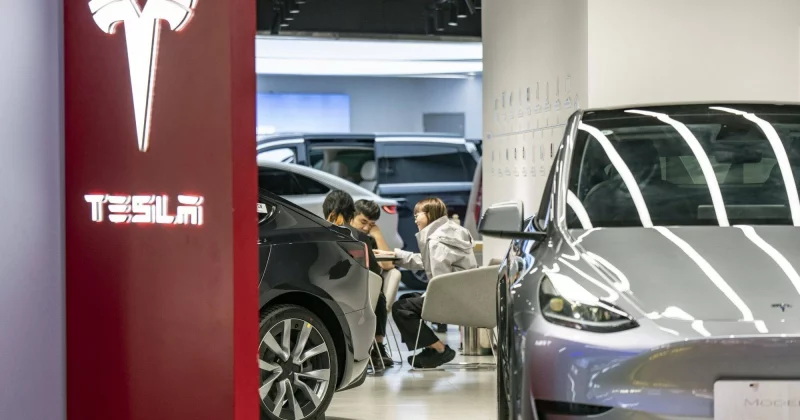
Tesla’s FSD launch in China intensifies competition with local EV makers
Tesla's autonomous driving system arrives in the world's largest EV market, but Chinese competitors say they've already built something better.
Tesla just entered what might be the most competitive autonomous driving market on the planet. The company launched its Full Self-Driving system in China in early 2025, rebranded locally as “Intelligent Assisted Driving,” and immediately walked into a knife fight with domestic players who have been sharpening their blades for years.
Here’s the thing: this isn’t a market where Tesla gets to play the role of disruptive newcomer bringing alien technology to the masses. Chinese EV makers like XPeng, Li Auto, and NIO have already built advanced autonomous driving systems specifically tuned for the chaotic, dense, and often unpredictable conditions of Chinese roads. Tesla is showing up to a party that started without it.
The lay of the land
Tesla’s FSD, operating as a Level 2 system in China, requires drivers to keep their hands on the wheel and their attention on the road. That’s the same classification as many competing systems already deployed across the country. The distinction matters because Level 2 means the car assists but doesn’t drive itself, a far cry from the robotaxi future Elon Musk has been promising for years.
XPeng’s president Brian Gu has been openly dismissive of Tesla’s competitive position in this space. He claimed that Chinese autonomous driving technologies already outperform Tesla’s FSD in local Chinese traffic situations. Whether that’s corporate trash talk or a genuine assessment, XPeng is backing it up with an aggressive roadmap. The company anticipates achieving Level 3 autonomy on Chinese roads within 2 years and Level 4 within 4 years.
For context, Level 3 means the car can handle most driving tasks without human intervention in certain conditions. Level 4 means it can do nearly everything on its own. If XPeng hits those targets, it would leapfrog Tesla’s current offering by a significant margin.
Then there’s Momenta, a name most Western investors haven’t heard but probably should. The company’s Mpilot system holds a dominant 60.1% share of China’s NOA ADAS market from January 2023 to October 2024. NOA, or Navigate on Autopilot, is the feature set that handles highway and city driving with minimal human input. In English: the company most Americans have never heard of already owns more than half of China’s advanced driver-assistance market.
Tesla’s sales momentum tells a complicated story
Tesla isn’t exactly struggling in China. In April, China-made Tesla sales reached 79,478 units, a 36% year-over-year increase. That’s a meaningful rebound that suggests the brand still carries weight with Chinese consumers, even amid growing nationalist sentiment around buying domestic.
But the month-over-month picture is less rosy. April sales declined 7.2% compared to the previous month, hinting that the initial excitement around recent price adjustments and the FSD rollout may already be cooling. Sustained growth in China requires more than periodic sales bumps. It requires winning the technology narrative.
And that narrative is increasingly being written by Chinese companies. The domestic EV industry has framed autonomous driving as one of the defining AI competitions between the US and China. Industry leaders see this not just as a car feature but as a proxy war for technological supremacy. When XPeng and others talk about beating Tesla’s FSD, they’re not just selling cars. They’re selling national pride.
The regulatory maze
China’s regulatory environment adds another layer of complexity. The country maintains strict controls over mapping data, a critical input for autonomous driving systems. Foreign companies like Tesla face additional scrutiny around data collection and storage, which can limit how quickly they iterate on their systems compared to domestic competitors who don’t face the same restrictions.
Tesla’s decision to rebrand FSD as “Intelligent Assisted Driving” for the Chinese market wasn’t just a marketing choice. It reflects the regulatory reality that Chinese authorities are cautious about systems that might overstate their capabilities to consumers. The Level 2 classification keeps expectations grounded and liability clear.
This regulatory framework has actually benefited Chinese companies. While Tesla navigated years of negotiations to bring FSD to China, domestic players were already deploying and refining their systems on local roads, collecting the real-world driving data that makes autonomous systems smarter over time. That head start in data collection could prove more valuable than any single technological advantage.
What this means for investors
For anyone watching the EV and autonomous driving space, China is the market that matters most. It’s the world’s largest EV market by volume, and the competition there will likely determine which companies and which technological approaches define the next decade of transportation.
Tesla’s FSD launch gives it a new feature to market in China, but it enters a landscape where Momenta already commands over 60% of the advanced driver-assistance market and XPeng is publicly setting timelines to surpass Level 2 entirely. The competitive moat Tesla enjoys in the US and Europe simply doesn’t exist in China.
The risk for Tesla is that China becomes a proving ground where its technology is benchmarked against, and potentially outperformed by, cheaper domestic alternatives. Chinese EV makers have consistently shown a willingness to undercut on price while matching or exceeding on technology. If FSD doesn’t deliver a noticeably superior experience on Chinese roads, it becomes just another feature in an increasingly crowded field.
Watch XPeng’s Level 3 timeline closely. If the company delivers on its 2-year promise, it would fundamentally shift the competitive dynamics, not just in China but globally, as Chinese automakers increasingly export their vehicles and technology to Southeast Asia, Europe, and beyond.