

Nexo Earn with Nexo
Tokenized RWA market reaches $31B, up 46% year-to-date as government bonds dominate

Tokenized RWA market reaches $31B, up 46% year-to-date as government bonds dominate

Government debt instruments now account for more than 60% of all tokenized real-world assets, with US bonds alone surpassing $15B on-chain.


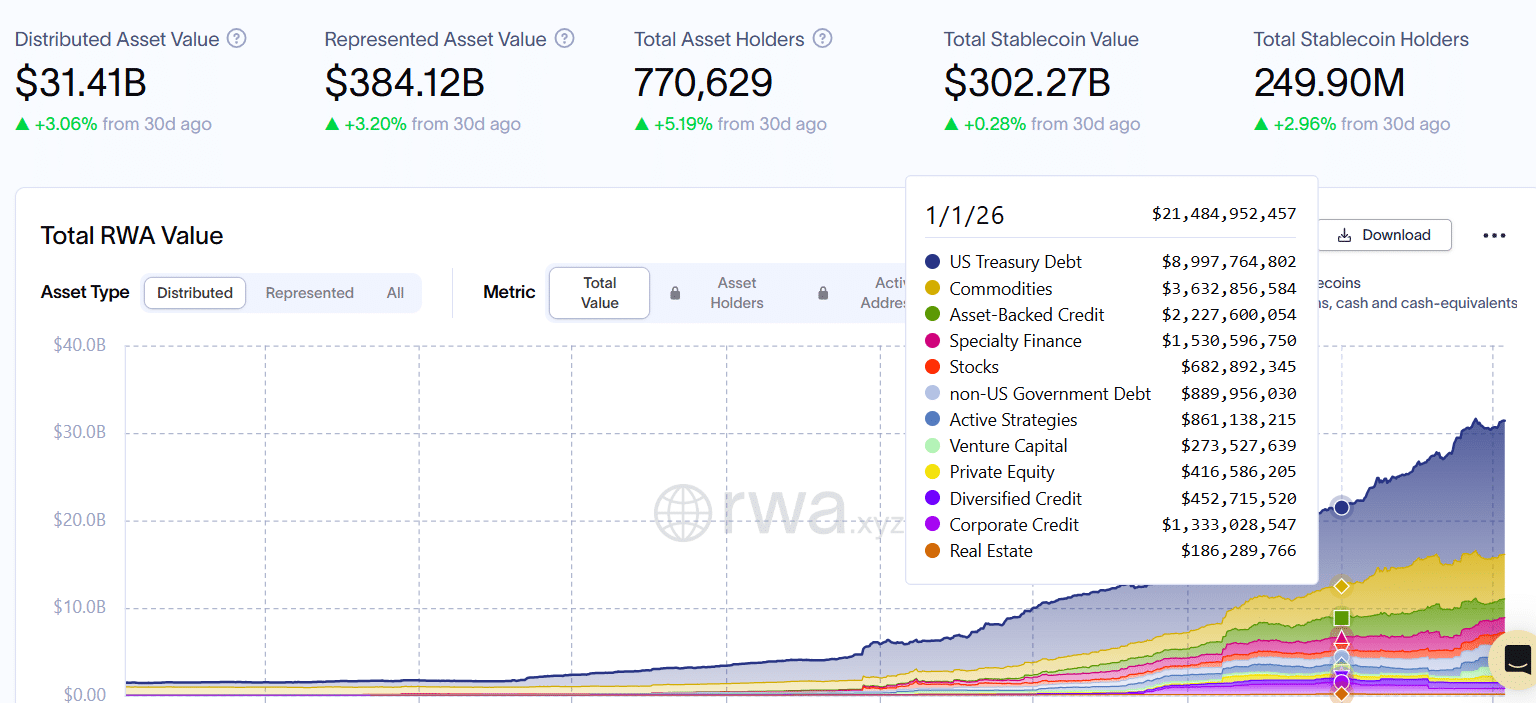
The value of tokenized real-world assets has climbed above $31 billion, increasing 46% since January, with growth concentrated on blockchain-based representations of government securities and other traditional assets, according to RWA.xyz.
Tokenized RWA market reaches $31B, up 44% year-to-date as government bonds dominate

Government bonds are running the show

US Treasury debt continues to lead the tokenized RWA market. As of the latest data, government-related debt has surpassed $15 billion, making up the largest share of the $31 billion market.

Advertisement

The remaining market breaks down across several asset classes, including private credit, institutional funds, commodities, followed by stocks and real estate.

Why institutions are participating

The traditional settlement cycle for US Treasuries is T+1. On-chain, settlement is effectively instantaneous. Tokenized treasuries can be used as collateral in DeFi protocols, traded 24/7, and transferred in minutes. For institutions managing large pools of liquidity, this efficiency is a meaningful advantage.

Improving regulatory clarity in key jurisdictions has also reduced compliance barriers, encouraging greater institutional participation.

What this means for investors

Analysts estimate the total addressable market for tokenized assets could exceed $10 trillion by 2030. At the current $31 billion level, the industry has captured roughly 0.3% of that potential.

Secondary market liquidity remains a challenge. Many tokenized RWA products still trade with limited depth, creating a gap between the promise of liquidity and actual exit opportunities.

Cross-border regulatory complexity adds further friction. A tokenized US Treasury held by an investor in one country and traded on a protocol in another can involve multiple overlapping legal frameworks that are still largely national in scope.

Tokenized treasuries offering real-world yields have already begun competing directly with DeFi lending protocols as a preferred low-risk yield source, putting downward pressure on native DeFi rates and pushing projects to differentiate beyond yield alone.

Disclosure: This article was edited by Editorial Team. For more information on how we create and review content, see our Editorial Policy.

Tokenized RWA market reaches $31B, up 46% year-to-date as government bonds dominate

Tokenized RWA market reaches $31B, up 46% year-to-date as government bonds dominate

Government debt instruments now account for more than 60% of all tokenized real-world assets, with US bonds alone surpassing $15B on-chain.

Share

Add us on Google

The value of tokenized real-world assets has climbed above $31 billion, increasing 46% since January, with growth concentrated on blockchain-based representations of government securities and other traditional assets, according to RWA.xyz.

Tokenized RWA market reaches $31B, up 44% year-to-date as government bonds dominate

Government bonds are running the show

US Treasury debt continues to lead the tokenized RWA market. As of the latest data, government-related debt has surpassed $15 billion, making up the largest share of the $31 billion market.

Advertisement

The remaining market breaks down across several asset classes, including private credit, institutional funds, commodities, followed by stocks and real estate.

Why institutions are participating

The traditional settlement cycle for US Treasuries is T+1. On-chain, settlement is effectively instantaneous. Tokenized treasuries can be used as collateral in DeFi protocols, traded 24/7, and transferred in minutes. For institutions managing large pools of liquidity, this efficiency is a meaningful advantage.

Improving regulatory clarity in key jurisdictions has also reduced compliance barriers, encouraging greater institutional participation.

What this means for investors

Analysts estimate the total addressable market for tokenized assets could exceed $10 trillion by 2030. At the current $31 billion level, the industry has captured roughly 0.3% of that potential.

Secondary market liquidity remains a challenge. Many tokenized RWA products still trade with limited depth, creating a gap between the promise of liquidity and actual exit opportunities.

Cross-border regulatory complexity adds further friction. A tokenized US Treasury held by an investor in one country and traded on a protocol in another can involve multiple overlapping legal frameworks that are still largely national in scope.

Tokenized treasuries offering real-world yields have already begun competing directly with DeFi lending protocols as a preferred low-risk yield source, putting downward pressure on native DeFi rates and pushing projects to differentiate beyond yield alone.

Disclosure: This article was edited by Editorial Team. For more information on how we create and review content, see our Editorial Policy.