
Trump administration directs prosecutors to halt Venezuela probes
The directive to cease investigations into Venezuelan leadership signals a major shift in US-Venezuela relations, with potential ripple effects for crypto markets tied to the sanctioned nation.
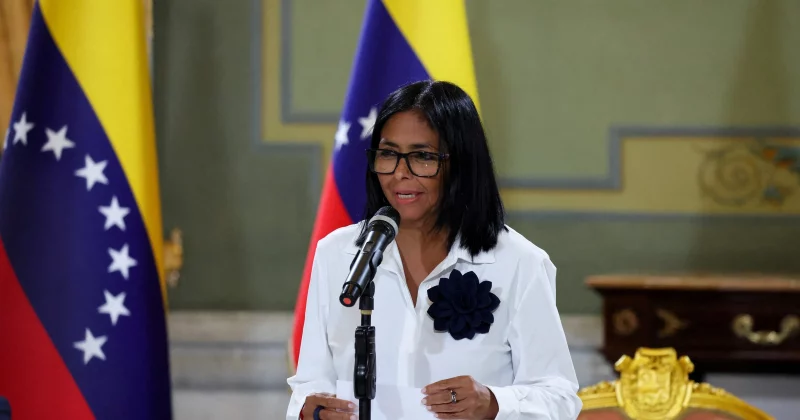
The Trump administration has instructed federal prosecutors in Miami to stop pursuing criminal investigations into Delcy Rodríguez, the acting President of Venezuela. The move represents a sharp pivot in US policy toward the South American nation, one that could reshape the geopolitical calculus around Venezuelan digital assets and sanctions enforcement.
This isn’t happening in a vacuum. The directive follows the dramatic US military capture of former Venezuelan President Nicolás Maduro on January 3, 2026, an operation that removed a figure who had been the primary target of American narco-terrorism enforcement for years. Maduro and his wife have pleaded not guilty to narco-terrorism charges in a New York federal court.
What’s actually happening
Federal prosecutors in Miami had opened a probe into Maduro’s government around March 2026, roughly two months after his capture. The investigation’s scope included Rodríguez, who has been a long-term focus of the Drug Enforcement Administration.
Now, the administration is telling those same prosecutors to stand down. The reasoning appears strategic rather than exculpatory: stabilize Venezuela in the post-Maduro era rather than prosecute every member of the old regime.
The directive effectively creates a two-track approach: prosecute Maduro to the fullest extent of US law while simultaneously extending an olive branch to the government that replaced him.
The crypto angle Venezuela can’t escape
Venezuela’s relationship with digital assets is one of the more fascinating case studies in state-sponsored crypto adoption. The country launched its Petro (PTR) token back in February 2018, explicitly designed to circumvent US sanctions targeting its oil sector and central bank.
The Petro was supposed to be Venezuela’s escape hatch from economic isolation. It was backed, at least in theory, by the country’s oil reserves. In practice, adoption was limited. US prohibitions made it radioactive for international traders, and domestic trust in any government-issued financial instrument was, to put it politely, low.
Venezuela has also become one of the more active markets for USDT (Tether) in Latin America, driven by hyperinflation that made the bolívar essentially useless for savings. Venezuelan authorities have also turned to USDT particularly for oil transactions. Any shift in the sanctions landscape would affect how freely those transactions can flow through compliant exchanges.
What this means for investors
The more substantive question is whether this directive is a one-off concession or the beginning of a systematic easing of Venezuela-related restrictions. If it’s the latter, compliant crypto platforms operating in Latin America could see increased volume from Venezuelan users who’ve been locked out of mainstream financial rails.
Any perceived softening on narco-terrorism enforcement could trigger congressional pushback, which might result in new legislative restrictions that affect crypto’s role in sanctions evasion. The compliance landscape around Venezuelan transactions is already complex.
The Maduro trial in New York will be the real barometer of how serious the administration is about its dual-track approach. If that prosecution moves forward aggressively while Rodríguez-related probes stay frozen, it confirms the strategic calculation: punish the past, negotiate with the present.