
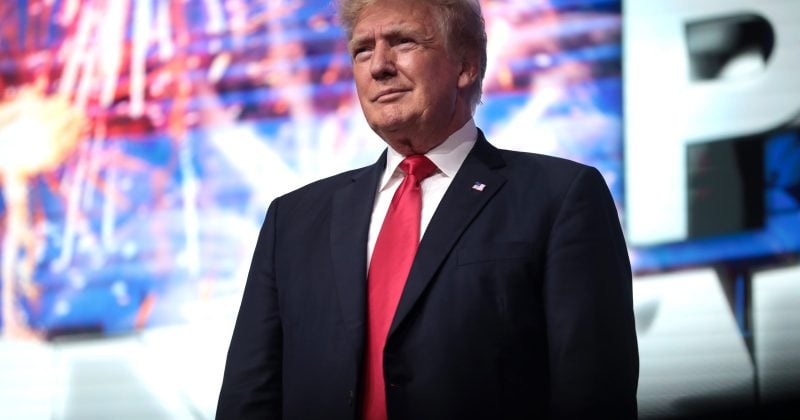
Trump accuses China of seeking total control over crypto and AI

Trump accuses China of seeking total control over crypto and AI

The president's national security framing lands alongside fresh disclosures showing the Trump family earned roughly $1.2B from crypto in 2025

President Donald Trump went on offense against China this week, framing the US-China rivalry in terms most crypto markets haven’t heard from the Oval Office quite so directly before. “We have to be at the top, otherwise China’s going to take it over,” Trump said during a July 2 interview, adding that the US is “number one in crypto, and we’re also number one in AI.” The remarks landed with particular weight given the timing: financial disclosures filed around June 30 revealed the Trump family earned approximately $1.2B from crypto ventures in 2025 alone.

The geopolitical argument, and what’s behind it

China has banned private cryptocurrency trading and mining domestically while aggressively developing its own state-controlled digital currency, the e-CNY. Beijing’s approach is essentially the opposite of Bitcoin’s founding philosophy: centralized, surveilled, and government-issued.

Trump’s former AI and crypto czar David Sacks made a similar argument repeatedly before departing his role, warning that Chinese dominance in both AI and digital assets posed a structural threat to US economic influence.

Advertisement

The GENIUS Act, passed in July 2025, established a regulatory framework for stablecoins. A Strategic Bitcoin Reserve was also created via executive order, signaling that Washington views Bitcoin less as a speculative curiosity and more as a sovereign asset worth holding. China, meanwhile, is pushing e-CNY adoption through state channels while maintaining its ban on the kind of permissionless crypto activity that defines most of the Western market. The two countries are also tangled in broader tech rivalry across semiconductors, AI model access, and export controls.

The conflict-of-interest problem hiding in plain sight

The same disclosures that surfaced Trump’s $1.2B crypto earnings show that roughly $550M of that figure came from World Liberty Financial token sales. The Trump family holds approximately 22.5 billion WLFI tokens through an entity called DT Marks Defi, a position valued at around $1.3B.

When a president argues that the US must dominate crypto for national security reasons, and that same president holds a ten-figure position in a crypto token, the line between policy advocacy and portfolio management becomes genuinely difficult to draw. The administration has not made new policy announcements specifically addressing those concerns.

What this means for markets and investors

Trump’s remarks do not contain new regulatory specifics. Stablecoin issuers operating under the GENIUS Act framework arguably benefit most directly from the current policy environment.

The WLFI token itself is worth watching given the scale of the Trump family’s disclosed position. Any policy development that materially affects World Liberty Financial’s business model, positively or negatively, now has an unusual degree of proximity to the executive branch.

What to watch: the pace of GENIUS Act implementation, any executive action expanding or modifying the Strategic Bitcoin Reserve, and whether Congress moves on broader crypto market structure legislation before the next election cycle.

Disclosure: This article was edited by Editorial Team. For more information on how we create and review content, see our Editorial Policy.

Trump accuses China of seeking total control over crypto and AI

Trump accuses China of seeking total control over crypto and AI

The president's national security framing lands alongside fresh disclosures showing the Trump family earned roughly $1.2B from crypto in 2025

President Donald Trump went on offense against China this week, framing the US-China rivalry in terms most crypto markets haven’t heard from the Oval Office quite so directly before. “We have to be at the top, otherwise China’s going to take it over,” Trump said during a July 2 interview, adding that the US is “number one in crypto, and we’re also number one in AI.” The remarks landed with particular weight given the timing: financial disclosures filed around June 30 revealed the Trump family earned approximately $1.2B from crypto ventures in 2025 alone.

The geopolitical argument, and what’s behind it

China has banned private cryptocurrency trading and mining domestically while aggressively developing its own state-controlled digital currency, the e-CNY. Beijing’s approach is essentially the opposite of Bitcoin’s founding philosophy: centralized, surveilled, and government-issued.

Trump’s former AI and crypto czar David Sacks made a similar argument repeatedly before departing his role, warning that Chinese dominance in both AI and digital assets posed a structural threat to US economic influence.

Advertisement

The GENIUS Act, passed in July 2025, established a regulatory framework for stablecoins. A Strategic Bitcoin Reserve was also created via executive order, signaling that Washington views Bitcoin less as a speculative curiosity and more as a sovereign asset worth holding. China, meanwhile, is pushing e-CNY adoption through state channels while maintaining its ban on the kind of permissionless crypto activity that defines most of the Western market. The two countries are also tangled in broader tech rivalry across semiconductors, AI model access, and export controls.

The conflict-of-interest problem hiding in plain sight

The same disclosures that surfaced Trump’s $1.2B crypto earnings show that roughly $550M of that figure came from World Liberty Financial token sales. The Trump family holds approximately 22.5 billion WLFI tokens through an entity called DT Marks Defi, a position valued at around $1.3B.

When a president argues that the US must dominate crypto for national security reasons, and that same president holds a ten-figure position in a crypto token, the line between policy advocacy and portfolio management becomes genuinely difficult to draw. The administration has not made new policy announcements specifically addressing those concerns.

What this means for markets and investors

Trump’s remarks do not contain new regulatory specifics. Stablecoin issuers operating under the GENIUS Act framework arguably benefit most directly from the current policy environment.

The WLFI token itself is worth watching given the scale of the Trump family’s disclosed position. Any policy development that materially affects World Liberty Financial’s business model, positively or negatively, now has an unusual degree of proximity to the executive branch.

What to watch: the pace of GENIUS Act implementation, any executive action expanding or modifying the Strategic Bitcoin Reserve, and whether Congress moves on broader crypto market structure legislation before the next election cycle.

Disclosure: This article was edited by Editorial Team. For more information on how we create and review content, see our Editorial Policy.