
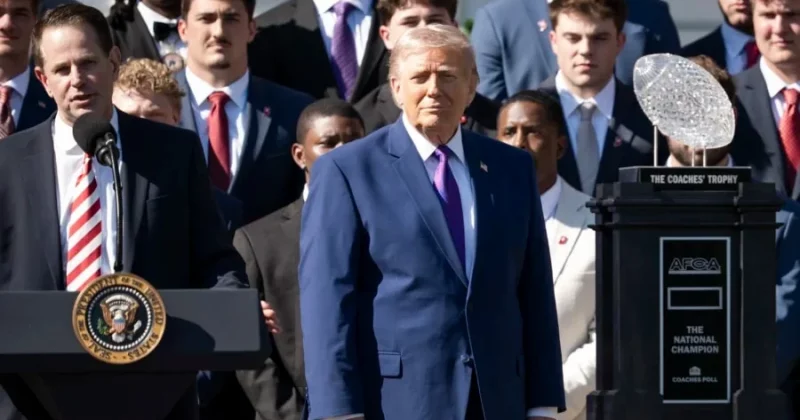
President Trump leads delegation of top business executives to China in first presidential visit since 2017
A roster of billionaires and crypto-adjacent CEOs are joining the president on a trip that could reshape trade, tech, and digital asset policy.
President Trump is heading to China on May 14-15 with a delegation of 16 to 17 top business executives in tow. It’s the first US presidential visit to the country in nearly a decade, and the guest list reads like a who’s who of American corporate power.
Tesla’s Elon Musk, Apple, BlackRock’s Larry Fink, Boeing, and Citigroup are among the names making the trip. Five of the billionaires in the delegation have a combined net worth of roughly $870 billion.
Why crypto investors should pay attention
Approximately 40% of the executives in the delegation have ties to digital assets. Bitcoin rose 2% following the delegation announcement on May 11.
BlackRock’s Fink has become one of the most influential figures in institutional crypto adoption, having shepherded the firm’s spot Bitcoin ETF into existence and repeatedly shifted his public stance on digital assets from skepticism to full-throated endorsement.
The bigger picture: tariffs, tech, and tension
The delegation was originally supposed to be announced in March 2026 but was delayed due to the US-Iran conflict.
Trade negotiations are expected to cover agriculture, aviation, and semiconductors. For crypto specifically, that means mining hardware. China still dominates the global supply chain for the specialized chips and equipment that power Bitcoin mining operations. Any agreement that eases technology tariffs could meaningfully reduce operational costs for US-based mining firms, which have been squeezed by rising hardware prices and post-halving economics.
The news moving money, markets, and the world—before your day starts.
Daily. Free. Join 34,000+ readers across crypto, finance, and policy.
Taiwan is home to TSMC, the world’s most important semiconductor manufacturer. Any escalation or de-escalation around Taiwan has direct implications for the chip supply chain that underpins both traditional tech and crypto mining infrastructure.
Trump’s last visit to China came in 2017, during the early stages of what would become a prolonged trade war.
What this means for investors
Experts have suggested that successful negotiations could boost institutional flows into crypto products.
The 2% Bitcoin move on the announcement alone hints at how sensitive the market is to these geopolitical signals.
Investors should also watch for any signals around stablecoin regulation or digital payment infrastructure. China has been aggressively developing its digital yuan, and any bilateral discussion about digital currencies could shift the regulatory landscape in ways that ripple through DeFi and stablecoin markets.