
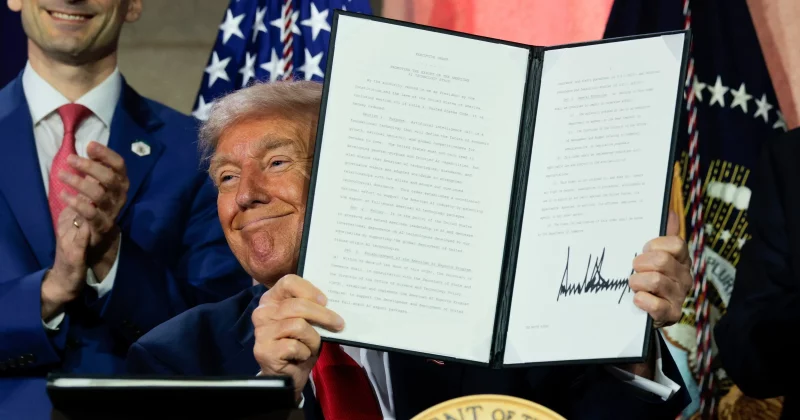
Trump plans executive order giving government early access to advanced AI models
AI companies would be required to share their most powerful models with federal agencies 90 days before the public ever sees them.
The Trump administration is preparing an executive order that would require AI companies to hand over their most advanced models to the US government a full 90 days before releasing them to the public. Think of it as a mandatory test drive for Washington before anyone else gets the keys.
The policy, if enacted, would represent one of the most direct interventions into the AI development pipeline by any administration. For an White House that has spent much of 2025 tearing down regulatory barriers around AI, requiring a three-month government preview window is a notable pivot toward more hands-on oversight.
What the early-access requirement actually means
The 90-day pre-release window would give federal agencies time to evaluate advanced AI models before they hit the market. In English: the government wants first dibs on poking around inside the most powerful AI systems being built, ostensibly to assess safety risks and national security implications.
This isn’t about regulating chatbots that write your cover letters. The focus is on “advanced models,” which typically means frontier systems, the kind pushing the boundaries of what AI can do. The ones that keep AI safety researchers up at night.
For AI developers, the compliance burden could be significant. A 90-day hold means longer timelines to market, additional infrastructure for government access, and potential friction around proprietary technology and trade secrets. Companies racing to ship products in a hyper-competitive landscape would suddenly need to build a government review period into their roadmaps.
The practical mechanics of how this would work, who exactly reviews the models, what criteria they’re evaluated against, and what happens if the government flags concerns, are the kinds of details that will determine whether this becomes a meaningful oversight mechanism or an administrative speed bump.
The contradiction at the heart of Trump’s AI agenda
Here’s the thing. The Trump administration has spent much of 2025 positioning itself as the most pro-AI government in American history. Executive Order 14179, signed earlier this year, was explicitly focused on strengthening US leadership in artificial intelligence and revising policies the administration considered obstructive to innovation.
The broader strategy has been clear: accelerate AI development, eliminate regulatory barriers, and ensure American companies maintain their edge over Chinese competitors. The administration has even gone so far as to actively challenge state laws that it views as interfering with federal AI policy.
The news moving money, markets, and the world—before your day starts.
Daily. Free. Join 34,000+ readers across crypto, finance, and policy.
So requiring companies to pause for 90 days before releasing their most advanced work sits in interesting tension with the “move fast and break things” ethos. It’s a bit like a parent who removes all the guardrails from the playground but insists on inspecting the swings personally before any kid can use them.
The administration would likely frame this not as regulation but as partnership. Government early access, in theory, could help identify risks before they become public crises, give national security agencies time to prepare for new capabilities, and ensure AI development stays aligned with federal priorities. Whether AI companies see it that way is another question entirely.
A separate directive from July 2025 offers some clues about the administration’s thinking. That order stressed that federally procured AI models should be “truth-seeking” and “ideologically neutral.” Together with the proposed early-access requirement, a pattern emerges: the administration wants to shape what AI looks like before it reaches the public, not just react after the fact.
What this means for investors
The immediate question for anyone with money in AI-adjacent stocks, funds, or tokens is whether a 90-day government review window meaningfully changes the competitive dynamics of the AI industry.
For the largest companies, like those already working closely with defense and intelligence agencies, this may barely register. Many frontier AI developers already have government relationships and security clearances. Adding a formal preview window formalizes what, in some cases, is already happening informally.
The real pressure falls on smaller AI companies and startups that lack the infrastructure, legal teams, and government relationships to navigate a mandatory federal review process. If you’re a lean AI lab trying to compete with well-resourced giants, adding 90 days and a government compliance layer to every major release is a meaningful disadvantage. This policy could, intentionally or not, widen the moat around incumbents.
There’s also the question of what happens to open-source AI development. If the requirement applies broadly to “advanced models,” open-source projects pushing frontier capabilities could find themselves caught in a regulatory framework designed for commercial products. That tension hasn’t been addressed yet.
For crypto markets specifically, the direct impact appears limited. No specific tokens or blockchain-based AI projects have been referenced in connection with this policy. But the broader signal matters: the US government is becoming more assertive about controlling the flow of powerful AI technology, and any AI-crypto crossover projects should be watching how this unfolds carefully. A government that insists on previewing AI models before release could eventually extend similar thinking to AI agents operating in financial systems, including decentralized ones.
The competitive landscape between the US and China adds another dimension. If American AI companies face a 90-day delay that Chinese competitors don’t, that’s a tangible disadvantage in a race where weeks matter. The administration will need to convince the industry that the security benefits outweigh the speed costs, and that’s a harder sell than any executive order can mandate on its own.