
Trump to defend leaked Iran deal at G7 summit press conference
A leaked interim agreement promising reopened oil flows and sanctions relief is dominating the G7 summit in France, with markets already pricing in the implications.
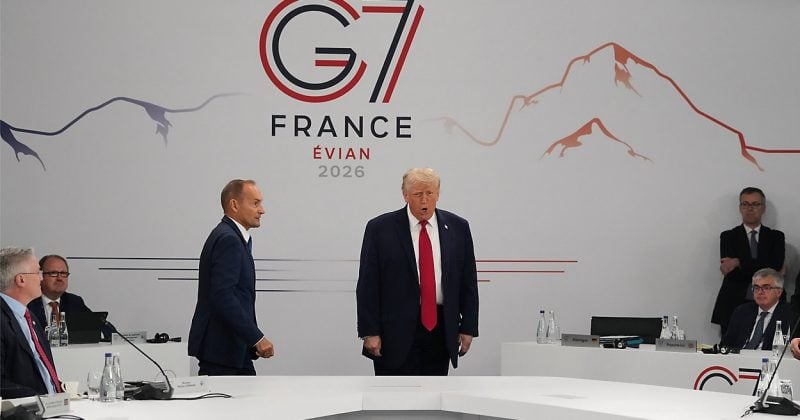
President Donald Trump is set to take the podium at the G7 summit in Évian-les-Bains, France, to publicly defend an interim agreement between the US and Iran that was never supposed to go public this early.
The leaked deal, which surfaced on June 17, outlines a framework for immediate de-escalation between Washington and Tehran. The centerpiece: Iran reopens the Strait of Hormuz and resumes unrestricted oil sales. In return, the US commits to pursuing the end of sanctions, contingent on a final nuclear agreement being reached.
What the leaked deal actually says
Phase one: Iran would reopen the Strait of Hormuz, a chokepoint through which roughly a fifth of the world’s oil supply passes daily. Alongside that, Tehran gets the green light to resume unrestricted oil sales to global markets.
Phase two: The US would move toward lifting sanctions on Iran, but only if both sides reach a comprehensive nuclear deal.
Trump has disputed some of the leaked terms, calling certain reported provisions inaccurate. He hasn’t specified which ones. The press conference at the summit is expected to be his venue for setting the record straight, and possibly revealing the full text of the agreement.
G7 leaders have rallied behind the framework. A joint statement issued on June 17 described the plan as a “breakthrough” and praised Trump’s leadership, with fellow heads of state signaling their readiness to assist with implementation.
The news moving money, markets, and the world—before your day starts.
Daily. Free. Join 34,000+ readers across crypto, finance, and policy.
The geopolitical backdrop
This framework didn’t emerge in a vacuum. It follows a period of sharply escalated tensions between Washington and Tehran, driven by prior US actions against Iran and a fragile ceasefire.
Trump has leaned heavily into the economic narrative, suggesting the deal could lead to meaningfully lower oil prices and improvements across global markets. Oil prices have already started declining in response to the leaked terms.
A formal signing ceremony is planned for June 19-20 in Switzerland. Trump’s personal attendance remains uncertain, with Vice President JD Vance potentially stepping in as the US representative at the signing table.
What this means for investors
More Iranian oil hitting global markets means downward pressure on crude prices. Lower energy costs tend to benefit equities broadly, particularly in sectors where fuel is a major input cost: airlines, logistics, manufacturing, agriculture.
The cautious case centers on execution risk. The enforcement mechanisms for this agreement remain unclear. Global leaders and analysts have raised questions about how compliance will be verified and what happens if either side deviates from the framework before a final nuclear deal is reached.
There’s also the issue of conditionality. Iran gets immediate economic relief through oil sales, while the US commitment to lift sanctions is contingent on a future agreement that doesn’t exist yet. If negotiations toward a final nuclear deal stall or collapse, the interim arrangement enters a gray zone where Iran is selling oil freely but sanctions remain technically in place.
Traders should also keep an eye on the Switzerland signing ceremony. If Trump attends personally, it signals maximum political commitment. If Vance goes instead, markets may interpret it as a hedge.