
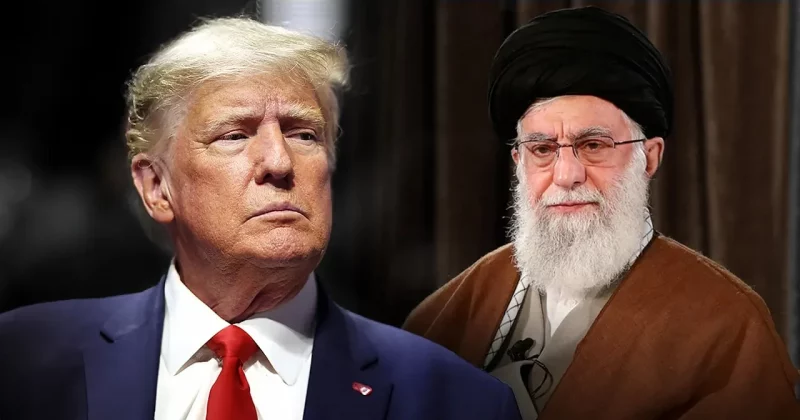
Trump says Iran talks on borderline between deal and strikes, and crypto markets are watching
The president's oscillating signals on Iran negotiations inject fresh geopolitical uncertainty into risk markets already navigating tariff chaos.
President Donald Trump told reporters Wednesday that negotiations with Tehran are “on the borderline” between reaching a diplomatic deal and resuming military strikes against Iran. That single sentence carries enough weight to move oil futures, rattle equities, and send Bitcoin into one of its familiar geopolitical-uncertainty dances.
The comment came just two days after Trump announced he had called off a planned strike on Iran to give diplomats more room to work. Since then, his public statements have swung between cautious optimism about an agreement and blunt threats of renewed military action. For traders parsing every word for directional clues, it has been an exhausting 72 hours.
What’s actually on the table
The broad strokes of a potential deal would reportedly involve Iran agreeing to curtail its nuclear program in exchange for sanctions relief and other concessions. Think of it as the geopolitical version of a term sheet where both sides keep leaking different versions to the press.
Iran’s negotiating team has put forward a proposal calling for broader regional de-escalation, sanctions relief, and the withdrawal of US forces from certain areas. That is a maximalist opening bid by any standard.
At the same time, Iranian officials have publicly warned that any American attack would trigger a “decisive military response.” This is standard deterrence language, but it takes on a different flavor when the US president is openly describing the situation as a coin flip between diplomacy and bombs.
Here’s the thing: the inconsistency isn’t necessarily accidental. Trump has long used unpredictability as a negotiating tactic, keeping counterparts guessing about which version of US policy they’ll wake up to on any given morning. Whether that approach works with Tehran, a government with its own deep bench of brinkmanship expertise, remains very much an open question.
Why crypto traders should care about Persian Gulf diplomacy
Geopolitical shocks, particularly those involving major oil-producing nations, ripple through every asset class. Crypto is no exception, despite the persistent myth that Bitcoin exists in some kind of macro-proof bubble.
The transmission mechanism is straightforward. A military escalation with Iran would almost certainly spike oil prices, which feeds into inflation expectations, which influences central bank rate decisions, which directly impacts risk appetite across the board. Bitcoin and Ethereum don’t trade in a vacuum. They trade in the same universe where fund managers decide how much risk they want on any given day.
There’s also a more direct channel. Sanctions are a core piece of any Iran deal or non-deal outcome. Tighter sanctions historically push affected nations and their trading partners toward alternative payment systems, and crypto has been part of that conversation for years. A collapse in negotiations could intensify enforcement actions around sanctions evasion, potentially dragging compliant exchanges and DeFi protocols into a more aggressive regulatory posture.
Conversely, a successful deal that lifts or eases sanctions could reduce some of the regulatory pressure around cross-border crypto flows. Neither outcome is certain, which is precisely the problem for anyone trying to position around it.
Look, Bitcoin has historically shown two distinct responses to geopolitical stress. In acute, surprise escalations, it tends to sell off alongside other risk assets as traders scramble for cash. In prolonged uncertainty, it sometimes attracts flows from investors who view it as a hedge against institutional instability. The Iran situation is currently in the ambiguous middle zone where either dynamic could take hold.
The broader risk landscape
This Iran uncertainty doesn’t exist in isolation. Markets are simultaneously processing ongoing tariff negotiations, a Federal Reserve that has signaled patience on rate cuts, and a global economy sending mixed signals on growth. Adding a potential Middle East military conflict to that cocktail doesn’t exactly calm nerves.
Oil markets are the most direct barometer. Any sustained disruption to shipping through the Strait of Hormuz, through which roughly a fifth of the world’s oil supply passes, would send crude prices sharply higher. That scenario may seem extreme, but it’s exactly the kind of tail risk that keeps portfolio managers up at night and drives demand for uncorrelated assets.
For the crypto market specifically, the key variable to watch isn’t the Iran headlines themselves but how traditional markets react to them. If equity volatility spikes and credit spreads widen, expect Bitcoin to face selling pressure in the short term regardless of any “digital gold” narrative. The correlation between Bitcoin and the S&P 500 during acute stress events has been stubbornly positive over the past several years.
The more interesting question is what happens if this limbo persists for weeks. Extended geopolitical uncertainty has a way of reshuffling portfolio allocations at the margins, and even a small percentage of global capital rotating into Bitcoin as a hedge could move the needle on price. Institutional investors have been gradually building crypto exposure, and some of them explicitly cite geopolitical hedging as part of their thesis.
What investors should watch: the next concrete signal from either Washington or Tehran about whether talks are progressing or collapsing. Trump’s “borderline” framing suggests we could be days, not weeks, from a resolution in one direction or another. In the meantime, expect elevated volatility across risk assets, with crypto taking its cues from the same macro forces driving everything else.