
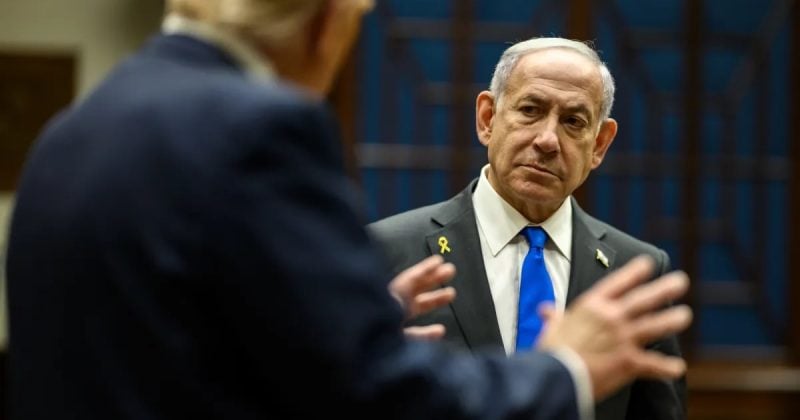
Trump tells Netanyahu to pull Israeli forces from Syria and Lebanon, and Bitcoin is paying attention

Trump tells Netanyahu to pull Israeli forces from Syria and Lebanon, and Bitcoin is paying attention

The US president's push for Israeli military redeployment is sending ripples through crypto markets as traders weigh de-escalation against persistent Middle East uncertainty.

President Donald Trump has told Israeli Prime Minister Benjamin Netanyahu to redeploy Israeli forces out of Syria and Lebanon. The directive marks a significant shift in US diplomatic posture toward the region, and crypto markets are already reacting.

Bitcoin saw a 5% spike above $64K on initial hopes of de-escalation before retreating below $63K as regional uncertainty continued.

What Trump is actually asking for

The request is straightforward on its surface: pull Israeli troops back from positions in Syria and Lebanon. In practice, it’s anything but simple.

Israel has maintained a military presence in southern Lebanon and parts of Syria as part of its broader strategy to counter Hezbollah and Iranian influence in the region. Israeli officials have confirmed their intent to maintain that presence, which means Trump’s directive puts Washington and Jerusalem on a potential collision course.

Advertisement

Trump has framed the move as an assertion of US leadership over regional dynamics. His June comments included the characteristically blunt declaration, “I call the shots,” in reference to how responses to Iranian activities should be coordinated.

“I call the shots.”

The broader proposal on the table involves replacing Israeli military positions with local forces, including potential involvement from the Lebanese Army or Syrian forces.

Why Bitcoin cares about troop movements in Lebanon

The initial 5% Bitcoin price jump above $64K reflected a straightforward thesis: if the US successfully pushes Israel toward de-escalation, the odds of a broader regional conflict drop. Traders bought the rumor.

Then reality crept in. Israeli officials pushed back on the redeployment timeline. Bitcoin slid back below $63K.

No other crypto assets were notably cited in connection with the geopolitical developments, which reinforces Bitcoin’s unique position as the asset most sensitive to macro and geopolitical catalysts.

The diplomatic chess match underneath

For Israel, the calculus is different. Southern Lebanon isn’t just a piece of territory. It’s a buffer zone against Hezbollah, which has been a primary security threat for decades. Pulling forces back without ironclad guarantees about what replaces them is a non-starter for most Israeli security planners.

What this means for investors

The 5% swing in Bitcoin around this single diplomatic development illustrates the asset’s sensitivity to geopolitical news. The gap between Bitcoin at $64K and Bitcoin below $63K closed in days, not weeks.

If the US-backed security arrangements actually gain traction and local forces credibly replace Israeli positions, that represents a genuine de-escalation signal. If Netanyahu effectively ignores the redeployment request and Israeli operations in Syria and Lebanon continue or expand, the diplomatic friction between the US and Israel itself becomes a new source of uncertainty.

Disclosure: This article was edited by Editorial Team. For more information on how we create and review content, see our Editorial Policy.

Trump tells Netanyahu to pull Israeli forces from Syria and Lebanon, and Bitcoin is paying attention

Trump tells Netanyahu to pull Israeli forces from Syria and Lebanon, and Bitcoin is paying attention

The US president's push for Israeli military redeployment is sending ripples through crypto markets as traders weigh de-escalation against persistent Middle East uncertainty.

President Donald Trump has told Israeli Prime Minister Benjamin Netanyahu to redeploy Israeli forces out of Syria and Lebanon. The directive marks a significant shift in US diplomatic posture toward the region, and crypto markets are already reacting.

Bitcoin saw a 5% spike above $64K on initial hopes of de-escalation before retreating below $63K as regional uncertainty continued.

What Trump is actually asking for

The request is straightforward on its surface: pull Israeli troops back from positions in Syria and Lebanon. In practice, it’s anything but simple.

Israel has maintained a military presence in southern Lebanon and parts of Syria as part of its broader strategy to counter Hezbollah and Iranian influence in the region. Israeli officials have confirmed their intent to maintain that presence, which means Trump’s directive puts Washington and Jerusalem on a potential collision course.

Advertisement

Trump has framed the move as an assertion of US leadership over regional dynamics. His June comments included the characteristically blunt declaration, “I call the shots,” in reference to how responses to Iranian activities should be coordinated.

“I call the shots.”

The broader proposal on the table involves replacing Israeli military positions with local forces, including potential involvement from the Lebanese Army or Syrian forces.

Why Bitcoin cares about troop movements in Lebanon

The initial 5% Bitcoin price jump above $64K reflected a straightforward thesis: if the US successfully pushes Israel toward de-escalation, the odds of a broader regional conflict drop. Traders bought the rumor.

Then reality crept in. Israeli officials pushed back on the redeployment timeline. Bitcoin slid back below $63K.

No other crypto assets were notably cited in connection with the geopolitical developments, which reinforces Bitcoin’s unique position as the asset most sensitive to macro and geopolitical catalysts.

The diplomatic chess match underneath

For Israel, the calculus is different. Southern Lebanon isn’t just a piece of territory. It’s a buffer zone against Hezbollah, which has been a primary security threat for decades. Pulling forces back without ironclad guarantees about what replaces them is a non-starter for most Israeli security planners.

What this means for investors

The 5% swing in Bitcoin around this single diplomatic development illustrates the asset’s sensitivity to geopolitical news. The gap between Bitcoin at $64K and Bitcoin below $63K closed in days, not weeks.

If the US-backed security arrangements actually gain traction and local forces credibly replace Israeli positions, that represents a genuine de-escalation signal. If Netanyahu effectively ignores the redeployment request and Israeli operations in Syria and Lebanon continue or expand, the diplomatic friction between the US and Israel itself becomes a new source of uncertainty.

Disclosure: This article was edited by Editorial Team. For more information on how we create and review content, see our Editorial Policy.