
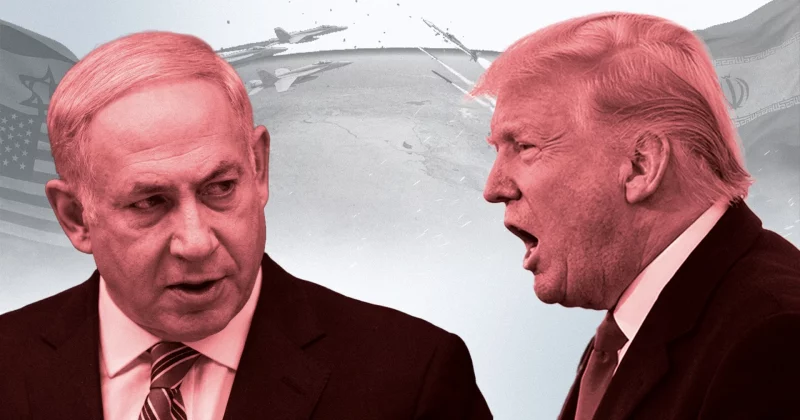
Trump informs Netanyahu of mediation efforts to draft framework ending US-Iran conflict
Qatar and Pakistan are reportedly brokering a ceasefire framework that would open a month-long negotiation window covering Iran's nuclear program, the Strait of Hormuz, and frozen assets.
President Trump has told Israeli Prime Minister Benjamin Netanyahu that mediators are actively drafting a framework intended to formally end the ongoing US-Iran conflict. The effort, led by Qatar and Pakistan, centers on what’s being described as a letter of intent or memorandum of understanding that would kick off a month-long negotiation period.
The stakes here extend well beyond the Middle East. A resolution, or the failure to reach one, carries implications for global energy markets, food prices, and the broader geopolitical chessboard that crypto markets have become increasingly sensitive to.
What the framework actually covers
The proposed negotiation period would tackle three critical issues: Iran’s nuclear program, the reopening of the Strait of Hormuz, and the release of frozen Iranian assets.
For anyone unfamiliar with why a narrow waterway matters so much, here’s the context. The Strait of Hormuz is essentially the bottleneck through which a massive share of the world’s oil supply flows. Its blockage doesn’t just spike crude prices. It could trigger a global food price crisis, since energy costs ripple through every link in agricultural supply chains.
Trump reportedly described his recent call with Netanyahu as “difficult,” which in diplomatic language usually means the two sides aren’t exactly seeing eye to eye on the ceasefire terms. That characterization alone signals the complexity of what mediators are trying to pull off.
Qatar and Pakistan are playing the broker role here. Qatar has long positioned itself as a neutral intermediary in Middle Eastern conflicts, having previously facilitated talks between the US and the Taliban. Pakistan’s involvement adds a nuclear-state dimension to the mediation, given its own complicated history with both Iran and the US.
No deal yet, and threats are still flying
Here’s the thing: no final agreement has been reached. What exists right now is a framework for talking, not a framework for peace.
That distinction matters enormously. Iran’s Islamic Revolutionary Guard Corps has explicitly threatened to expand the war if US or Israeli attacks continue. That’s not subtle posturing. The IRGC is one of the most powerful military organizations in the Middle East, and when it signals escalation, regional markets listen.
The conditional nature of Iran’s threat creates a fragile dynamic. Any incident, whether a drone strike, a proxy attack, or even a miscommunication, could collapse the mediation effort before negotiations formally begin. Think of it as trying to build a bridge while both sides are still lobbing grenades at each other.
The month-long negotiation window, if it materializes, would need to produce measurable progress on benchmarks related to Iran’s nuclear activities. That’s arguably the hardest piece of the puzzle. Iran’s nuclear program has been a point of international contention for over two decades, surviving multiple rounds of sanctions, one landmark deal (the JCPOA), and the subsequent US withdrawal from that deal.
Reopening the Strait of Hormuz would likely be the most immediately impactful outcome for global markets. Energy traders have been pricing in disruption risk since the conflict escalated, and any credible path to normalizing shipping routes would relieve pressure across commodity markets.
The frozen Iranian assets represent another thorny negotiation point. The exact figures involved have been a matter of debate for years, but the sums are substantial enough to serve as both leverage and incentive in any deal structure.
What this means for markets and investors
Geopolitical risk has become one of the most reliable drivers of crypto market volatility over the past two years. Bitcoin, once pitched as uncorrelated to traditional markets, has shown increasing sensitivity to macro shocks, particularly those involving energy prices and dollar liquidity.
A successful ceasefire framework could ease global risk premiums. Lower oil prices would reduce inflationary pressure, which in turn could give central banks more room to maintain or even loosen monetary policy. That’s the kind of environment where risk assets, crypto included, tend to perform well.
The flip side is equally important. If mediation collapses and the IRGC follows through on its escalation threats, the resulting supply shock in energy markets could trigger a flight to safety that historically has not favored volatile assets like crypto. Gold and US Treasuries tend to absorb that capital first.
For crypto investors specifically, the Strait of Hormuz situation is worth monitoring closely. A prolonged blockage wouldn’t just affect oil. It would strain global trade infrastructure in ways that could accelerate interest in alternative payment rails and settlement systems, a narrative that has historically boosted blockchain-adjacent assets.
The “difficult” nature of the Trump-Netanyahu call also introduces a variable that markets haven’t fully priced in: the possibility that the US and Israel aren’t aligned on ceasefire terms. If Israel perceives any deal as too favorable to Iran, it could act independently, a scenario that would dramatically alter the risk calculus regardless of what mediators produce on paper.
Investors should watch for two signals in the coming weeks. First, whether the letter of intent actually gets signed, converting talk of a framework into a formal negotiation timeline. Second, whether the IRGC’s rhetoric shifts from threats of escalation to something resembling restraint. Until both of those conditions are met, this remains a situation where the downside risks are at least as significant as the upside potential.