
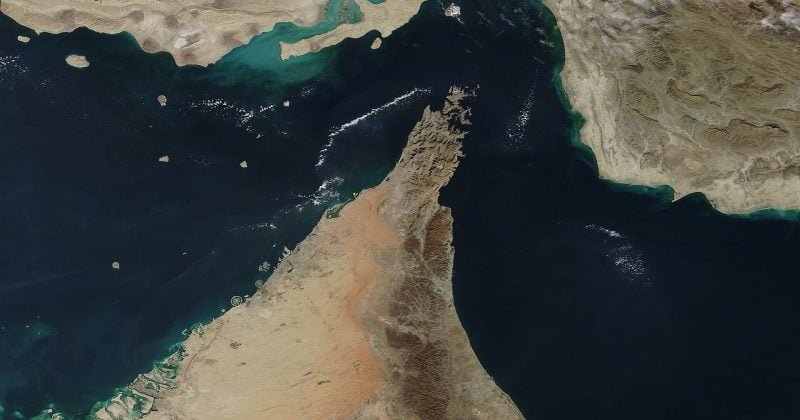
Trump announces naval blockade of Strait of Hormuz as oil prices spike and crypto markets brace for impact

Trump announces naval blockade of Strait of Hormuz as oil prices spike and crypto markets brace for impact

The reinstatement of a military blockade on the world's most important oil chokepoint is sending shockwaves through energy markets, with ripple effects already reaching risk assets including crypto.

President Trump announced on July 13 that the US military will reimpose a naval blockade on Iranian vessels passing through the Strait of Hormuz, effective 4 p.m. ET on July 14. Brent crude immediately surged past $85 per barrel, hitting a one-month high.

For context, roughly 20% of the world’s oil passes through this 21-mile-wide waterway every single day.

What’s actually happening in the strait

This isn’t the first time the US has locked down Hormuz this year. A previous blockade went into effect on April 13 as part of the ongoing 2026 Iran conflict, but it was partially lifted after a short-lived ceasefire.

Advertisement

Now Trump is bringing it back, announcing the move via Truth Social. CENTCOM has framed the operation as part of a larger strategy to reassert control over the strait.

Trump initially floated a 20% toll on all cargo transiting the waterway. That idea has since evolved into something different: the administration is reportedly pushing Gulf states to make large-scale investment commitments in exchange for keeping the strait open to friendly commerce.

Why crypto traders should care about oil prices

Higher oil prices feed directly into inflation expectations. And inflation expectations drive central bank policy. If energy costs spike and stay elevated, the Federal Reserve’s ability to cut rates gets significantly harder to justify.

There’s also the mining angle. Bitcoin’s proof-of-work consensus mechanism is fundamentally an energy conversion process. When energy prices rise globally, mining margins compress, particularly for operations in regions dependent on fossil fuel-generated electricity. Miners running tight margins could be forced to sell Bitcoin holdings to cover operational costs, creating additional sell pressure.

The broader macro picture

The previous ceasefire that prompted the partial lifting of the April blockade clearly didn’t hold. The fact that we’re back to full blockade status in less than three months suggests the conflict is intensifying rather than winding down.

What this means for investors

Traders should watch the $85 level on Brent crude as a barometer. If oil stabilizes there, markets can probably digest the news. If it pushes toward $90 or beyond, expect broader risk-off moves that will pressure crypto alongside equities.

Disclosure: This article was edited by Editorial Team. For more information on how we create and review content, see our Editorial Policy.

Trump announces naval blockade of Strait of Hormuz as oil prices spike and crypto markets brace for impact

Trump announces naval blockade of Strait of Hormuz as oil prices spike and crypto markets brace for impact

The reinstatement of a military blockade on the world's most important oil chokepoint is sending shockwaves through energy markets, with ripple effects already reaching risk assets including crypto.

President Trump announced on July 13 that the US military will reimpose a naval blockade on Iranian vessels passing through the Strait of Hormuz, effective 4 p.m. ET on July 14. Brent crude immediately surged past $85 per barrel, hitting a one-month high.

For context, roughly 20% of the world’s oil passes through this 21-mile-wide waterway every single day.

What’s actually happening in the strait

This isn’t the first time the US has locked down Hormuz this year. A previous blockade went into effect on April 13 as part of the ongoing 2026 Iran conflict, but it was partially lifted after a short-lived ceasefire.

Advertisement

Now Trump is bringing it back, announcing the move via Truth Social. CENTCOM has framed the operation as part of a larger strategy to reassert control over the strait.

Trump initially floated a 20% toll on all cargo transiting the waterway. That idea has since evolved into something different: the administration is reportedly pushing Gulf states to make large-scale investment commitments in exchange for keeping the strait open to friendly commerce.

Why crypto traders should care about oil prices

Higher oil prices feed directly into inflation expectations. And inflation expectations drive central bank policy. If energy costs spike and stay elevated, the Federal Reserve’s ability to cut rates gets significantly harder to justify.

There’s also the mining angle. Bitcoin’s proof-of-work consensus mechanism is fundamentally an energy conversion process. When energy prices rise globally, mining margins compress, particularly for operations in regions dependent on fossil fuel-generated electricity. Miners running tight margins could be forced to sell Bitcoin holdings to cover operational costs, creating additional sell pressure.

The broader macro picture

The previous ceasefire that prompted the partial lifting of the April blockade clearly didn’t hold. The fact that we’re back to full blockade status in less than three months suggests the conflict is intensifying rather than winding down.

What this means for investors

Traders should watch the $85 level on Brent crude as a barometer. If oil stabilizes there, markets can probably digest the news. If it pushes toward $90 or beyond, expect broader risk-off moves that will pressure crypto alongside equities.

Disclosure: This article was edited by Editorial Team. For more information on how we create and review content, see our Editorial Policy.