
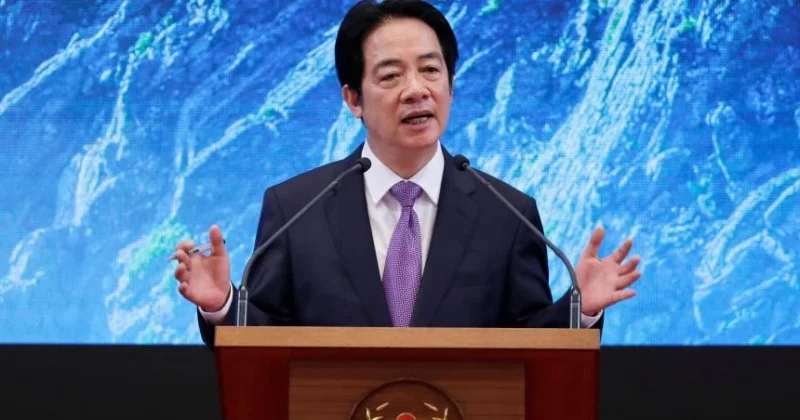
Trump plans to speak with Taiwan’s President Lai Ching-te in unprecedented diplomatic shift
The move breaks decades of US protocol on Taiwan and could ripple through crypto markets given the island's dominance in chip manufacturing for Bitcoin miners.
President Donald Trump announced he intends to speak directly with Taiwan’s President Lai Ching-te, a move that would shatter decades of carefully maintained diplomatic protocol between Washington and Taipei. “I speak to everybody,” Trump said, framing the planned conversation as unremarkable.
It is, in fact, very remarkable. No sitting US president has held a direct phone call with a Taiwanese leader since Washington formally recognized Beijing in 1979. Taiwan’s foreign ministry confirmed Thursday that President Lai would be happy to take the call.
Why this matters beyond the headlines
Here’s the thing about US-Taiwan relations: they’ve always operated in a kind of diplomatic uncanny valley. The US sells Taiwan weapons, stations naval assets nearby, and maintains what it calls “strategic ambiguity” about whether it would defend the island militarily. But it doesn’t officially recognize Taiwan as a sovereign nation, and direct leader-to-leader communication has been treated as a bright red line.
Trump is now walking up to that line with a megaphone.
The conversation reportedly centers on what Trump has called the “Taiwan problem,” and it comes on the heels of what he described as a positive meeting with Chinese President Xi Jinping. That sequencing matters. It suggests Trump may be attempting to use Taiwan as leverage in broader US-China negotiations, a strategy that carries enormous geopolitical risk.
Meanwhile, the US is reportedly contemplating a major arms package for Taiwan estimated at up to $14 billion. The timing of that package, whether it’s accelerated, delayed, or restructured, is now inextricably linked to whatever Trump and Lai discuss.
Beijing’s position has been consistent and unambiguous: Taiwan is part of China, full stop. Any official contact between US and Taiwanese leaders is viewed as a direct sovereignty challenge. Previous, far more modest interactions have triggered diplomatic protests, military exercises in the Taiwan Strait, and retaliatory economic measures.
A direct presidential phone call would be several orders of magnitude beyond anything Beijing has protested before.
The crypto connection: chips, miners, and supply chain risk
For crypto investors, the instinct might be to file this under “geopolitics, not my problem.” That instinct would be wrong.
Taiwan is home to TSMC, the Taiwan Semiconductor Manufacturing Company, which produces the vast majority of the world’s most advanced chips. That includes the specialized processors used in Bitcoin ASIC miners and the high-end GPUs that power everything from Ethereum validators to AI training clusters. In English: if Taiwan’s chip production gets disrupted, the hardware that secures Bitcoin’s network becomes significantly harder and more expensive to obtain.
This isn’t hypothetical risk. TSMC’s dominance in advanced semiconductor fabrication is so complete that any escalation in cross-strait tensions immediately reprices global chip supply expectations. Mining operations planning hardware refreshes, GPU-dependent AI-crypto hybrid projects, and anyone banking on continued Moore’s Law improvements in mining efficiency all have skin in this game.
Look, nobody is suggesting a Chinese invasion of Taiwan is imminent because of a phone call. But markets don’t wait for invasions. They price in probability shifts. And the probability of meaningful disruption to Taiwan’s semiconductor ecosystem just ticked upward.
Historically, spikes in US-China tension have correlated with increased volatility across risk assets, crypto included. Bitcoin has occasionally benefited from geopolitical uncertainty as a perceived safe haven, but that narrative has been inconsistent. More often, acute geopolitical stress triggers broad risk-off moves that drag crypto down alongside equities before any flight-to-safety bid materializes.
What investors should watch
The first thing to monitor is Beijing’s response. China’s diplomatic playbook for Taiwan-related grievances is well-established: verbal protests, military posturing in the Taiwan Strait, and targeted economic retaliation. The intensity of the response will signal how seriously Xi’s government takes this particular provocation.
If China escalates beyond its usual protest template, say, with large-scale military exercises near Taiwan or sanctions targeting US tech firms, expect crypto volatility to spike. Bitcoin’s 30-day realized volatility would likely expand as traders hedge against supply chain disruption scenarios.
Second, watch the $14 billion arms package. If Trump pairs a direct call with Lai with an accelerated weapons deal, it would represent a two-front diplomatic escalation that Beijing would find difficult to absorb quietly. Conversely, if the arms package gets delayed or scaled back as a concession, the call might be interpreted as theater rather than policy shift.
Third, keep an eye on TSMC’s stock price and forward guidance. The company is crypto’s most important upstream dependency that most crypto investors never think about. Any hint that TSMC is adjusting production plans, accelerating its Arizona fab timeline, or factoring in geopolitical risk premiums would have downstream effects on mining hardware costs and availability.
The broader question for crypto markets is whether this represents a new normal of elevated geopolitical tension or a one-off negotiating tactic. Trump’s foreign policy has historically been transactional, using provocative gestures as opening bids rather than fixed positions. If this call is a bargaining chip that gets traded away in a broader US-China deal, markets will shrug it off quickly.
But if it marks the beginning of a sustained US policy shift toward treating Taiwan as a de facto diplomatic equal, the repricing of geopolitical risk across every asset class, crypto very much included, could be significant and lasting.