
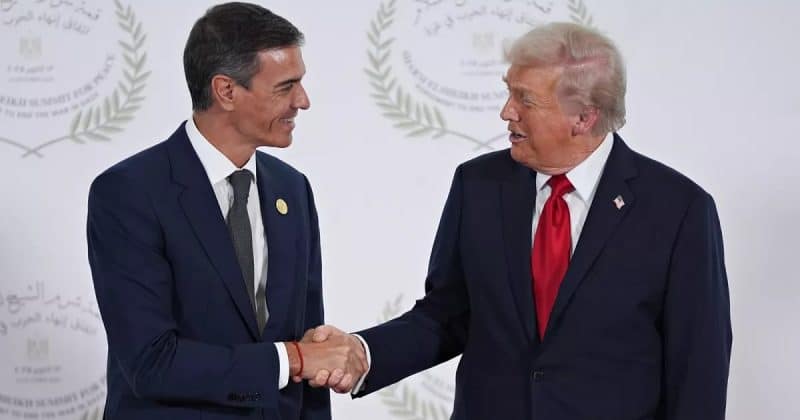
Trump orders full trade cutoff with Spain, rattling NATO alliances and global markets

Trump orders full trade cutoff with Spain, rattling NATO alliances and global markets

The president's sweeping trade ban over a military base dispute adds another layer of geopolitical uncertainty for risk assets, including crypto.

President Donald Trump declared a complete trade ban with Spain on March 3, ordering Treasury Secretary Scott Bessent to “cut off all dealings” with the country. The trigger: Spain’s refusal to let the US use its air bases for military operations tied to rising tensions with Iran.

“We’re going to cut off all trade with Spain. We don’t want anything to do with Spain,” Trump said during a White House meeting that, in a twist of diplomatic timing, was held alongside German Chancellor Friedrich Merz.

What actually happened

The dispute centers on two US military installations on Spanish soil: the naval base at Rota and the air base at Morón. Spain denied Washington permission to use these facilities for operations connected to Iran, forcing the relocation of 15 US aircraft.

Advertisement

Spain’s government, led by Prime Minister Pedro Sánchez, has been a recurring source of frustration for Trump on defense matters. The country’s military spending has fallen short of NATO’s guideline that members commit 2% of GDP to defense, a benchmark Trump has hammered allies about since his first term.

Trump has referenced Supreme Court limits on his emergency tariff powers, which suggests the administration may be exploring embargo-style mechanisms rather than traditional tariff escalation. That distinction matters because embargoes carry far broader economic consequences than targeted duties on specific goods.

The NATO problem nobody wanted

Spain is the fourth-largest economy in the eurozone. The timing made things worse. Announcing the trade ban while hosting Germany’s chancellor put Merz in an extraordinarily awkward position. Germany, as the EU’s largest economy, would inevitably feel downstream effects from any sustained US-Spain trade rupture.

Spain’s Sánchez government has framed its position as consistent with its NATO obligations, citing the 2% defense spending target as evidence of good faith.

What this means for crypto and risk assets

The mechanism is indirect but well-documented. Trade confrontations involving tariffs, sanctions, or embargoes historically increase volatility across risk assets. When Trump launched his initial tariff campaigns during his first term, crypto markets experienced notable drawdowns alongside equities. The pattern repeated during trade escalations in his second term.

If the Treasury Department actually implements mechanisms to enforce a full trade cutoff, it could expand the surveillance and compliance apparatus around international financial flows. That kind of expansion tends to increase regulatory pressure on crypto exchanges and cross-border payment rails, even when crypto isn’t the target.

As of early July 2026, there was no evidence that the trade cutoff had actually been implemented. Markets have learned to price in the announcement, then wait to see if follow-through materializes.

Disclosure: This article was edited by Editorial Team. For more information on how we create and review content, see our Editorial Policy.

Trump orders full trade cutoff with Spain, rattling NATO alliances and global markets

Trump orders full trade cutoff with Spain, rattling NATO alliances and global markets

The president's sweeping trade ban over a military base dispute adds another layer of geopolitical uncertainty for risk assets, including crypto.

President Donald Trump declared a complete trade ban with Spain on March 3, ordering Treasury Secretary Scott Bessent to “cut off all dealings” with the country. The trigger: Spain’s refusal to let the US use its air bases for military operations tied to rising tensions with Iran.

“We’re going to cut off all trade with Spain. We don’t want anything to do with Spain,” Trump said during a White House meeting that, in a twist of diplomatic timing, was held alongside German Chancellor Friedrich Merz.

What actually happened

The dispute centers on two US military installations on Spanish soil: the naval base at Rota and the air base at Morón. Spain denied Washington permission to use these facilities for operations connected to Iran, forcing the relocation of 15 US aircraft.

Advertisement

Spain’s government, led by Prime Minister Pedro Sánchez, has been a recurring source of frustration for Trump on defense matters. The country’s military spending has fallen short of NATO’s guideline that members commit 2% of GDP to defense, a benchmark Trump has hammered allies about since his first term.

Trump has referenced Supreme Court limits on his emergency tariff powers, which suggests the administration may be exploring embargo-style mechanisms rather than traditional tariff escalation. That distinction matters because embargoes carry far broader economic consequences than targeted duties on specific goods.

The NATO problem nobody wanted

Spain is the fourth-largest economy in the eurozone. The timing made things worse. Announcing the trade ban while hosting Germany’s chancellor put Merz in an extraordinarily awkward position. Germany, as the EU’s largest economy, would inevitably feel downstream effects from any sustained US-Spain trade rupture.

Spain’s Sánchez government has framed its position as consistent with its NATO obligations, citing the 2% defense spending target as evidence of good faith.

What this means for crypto and risk assets

The mechanism is indirect but well-documented. Trade confrontations involving tariffs, sanctions, or embargoes historically increase volatility across risk assets. When Trump launched his initial tariff campaigns during his first term, crypto markets experienced notable drawdowns alongside equities. The pattern repeated during trade escalations in his second term.

If the Treasury Department actually implements mechanisms to enforce a full trade cutoff, it could expand the surveillance and compliance apparatus around international financial flows. That kind of expansion tends to increase regulatory pressure on crypto exchanges and cross-border payment rails, even when crypto isn’t the target.

As of early July 2026, there was no evidence that the trade cutoff had actually been implemented. Markets have learned to price in the announcement, then wait to see if follow-through materializes.

Disclosure: This article was edited by Editorial Team. For more information on how we create and review content, see our Editorial Policy.