
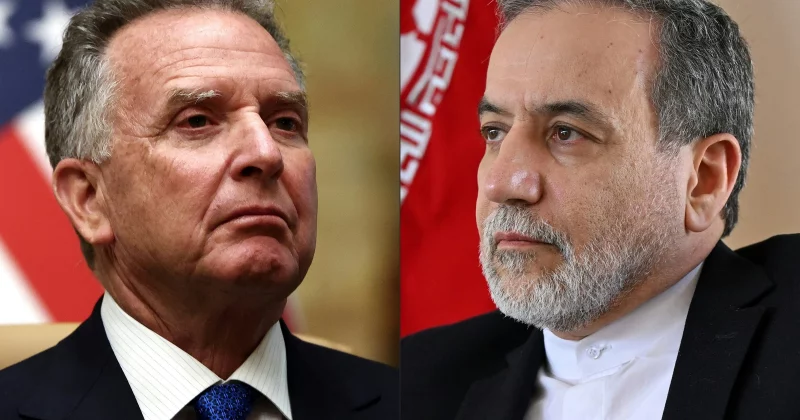
Donald Trump says US and Iran are close to finalizing deal
The proposed agreement would reopen the Strait of Hormuz and unfreeze Iranian assets, with Bitcoin swinging between $68K and $77K as traders track every headline.
President Donald Trump announced that the US and Iran are nearing what he called a “Complete and Final Agreement,” one that would reopen the Strait of Hormuz and unfreeze billions in Iranian assets.
Trump said on May 6 there is a “very good chance” of concluding a deal centered on Iran’s nuclear program and sanctions relief. The day before, he announced a pause to military operations under “Project Freedom,” citing “Great Progress” in negotiations.
What’s actually on the table
The core framework involves Iran agreeing to limits on its nuclear ambitions in exchange for the US lifting sanctions. A memorandum of understanding would effectively declare an end to hostilities, with a roughly 30-day window to hammer out remaining details.
Two major economic components stand out. First, reopening the Strait of Hormuz, the narrow waterway through which a massive share of global oil shipments pass. Second, unfreezing Iranian assets, with figures of around $20 billion mentioned in discussions.
To put that in perspective, earlier proposals had referenced just $6 billion in unfrozen assets. The jump to $20 billion signals either significantly expanded negotiations or a much larger concession from the US side.
Pakistan has been serving as an intermediary, facilitating the exchange of new Iranian proposals as recently as mid-May. The fact that a third-party mediator is still shuttling proposals back and forth tells you this isn’t a done deal. It’s a deal in progress, with military options explicitly still on the table should talks collapse.
The news moving money, markets, and the world—before your day starts.
Daily. Free. Join 34,000+ readers across crypto, finance, and policy.
The crypto connection
During April and May 2026, Bitcoin traded in a range between $68K and $77K, with price swings correlating closely to news cycles around the US-Iran negotiations. Ceasefire announcements pushed prices one direction. Threats of renewed military action pushed them the other.
Prior US-Israeli strikes on Iran and the extensive blockade of the Strait had already elevated geopolitical risk to levels that made traditional safe-haven narratives messy.
What this means for investors
The $20 billion in potentially unfrozen assets is the number to watch. Sanctions relief on this scale would re-integrate a significant economy into global financial channels, potentially strengthening trade relationships across the Middle East and Central Asia.
For crypto specifically, regions directly affected by sanctions have historically shown higher adoption rates for digital assets as workarounds for restricted banking access. Ironically, a successful deal that lifts sanctions could reduce some of that demand.
The 30-day negotiation window creates a defined period of uncertainty. The correlation between negotiation-linked news and crypto price action has been tight enough that some market participants are clearly building positions around diplomatic timelines.
There’s also a scenario worth considering where the deal falls through entirely. Trump explicitly paused military operations rather than ending them. If negotiations stall and “Project Freedom” resumes, the risk-off trade would likely hit crypto hard, potentially pushing Bitcoin below the $68K floor that’s held through the recent range.
The Iran nuclear deal under Obama took years of back-and-forth before JCPOA was signed, and Trump himself pulled the US out of that agreement during his first term.