
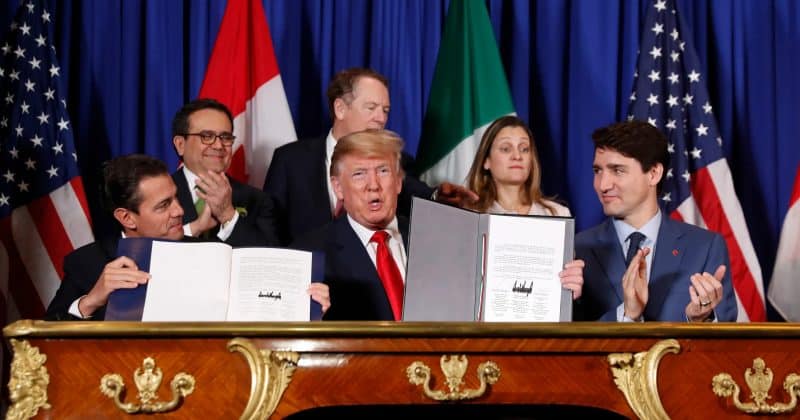
Trump claims US would fare better without USMCA trade agreement

Trump claims US would fare better without USMCA trade agreement

The president says he's not looking to renew the North American trade pact ahead of its mandatory July 1 review, raising questions about cross-border commerce and broader market stability.

President Donald Trump said the United States would perform better without the USMCA, the trade agreement governing commerce between the US, Canada, and Mexico. The statement lands just weeks before the pact’s mandatory joint review on July 1, 2026.

Trump went further, claiming the US “doesn’t need anything that Canada has or Mexico has,” a reference to imports including cars, lumber, energy, and dairy products.

What the USMCA actually does

The USMCA replaced NAFTA and came into force on July 1, 2020, covering everything from auto manufacturing to agriculture to digital commerce.

The agreement includes a built-in expiration mechanism. Every six years, the three countries sit down for a joint review. If all parties agree, the deal gets extended for another 16 years. If they don’t, the agreement begins a 10-year wind-down process before it fully expires in 2036.

Advertisement

That six-year checkpoint arrives on July 1, 2026. And Trump has made his position clear: he’s not interested in renewal.

Why this matters beyond traditional trade

The immediate stakes are most obvious in agriculture. Farm groups have been lobbying hard for the USMCA’s extension because it guarantees duty-free trade across a wide range of agricultural products. Without it, US farmers could face new tariffs when selling to their two largest trading partners.

Manufacturing sits in a similar position. The auto industry, in particular, built its supply chains around USMCA’s rules of origin requirements, which dictate how much of a vehicle needs to be produced in North America to qualify for tariff-free treatment.

Trump’s argument rests on trade deficits. He’s pointed to the gap between US imports from and exports to Canada and Mexico as evidence that the current arrangement doesn’t serve American interests.

For crypto markets specifically, Trump’s USMCA comments contained zero references to digital assets, blockchain, or anything remotely adjacent to the crypto ecosystem.

What investors should actually watch

The July 1 review date is the first domino. If the US formally signals non-renewal, markets will begin pricing in a future without structured North American trade rules. That process will be slow, given the 10-year wind-down, but forward-looking markets won’t wait a decade to react.

Agricultural commodities could see immediate volatility. Corn, soybeans, dairy, and livestock products all flow freely across North American borders under current rules. New tariffs or trade barriers would increase costs for consumers and compress margins for producers. Companies with heavy exposure to cross-border supply chains, particularly in the auto sector, face similar repricing risk.

Disclosure: This article was edited by Editorial Team. For more information on how we create and review content, see our Editorial Policy.

Trump claims US would fare better without USMCA trade agreement

Trump claims US would fare better without USMCA trade agreement

The president says he's not looking to renew the North American trade pact ahead of its mandatory July 1 review, raising questions about cross-border commerce and broader market stability.

President Donald Trump said the United States would perform better without the USMCA, the trade agreement governing commerce between the US, Canada, and Mexico. The statement lands just weeks before the pact’s mandatory joint review on July 1, 2026.

Trump went further, claiming the US “doesn’t need anything that Canada has or Mexico has,” a reference to imports including cars, lumber, energy, and dairy products.

What the USMCA actually does

The USMCA replaced NAFTA and came into force on July 1, 2020, covering everything from auto manufacturing to agriculture to digital commerce.

The agreement includes a built-in expiration mechanism. Every six years, the three countries sit down for a joint review. If all parties agree, the deal gets extended for another 16 years. If they don’t, the agreement begins a 10-year wind-down process before it fully expires in 2036.

Advertisement

That six-year checkpoint arrives on July 1, 2026. And Trump has made his position clear: he’s not interested in renewal.

Why this matters beyond traditional trade

The immediate stakes are most obvious in agriculture. Farm groups have been lobbying hard for the USMCA’s extension because it guarantees duty-free trade across a wide range of agricultural products. Without it, US farmers could face new tariffs when selling to their two largest trading partners.

Manufacturing sits in a similar position. The auto industry, in particular, built its supply chains around USMCA’s rules of origin requirements, which dictate how much of a vehicle needs to be produced in North America to qualify for tariff-free treatment.

Trump’s argument rests on trade deficits. He’s pointed to the gap between US imports from and exports to Canada and Mexico as evidence that the current arrangement doesn’t serve American interests.

For crypto markets specifically, Trump’s USMCA comments contained zero references to digital assets, blockchain, or anything remotely adjacent to the crypto ecosystem.

What investors should actually watch

The July 1 review date is the first domino. If the US formally signals non-renewal, markets will begin pricing in a future without structured North American trade rules. That process will be slow, given the 10-year wind-down, but forward-looking markets won’t wait a decade to react.

Agricultural commodities could see immediate volatility. Corn, soybeans, dairy, and livestock products all flow freely across North American borders under current rules. New tariffs or trade barriers would increase costs for consumers and compress margins for producers. Companies with heavy exposure to cross-border supply chains, particularly in the auto sector, face similar repricing risk.

Disclosure: This article was edited by Editorial Team. For more information on how we create and review content, see our Editorial Policy.