
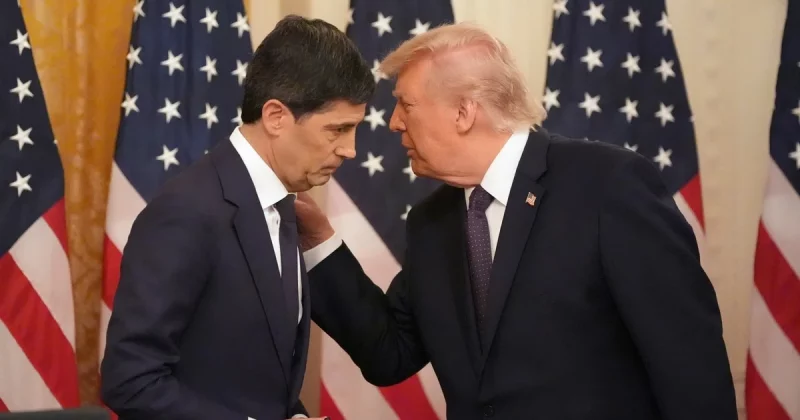
Trump urges Kevin Warsh to maintain independence as new Fed chair takes oath at White House
The first Fed chair sworn in at the White House since Alan Greenspan in 1987, Warsh inherits a central bank under intense political scrutiny.
Kevin Warsh is now the 17th Chair of the Federal Reserve. And the president who appointed him wants you to know he’s totally going to leave the guy alone.
During a White House swearing-in ceremony on May 22, President Trump offered Warsh a piece of advice that read more like a public performance than a private conversation. He told the new Fed chair to “just do your own thing” and, in a moment of theatrical restraint, added: “Don’t look at me. Don’t look at anybody.”
It was the first time a Federal Reserve chair has taken the oath of office at the White House since Alan Greenspan did so in 1987. The symbolism was hard to miss, and the irony was even harder.
A carefully staged independence
Here’s the thing about telling someone to be independent during a ceremony you personally orchestrated at your residence: it kind of undermines the message. But the markets didn’t seem to mind.
Major US stock indexes surged approximately 600 points following the swearing-in. That’s the kind of reception usually reserved for surprise rate cuts, not personnel changes. Investors apparently liked what they saw, or at least what they heard.
Warsh, 56, succeeds Jerome Powell, whose tenure was defined in no small part by relentless public pressure from Trump during his first term. Powell endured years of tweets, press conference jabs, and barely veiled threats about being fired. The fact that Trump is now explicitly, publicly urging his handpicked successor to ignore him suggests either genuine growth or very good political coaching.
Warsh himself has been consistent on the independence question. During his Senate confirmation hearing in April 2026, he stated plainly that Fed independence is “essential” and rejected any notion that political influence should steer rate decisions. He was nominated by Trump back in January 2026, giving the Senate several months to vet the pick.
Not everyone was reassured. Senator Elizabeth Warren called Warsh a potential “sock puppet” for Trump during the confirmation process. It’s the kind of accusation that sticks regardless of evidence, precisely because it’s almost impossible to disprove in real time. You only know if a Fed chair is truly independent once they do something the president doesn’t like.
The news moving money, markets, and the world—before your day starts.
Daily. Free. Join 34,000+ readers across crypto, finance, and policy.
What Warsh brings to the table
Warsh is not a newcomer to the Fed. He served as a Governor on the Federal Reserve Board from 2006 to 2011, a stretch that included the worst financial crisis since the Great Depression. During that period, he was notably skeptical of large-scale asset purchases, the Fed’s go-to crisis tool commonly known as quantitative easing.
That skepticism matters. It signals that Warsh is unlikely to be the kind of chair who reaches for the money printer at the first sign of market stress. For inflation hawks, this is encouraging. For anyone hoping the Fed will aggressively cut rates to juice growth, it might be less so.
His background before the Fed included stints on Wall Street and at the White House under George W. Bush. He’s a creature of both financial markets and political institutions, which makes his insistence on independence either deeply principled or deeply strategic. Possibly both.
The broader context here is that Warsh inherits a central bank still navigating a tricky inflation environment. The Fed has been walking a tightrope between keeping prices in check and not choking off economic growth. Powell’s final months were marked by cautious rate adjustments and careful communication. Warsh now owns that balancing act.
What this means for markets and crypto
The 600-point stock market rally tells you what Wall Street’s first instinct was: optimism. Traders appear to believe Warsh will be a pragmatic, market-friendly chair who won’t be easily pushed around by political pressure. Whether that belief holds up over the next several quarters is a different question entirely.
For crypto markets, the Fed chair appointment is always consequential even when it doesn’t seem directly related. The Federal Reserve’s stance on interest rates is the single biggest macro variable affecting risk asset prices, and Bitcoin, Ethereum, and everything else in the digital asset space are firmly in the risk asset category.
A Fed chair who leans hawkish, as Warsh’s history with opposing large-scale asset purchases might suggest, could mean a slower path to rate cuts. That’s generally a headwind for crypto, where lower rates tend to push investors further out on the risk curve. On the other hand, if Warsh’s independence means a more predictable, less politically volatile Fed, that kind of stability can benefit all markets, including digital assets.
Look, the real test comes when Trump inevitably wants something from the Fed that Warsh doesn’t want to give. Maybe it’s a rate cut before a midterm election. Maybe it’s a public statement that flatters the administration’s economic narrative. Whatever form it takes, that moment will reveal whether “don’t look at me” was genuine deference or just good television.
Investors should also watch Warsh’s early communication style carefully. Powell was famously measured, sometimes to the point of opacity. Warsh has a reputation for being more direct, which could introduce a different kind of volatility: the kind that comes from a Fed chair who actually says what he means. In a market that has spent years parsing every comma in FOMC statements, clarity could be as disruptive as ambiguity.
The Democratic criticism from senators like Warren isn’t going away, either. Every Warsh decision that aligns with what Trump would have wanted will be framed as evidence of influence, regardless of the actual reasoning behind it. That political noise could add uncertainty to an already complex monetary policy landscape, and uncertainty is something crypto markets are particularly sensitive to.