
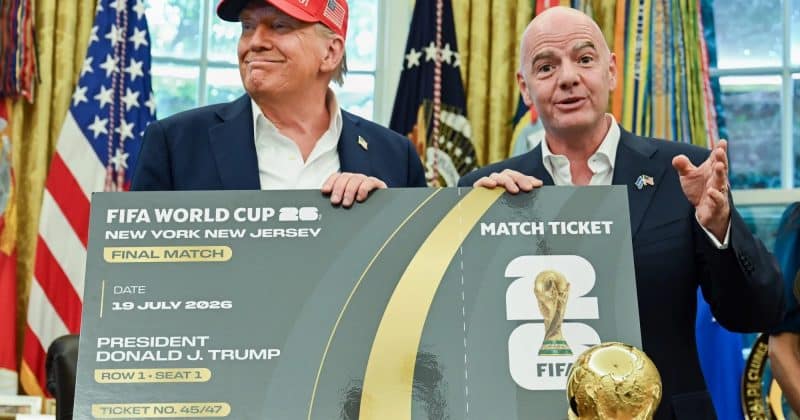
Trump promotes 2026 World Cup amid visa chaos, airport detentions, and global backlash
The biggest sporting event in US history is already mired in controversy as players and officials face denied entry and hours-long detentions at American airports
The 2026 FIFA World Cup was supposed to be America’s grand showcase to the world. Instead, days before kickoff, the tournament’s headlines aren’t about goals and group-stage drama. They’re about a Somali referee turned away at Miami’s airport and an Iraqi striker detained for nearly seven hours at Chicago O’Hare.
President Trump stepped in on June 10-11 to assure the public his administration was “working very closely” with FIFA to sort out the mess. The timing was notable: the tournament was set to begin on June 11-12, meaning the reassurance came roughly 24 hours before the first whistle.
A tournament tangled in travel bans
The US has suspended immigrant visa processing for 75 countries and implemented heightened scrutiny at ports of entry. The tournament involves 39 countries under travel restrictions, including full bans for Haiti and Iran.
The most visible casualty so far: Somali referee Omar Artan, who was denied entry at Miami airport on June 8 despite holding a valid visa. Then there’s Iraqi striker Aymen Hussein, who sat in detention at O’Hare for close to seven hours before eventually being processed. Some Iranian players only received their visas at the last minute before the tournament’s opening matches.
The pattern echoes the travel ban controversies of 2017-2018, except this time the stakes include a multi-billion-dollar global event co-hosted with Canada and Mexico.
FIFA’s delicate diplomatic dance
FIFA President Gianni Infantino found himself in an unenviable position at a pre-tournament press conference on June 10-11:
“We are not kings of the world. We can’t dictate U.S. visa policy.”
Infantino has defended the US as a host nation while acknowledging FIFA’s limitations in influencing government decisions on entry approvals. The Trump administration reaffirmed its commitment to facilitating access for “the right people,” a phrase that does quite a bit of heavy lifting when you’re talking about credentialed participants in an event your country volunteered to host. During the initial World Cup bidding process, Trump had promised FIFA that access would be fair and non-discriminatory for all eligible participants and fans.
What’s actually at stake beyond the pitch
The immediate concern is operational. When a referee gets denied entry two days before the tournament starts, it creates cascading logistical problems for match scheduling and officiating assignments.
Travelers from restricted countries might choose to watch matches in Canada or Mexico instead, where entry is less fraught. That’s revenue leaving US host cities for Montreal, Toronto, Guadalajara, and Mexico City.
The sports industry more broadly is paying attention because the 2026 World Cup is a proof of concept for future mega-events in the US. The International Olympic Committee and other governing bodies will be evaluating how this played out when considering future US proposals.