
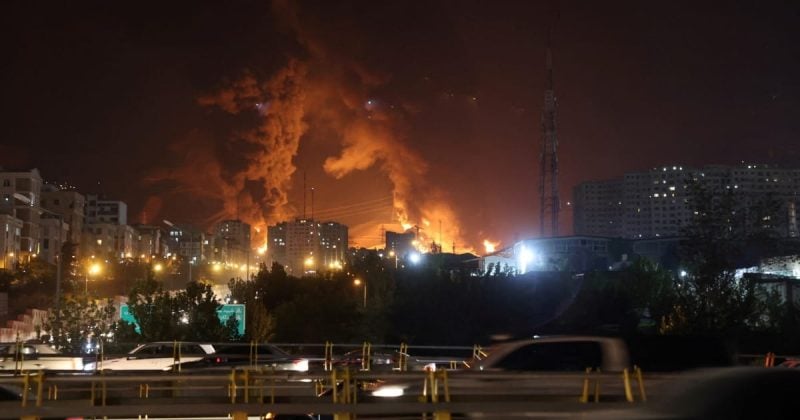
United Arab Emirates conducted dozens of airstrikes on Iran with US and Israel support
The UAE's covert military campaign against Iran, launched alongside coordinated US-Israeli strikes, marks a seismic shift in Gulf geopolitics with major implications for oil and crypto markets.
The United Arab Emirates quietly launched dozens of airstrikes against Iranian targets beginning in late February 2026, operating in coordination with the United States and Israel. The revelation, reported by The Wall Street Journal, exposes a level of direct Emirati military engagement against Iran that has not been publicly acknowledged by UAE leadership.
The coordinated campaign began on February 28, 2026, when the US and Israel initiated their own airstrikes on Iran. The UAE joined in near-simultaneously, marking the first time the Gulf state has been confirmed as an active participant in offensive military operations against Tehran.
What happened, and what got hit
Among the most consequential operations was an early April 2026 strike on Iran’s Lavan Island oil refinery. The attack inflicted significant damage and left the facility non-operational for an extended period. Lavan Island sits in the Persian Gulf and serves as a critical node in Iran’s oil export infrastructure, making it a high-value strategic target.
The UAE’s offensive posture didn’t emerge in a vacuum. Since February 2026, the Emirates intercepted hundreds of Iranian missiles and drones directed at its territory. Iran’s retaliatory strikes have targeted Emirati oil infrastructure and other strategic sites, including a drone attack in early May 2026 that ignited a fire at an oil facility in Fujairah, one of the UAE’s key bunkering ports on the Gulf of Oman.
A fragile ceasefire took effect around April 8, 2026. It didn’t hold. Iranian strikes targeting the UAE resumed in early May, effectively collapsing the tentative peace before it could gain any momentum.
Macro, rates, and crypto—what moved markets and what matters next.
Daily. Free. Join 34,000+ readers across crypto, finance, and policy.
A new axis in the Gulf
The UAE’s military coordination with Israel represents a striking evolution of the relationship that was formalized through the Abraham Accords in 2020. Six years later, the partnership has moved well beyond trade delegations and tourism flights.
That the UAE has not publicly acknowledged its strikes is telling. Abu Dhabi has historically preferred to project an image of diplomatic neutrality and economic pragmatism. Publicly owning an air campaign against Iran would complicate its carefully cultivated brand as a global business hub and force a reckoning with its own sizable Iranian expatriate community and trade ties.
What this means for markets
When missiles start flying near the Strait of Hormuz, the oil market pays attention. Roughly one-fifth of the world’s petroleum passes through that chokepoint daily. The strike on Lavan Island alone demonstrates that oil infrastructure is firmly in the crosshairs on both sides of this conflict.
The May drone strike on Fujairah underscores the vulnerability. Fujairah sits on the UAE’s eastern coast, positioned specifically to bypass the Strait of Hormuz as an export route.