
Ukraine reports drone strike on nuclear fuel facility near Chernobyl
A Shahed drone hit a spent fuel storage building in the Chernobyl exclusion zone, prompting international condemnation and a war crime investigation.
A Russian drone struck a nuclear fuel storage facility inside the Chernobyl exclusion zone on June 7, 2026, in what Ukrainian President Volodymyr Zelenskyy called an “extremely vile” attack on critical nuclear infrastructure. The building was empty of fuel containers at the time, and radiation levels remained stable after the strike.
What happened
The strike occurred at approximately 02:05 to 02:10 a.m. local time, according to Ukrainian officials. The weapon was identified as a Shahed/Geran-2 drone, the same Iranian-designed munition that Russia has used extensively throughout the war.
The target was the Centralized Spent Fuel Storage Facility, specifically its reception building. This is the structure designed to receive and process spent nuclear fuel containers before they go into long-term storage. The building was unoccupied at the time, and no spent fuel containers were inside.
Initial assessments indicated partial destruction of the reception building. The International Atomic Energy Agency confirmed significant damage to the building’s facade, windows, and doors, noting that blast effects were also visible on nearby structures.
No injuries were reported. Radiation monitoring showed levels remained normal in the area following the strike.
The Ukrainian Security Service, known as the SBU, has initiated a war crime investigation into the attack.
A troubling pattern emerges
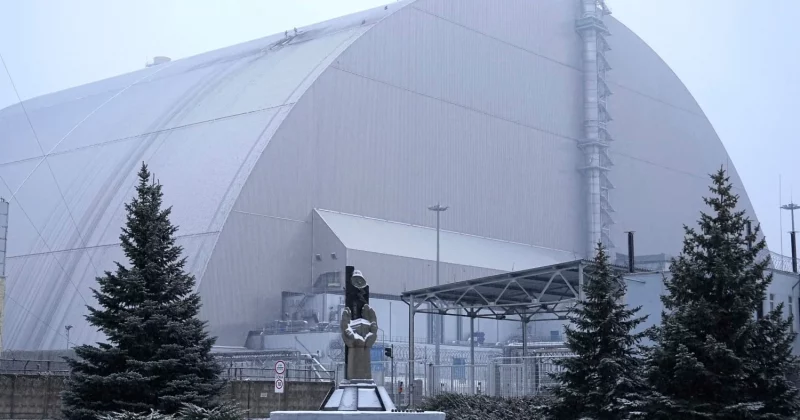
On February 14, 2025, a drone struck the New Safe Confinement structure at the Chernobyl plant itself. That’s the massive arch-shaped shield built to contain the remains of Reactor No. 4, the one that melted down in 1986. Russia has now hit two separate nuclear-related structures at Chernobyl in the span of roughly 16 months.
Early in the war, Russian forces occupied the Zaporizhzhia Nuclear Power Plant, Europe’s largest, creating a prolonged standoff that kept the IAEA scrambling to maintain monitoring access.