
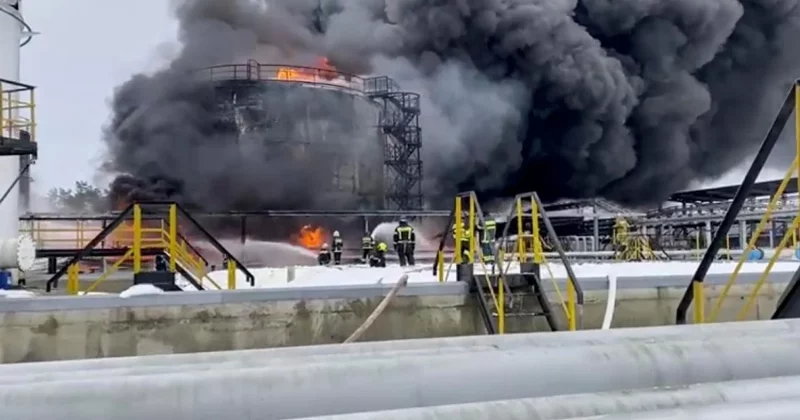
Ukraine strikes Russian Syzran oil refinery in drone attack, adding pressure to global energy markets
The repeated targeting of Rosneft's Syzran facility is part of a broader Ukrainian campaign to degrade Russia's refining capacity, with ripple effects that extend into inflation expectations and risk assets like Bitcoin.
Ukraine hit Russia’s Syzran oil refinery with another drone strike, continuing a sustained campaign against one of the country’s most strategically important fuel-processing facilities. The refinery, located in Samara Oblast and operated by Rosneft, Russia’s largest oil producer, has now been targeted multiple times since 2024.
For crypto investors, the connection might seem distant. It isn’t. Energy infrastructure attacks feed directly into oil price volatility, which feeds into inflation expectations, which feeds into central bank policy, which feeds into how risk assets like Bitcoin behave. Think of it as a very violent game of dominoes.
A refinery under siege
The Syzran refinery has become something of a recurring target in Ukraine’s long-range drone strategy. Significant strikes were reported in August and December 2025, and again in April 2026, each causing operational shutdowns of varying severity.
The December 2025 attack was particularly damaging. It disabled the CDU-6 crude distillation unit, a core piece of refining infrastructure that processes raw crude into usable fuel products. Rosneft was forced into repairs that kept operations disrupted for nearly two weeks.
That matters because crude distillation units are the first step in the refining chain. Knock one out, and everything downstream stops. It’s like removing the engine from a car and expecting the air conditioning to still work.
Ukraine’s targeting of Syzran is not random. The facility is crucial for both Russia’s domestic fuel supply and its export revenues. By degrading refining capacity, Ukraine aims to squeeze two pressure points simultaneously: the Russian military’s logistics chain and the Kremlin’s war-funding revenue stream.
The latest strike fits into a broader pattern of escalation. Ukraine has been ramping up retaliatory long-range strikes on Russia in recent weeks, with oil infrastructure emerging as the primary target set. The logic is straightforward: Russia’s war machine runs on petrodollars, so you hit the refineries.
The oil-to-crypto pipeline
Here’s the thing about geopolitical energy shocks. They don’t stay contained in the oil market.
When a major refinery goes offline, even temporarily, it creates upward pressure on both Brent crude and Urals oil prices. Russia’s Urals blend trades at a discount to Brent, but supply disruptions narrow that gap and push benchmark prices higher across the board.
Higher oil prices reinforce inflationary trends. Central banks, already navigating a tricky monetary policy environment, find themselves with less room to cut rates when energy costs are climbing. And rate expectations are one of the single most important variables for Bitcoin and the broader crypto market.
The relationship is not always linear, but the correlation pattern has been consistent over the past two years. When inflation expectations rise unexpectedly, risk assets tend to pull back as traders price in tighter monetary conditions for longer. Bitcoin, which spent much of 2024 and 2025 trading as a macro-sensitive asset, remains particularly exposed to these dynamics.
Conversely, there’s a competing narrative. Bitcoin as an inflation hedge. Some investors rotate into BTC precisely when they see inflationary pressures building, viewing it as a store of value outside the traditional financial system. The net effect depends on which cohort of capital is moving faster: the risk-off crowd selling into tighter policy expectations, or the inflation-hedge crowd buying the dip.
No crypto tokens are directly tied to the Syzran strikes or Ukraine’s drone campaign. But the second-order effects are real and measurable. Energy market volatility is one of the macro channels through which geopolitical risk transmits into digital asset prices.
Broader context and what to watch
Ukraine’s strategy of targeting Russian energy infrastructure has evolved significantly since the early stages of the conflict. What began as occasional strikes on fuel depots has become a systematic campaign aimed at degrading Russia’s refining capacity across multiple facilities.
Rosneft, as Russia’s largest oil producer and the operator of the Syzran facility, sits at the center of this targeting. The company’s refining operations are spread across several locations, but repeated hits on the same facilities suggest Ukraine has identified specific chokepoints in Russia’s fuel supply chain and is exploiting them methodically.
The cumulative effect of these strikes is harder to quantify than any single incident. Each individual shutdown might last days or weeks. But the pattern of repeated targeting forces Rosneft into a costly cycle of damage assessment, repair, and restart, all while operating under the constant threat of another strike. That uncertainty alone suppresses effective refining capacity even when equipment is nominally operational.
For investors watching the crypto-macro intersection, the key variable is sustained energy price pressure versus one-off spikes. A single refinery hit creates a brief price blip that markets absorb quickly. A sustained campaign that degrades aggregate Russian refining output over months is a different animal entirely. That scenario feeds into structural inflation expectations and could influence central bank rate paths in ways that matter for Bitcoin’s medium-term trajectory.
The other thing to watch is whether escalation in the energy war triggers broader sanctions enforcement or policy responses from Western governments. Any tightening of sanctions on Russian oil exports, or countermeasures from Moscow restricting supply to global markets, would amplify the inflationary transmission channel significantly.
Bitcoin’s sensitivity to these macro crosscurrents has only increased as institutional adoption has grown. The asset no longer trades in isolation from traditional markets. When Brent crude spikes on a refinery strike in Samara Oblast, the signal propagates through inflation swaps, rate futures, equity risk premiums, and eventually into crypto positioning. The pipeline is longer than it used to be, but it is very much intact.