
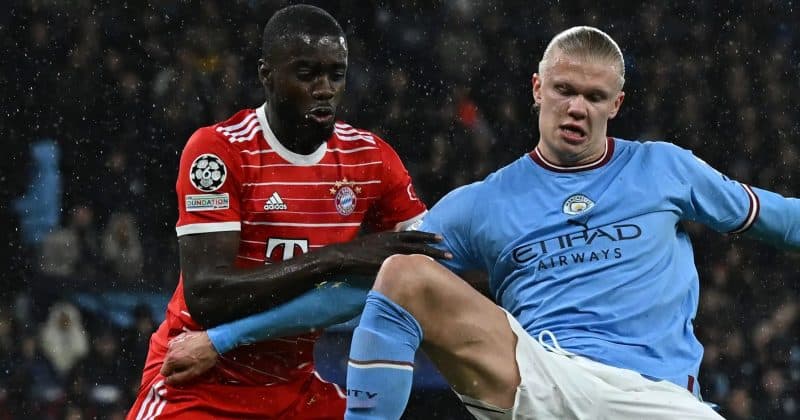
Dayot Upamecano prepares for Haaland clash in World Cup showdown

Dayot Upamecano prepares for Haaland clash in World Cup showdown

France defender outlines tactical blueprint to neutralize Norway's four-goal striker in pivotal Group I match

Bayern Munich’s Dayot Upamecano is preparing a tactical approach centered on what he calls “double-sided control” to contain Manchester City striker Erling Haaland when France meets Norway in a Group I fixture at Boston Stadium on June 25 or 26, 2026. The match could determine which side finishes atop the group.

The tactical chess match

Upamecano has emphasized positioning and spatial control over direct physical confrontation with Haaland. Haaland’s four tournament goals suggest that defenders who engage him in one-on-one physical battles tend to lose those battles. The “double-sided control” approach implies coordinated defensive coverage, essentially making Haaland beat two players instead of one.

Advertisement

France’s Kylian Mbappé on the opposite end of the pitch means Norway can’t simply funnel all resources into feeding Haaland.

Haaland’s tournament tear

Four goals already in the tournament is Haaland doing exactly what everyone expected Haaland to do. A win for either side could effectively secure the top position in Group I, which matters for the knockout round draw.

What this means for crypto markets

Despite the enormous global attention that a France-Norway World Cup match commands, the crypto market response has been functionally nonexistent. Haaland has a minor fan token (HAALAND) that has seen limited recent activity. There are some NFTs floating around tied to his likeness. None of it has generated meaningful trading volume or price movement tied to the tournament.

Investors looking at sports-adjacent crypto plays would be better served watching larger market trends, overall sentiment, Bitcoin’s trajectory, and regulatory developments, rather than trying to time trades around individual matches or player performances.

Disclosure: This article was edited by Editorial Team. For more information on how we create and review content, see our Editorial Policy.

Dayot Upamecano prepares for Haaland clash in World Cup showdown

Dayot Upamecano prepares for Haaland clash in World Cup showdown

France defender outlines tactical blueprint to neutralize Norway's four-goal striker in pivotal Group I match

Bayern Munich’s Dayot Upamecano is preparing a tactical approach centered on what he calls “double-sided control” to contain Manchester City striker Erling Haaland when France meets Norway in a Group I fixture at Boston Stadium on June 25 or 26, 2026. The match could determine which side finishes atop the group.

The tactical chess match

Upamecano has emphasized positioning and spatial control over direct physical confrontation with Haaland. Haaland’s four tournament goals suggest that defenders who engage him in one-on-one physical battles tend to lose those battles. The “double-sided control” approach implies coordinated defensive coverage, essentially making Haaland beat two players instead of one.

Advertisement

France’s Kylian Mbappé on the opposite end of the pitch means Norway can’t simply funnel all resources into feeding Haaland.

Haaland’s tournament tear

Four goals already in the tournament is Haaland doing exactly what everyone expected Haaland to do. A win for either side could effectively secure the top position in Group I, which matters for the knockout round draw.

What this means for crypto markets

Despite the enormous global attention that a France-Norway World Cup match commands, the crypto market response has been functionally nonexistent. Haaland has a minor fan token (HAALAND) that has seen limited recent activity. There are some NFTs floating around tied to his likeness. None of it has generated meaningful trading volume or price movement tied to the tournament.

Investors looking at sports-adjacent crypto plays would be better served watching larger market trends, overall sentiment, Bitcoin’s trajectory, and regulatory developments, rather than trying to time trades around individual matches or player performances.

Disclosure: This article was edited by Editorial Team. For more information on how we create and review content, see our Editorial Policy.